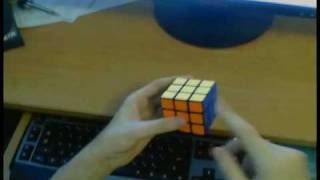
Learn how to set up the Sune OLL case for speedcubing. The video shows two methods: inverting the algorithm by reversing and negating each move, or finding the cycle length by applying Sune repeatedly until the cube returns to solved. The inverse method creates the exact case the standard Sune algorithm solves.
Chapters
Hi, this will be a quick video to answer a common but simple and important question. Basically, it's about setting up cases. Say you wanted to show someone what the sun case looks like. For those of you who don't know, sun is one of the 57 OLLs that you have to learn in the Fridrich method. Now, it is also sometimes referred to as the fish pattern case. I'm not sure why, this apparently looks like a fish to some people. So your goal is basically to get Urbis Cube to this state. A state in which if you apply the Sune algorithm, the cube will be solved. So this is the Sune algorithm. Okay, so one simple way to do this is to simply reverse the Sune algorithm. This is not always a quick and viable option in practice because you usually need a pencil and paper or something. But here's how you do it. Basically, you take any algorithm, so for example, we have the Sune. Now to get the inverse of this algorithm, you have to read it backwards and you have to negate everything. Meaning that the clockwise turns become counterclockwise and the counterclockwise become clockwise. So the result in this case would be R U2 R' U' R U' R'. So this simply undoes Sune. So if I apply it, I apply that inverse R U2 R' U' R U' R', then you can see that basically if I now apply the Sune, I would be undoing all of the moves that I just made and I would be solving the cube. So if I apply the sune now, then obviously I'm just undoing all the moves that I did to screw up the cube, and I would be solving the cube. I would be returning back to the state I was in before. Now the second method is much more practical but may take a little longer. Here's what you need to realize to understand how it works. So take the Rubik's Cube in any state, for example the solved one because it is easy to identify. Now if you take any algorithm and you apply it repeatedly, potentially many times, the cube will eventually cycle back to the solved state. This is simply a consequence of the fact that the cube has finitely many possible configurations. If you applied an algorithm and always got something new, then you could in theory generate infinite number of states. So anyway, the number of times you have to apply an algorithm to cycle back to what you started with is called the degree of that algorithm. So let's count for the degree of SooNess. I will