#45 - Keith Rabois: Spotting Talent, Operating, and the PayPal Mafia
In this extensive interview, Keith Rabois, veteran founder, operator, and venture investor, shares his contrarian yet data‑driven views on the venture ecosystem, fund performance, LP selection, and personal philosophy. He argues that venture capital has changed little over the past five decades, with only brief boom windows (late‑1990s and 2019‑2021) offering alternative models. Rabois stresses the importance of early‑stage, high‑conviction investing, high ownership, and doubling down on winners, citing a 5× fund return as a benchmark. He is skeptical of emerging managers, predicts most new funds will fail, and refuses capital from LPs whose missions he disagrees with (e.g., Chinese or Saudi entities). He discusses his personal contrarian ideas—sleep as paramount, avoiding stretching—and how serendipitous encounters (e.g., meeting Peter Thiel delivering newspapers) shaped his network. Rabois emphasizes disciplined time allocation, the difficulty of filtering founder meetings, and the need for a personal “why‑me” edge in VC. He describes his creative‑disciplinary blend, a zero‑tolerance for excuses, selective reading (primarily Stratechery), and the concept of “cult” companies with secretive, self‑reinforcing cultures. He reflects on his recent move to Miami, the OpenStore venture, the aging of founders, and his legacy goals: building the most public tech companies and uplifting undiscovered talent. Finally, he advises focusing on sleep and embracing stress, recommending Kelly McGonigal’s The Upside of Stress.
Chapters
Where exactly was Google built? Not San Francisco. Where's Facebook built? Not San Francisco. You know, where was any Apple? Not San Francisco. Very, very rare that actually even in.
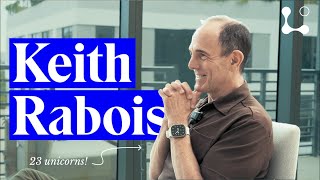
The height of San Francisco's heyday, people were not building the best companies there. That is Keith Rabois. As a founder, investor, and operator, he's as rare as they come. Keith has helped start or fund a company that's been worth more than a billion dollars every year for the last 23 years in a row. How? According to him, it comes down to a knack for spotting great undiscovered talent.
When you meet a rookie in spring training, can you tell whether they're gonna be super successful or not? And he looked back at me, he's like, Absolutely. And I was like, well, how?
He explained that it's actually not what you would think. He's like, It's all their confidence. Over the course of his decades long career, he's had a hand in creating tons of generational companies. As an investor in names like Airbnb, Palantir, DoorDash, Affirm, and YouTube, or as an operator at places like PayPal, LinkedIn, Square, and as the co-founder of OpenDoor. His track record speaks for itself, and if you trace it back far enough, you'll find he's in good company. He's a part of a small group dubbed the PayPal Mafia, made up of early employees and former executives at the company, including Max Levchin, Peter Thiel, and Elon Musk. The secret, again, is a high density of hyper-driven, talented misfits with a love of breaking the rules. Four of the six PayPal founders built bombs in high school. Today, Keith hasn't slowed down. He has a new company called OpenStore, an e-commerce business where he works as CEO. He's also a general partner at Founders Fund, serves on 19 boards, is a voracious reader, parent of two, evangelist for the city of Miami, and still finds the time to work out twice a day.
The more stress you have in your life, the better. Stress can make you happier, healthier, wealthier, and live longer if you embrace it correctly.
We spoke about spotting talent, how to operate, what people don't get about AI, founding versus investing, allocating time, and why you probably shouldn't stretch.
Yeah, really. Everybody used to think I was crazy.
You shouldn't stretch.
No, don't stretch. Trust me. Don't waste any time stretching. It's horrible.
This is the Labossiere Podcast. Welcome to the new narrative. Of the six PayPal founders, built bombs in high school. Five were just 23 years old or younger. Four had been born outside the United States. Three had escaped here from communist countries. With such varied backgrounds, what personality trait or belief did bomb building translate most directly to?
Probably rule breaking. I mean, just to be clear on the bomb building, most of them were escaping communist regimes. So building bombs was a way of protesting all these atrocities. I don't think any of them were building bombs in the United States, but generally speaking, PayPal was a bunch of misfits and defied a lot of conventions and really doesn't take anything for granted. Basically nobody who was successful at PayPal followed instructions very well.
What were you doing in those early days? Probably not making bombs.
I know. I was too conventional. If anything, the criticism of me at PayPal was probably, I was like the most normal person in quotes that worked there, but that was a negative. That was a criticism. It wasn't designed as a company. I'm probably also maybe the most normal person at Founders Fund. That's definitely a critique. I'm the most conventional person, which sounds crazy, but that's how Peter would still probably critique me, is I'm the most conventional person that Founders Fund can tolerate.
Cool. You've had this incredible amount of success that traces back to working with or investing in people that came from this small group at PayPal, your PayPal mafia people. Beyond those first six, what were the conditions for this mafia to even take form in the first place? What make this group of people so special that like we haven't really seen anything like it?
Well, the first thing is just hiring, which I didn't have anything really realistically to do with it. It really ascribed credit to Peter and Max Ledgin for hiring the team. Max hired basically all the technical talent. Peter hired virtually everybody else. And so first thing is just the magnet, knowing who to bring into the cult. Then secondarily having conditions in a meritocratic environment where you can see who's good, who's not, give people expand their opportunities. This kind of a a lesson from David Sax, who is our COO, is you want to constantly test people out and expand the scope of the responsibilities until they fail. And so a philosophy that you would challenge people and see how much potential they had without any artificial constraints and limits was pretty endemic. And then third thing is building Payroll is a really hard business. So when you're challenged by significant constraints, lots of external people hated us. There was lots of problems to solve. You get to see who can thrive under conditions of stress and challenge and who doesn't. And so it was very predictable and predictable. ding who did well and who did well subsequently. It wasn't that hard to extrapolate.
With that as context and fast forwarding to today, as someone who does this really well, what do most people get wrong about spotting talent? What's the biggest misconception?
Well, I think they worry too much about the downsides, meaning most people who are extraordinarily successful in any field have significant positive attributes that stand out. but they're typically not balanced. But that's okay. Founders who succeed can balance themselves through other people. They don't need to balance themselves. So basically the proverbial lesson is, you're supposed to improve your weaknesses. That's a really bad idea, generally speaking, for founders. And for anybody who wants to be top 10 basis points in any field, you either want to double down, triple down, quadruple down on your strengths. There's this kind of great anecdote from this book on how to identify your strengths, kind of a management book. which isn't amazing, but the first chapter is pretty good. And it's about Tiger Woods. And the story, you know, the anecdote is like, you have to guess how many hours a week does Tiger practice his sand wedge? And after a little bit of pause, the suspenseful, you know, drum roll and all that stuff, the answer is never. He spends all his time avoiding getting in the sand and versus trying to figure out what to do once he's there. So I think that's a really good sort of metaphorical example for strengths. Find out where you're the best. and make it better and better and better and leverage it every day and don't try to fix your weaknesses. A little bit more specifically on the.
Talent side, Tyler Cowen and Daniel Gross wrote a book called Talent. They have this long list of out-of-the-box kind of questions for interviews, stuff like, what are the open tabs in your browser right now?
Do you have any go-tos that are particularly illuminating? No, I don't believe in open tabs. I'm obsessive of always my tabs being closed, extremely focused. It drives me absolutely insane when I look at other people's laptops. and they have open tabs. I'm like going around closing their laptops drives me, like I can't even look at their laptops.
So I literally try to close all their tabs too. Do you have any go-to questions in.
Like an interview to- I do. It depends a little bit on the role and the seniority of the person. I'll typically ask the person, like if you were a product, what's your value proposition? Which is like compared to other people with similar backgrounds, LinkedIn profiles, how are you most different is the way to express it. I'll ask would typically ask people about their last company and if they were CEO, what they would do differently. Those are kind of very classic. And then third, I'm always trying to find out what are they optimizing for? Like what's most, what are they trying to achieve? Should make sure there's a match between whatever opportunity we're talking about and what their goals in life are.
You said a remote company is an immediate no for you when investing.
Yes.
Do you think you would be as good a judge of talent over a phone or Zoom call as you are in person?
No, definitely not. I prefer to meet founders in person. really try to avoid doing Zoom calls for pitches. And if I'm interested at all, we'll find a way to do a real world meeting.
You said you look for people who spike, right? And are in the top 10 basis points of specific traits or competencies. By definition, we're talking about really rare people here. So two-pronged question. How do you attract those people as a founder versus as an investor?
Well, I don't-- I mean, that's totally sure probably the question. as an investor, the traits that make someone exceptional are different than as a founder. Fortunately, you're not really trying to find often too many new investors like, like a team like ours. We're not hiring very frequently. You're not scaling an organization, although a16z tries, but I think that's kind of a fool's errand in venture. Venture is a power law business. Within a power law business, it should be a small industry. It, there's not that many places to deploy Capital successfully with Venture scale returns. So fundamentally, once every two, three, four, five years. If you find a new investor has some traits that might predict, well, that's good enough. Founders, of course, if you're running a large fund or deploying capital, you need to find founders every year consistently every year that have these traits. So the exercise is completely different. But I think it is harder to predict who's going to be a good investor than it is to predict who's going to be a good founder. The common, one common thing about investors that do succeed is they figure out what their comparative, his or her, each person, what their unique comparative advantage is and they know what it is and they want to double and triple down on that. So that part is common among exceptional and extraordinary founders. But the prediction of who's likely to be a really good investor upfront is really, really, really difficult. It's one of the biggest parts of our industry that are almost impossible to solve is how do you build for decades because you're measured over across decades. So you need to build a venture fund over multiple, multiple decades. But no one really is extraordinary at predicting future investors.
Gotcha. I've heard you tell a story about meeting Derek Jeter and asking him if you can tell someone's good at baseball before they get good.
Yeah. So what happened was when Derek retired in 2015, I was lucky enough and fortunate enough to meet him through a friend of mine named David Lee. And Derek was asking me what I do, which at the time, was more like angel investing, still professionally had started seed investing at Coastal Ventures. And I try to explain what I do and to communicate it, the art of seed early stage investing. I basically asked him a question. I said, when you meet a rookie in spring training, can you tell whether they're going to be super successful or not? And he looked back at me. He's like, absolutely. And I was like, well, how? And he explained that it's actually not what you would think, not my intuition was to be some technical observation or something. It's like it's all their confidence. And I said, that's basically my job is to find the rookies in spring training and know which ones are gonna be future all-stars.
Who's the most confident person you've met recently?
The most confident or confident? Oh, wow. That's a good question. Most of the people I meet are pretty confident. Hmm. That is a really good question. I don't know. I don't really filter people that way, but if I found someone who was, I think I think the filtering for baseball is different. The metaphor of trying to isolate, what's the predictive variable translates, but I don't think that's the best way to predict a founder.
Gotcha. There's a great Steve Jobs quote that I want to use as a lead into this next one. He says, the key observation is that in most things in life, the dynamic range between average quality and best quality is at most two to one. For example, if you're in New York and compared the best taxi driver to an average taxi, you might get there 20% faster. In terms of computers, the best PC is perhaps 30% better than the average PC. There's not much difference in rarely you find a difference of two to one. Pick anything. But in the field I was interested in originally, hardware design, I noticed that the dynamic range between what an average person could accomplish and what the best person could accomplish was 50 or 100 to one. Given that, you're well advised to go after the cream of the cream. That's what we've done. You can build a team that pursues the A+ players.
What areas specifically are you 50 or 100 to one in? That's a good question. I agree with Steve's quote that technology and founding companies is all about finding the people who are 50 to 100. by metaphor, actually baseball does work. If you're a pitcher in baseball, you're probably a thousand X better than a high school pitcher. Like there is a scarcity of people who can throw a fastball regularly, let's say 90 miles an hour, which is kind of minimum viable major league baseball player. There's not any access and no one knows how to train people like to get there. Uh, so like fundamentally, like you literally can't play major league baseball unless you're in this class and there's not a substitute like major league baseball can expand because of that. So it's a little bit like founders, you can't expand the pool of founders too easily in the to the world because of that trait in the dynamic range characteristic. Restating it first is also at the end of the day, the problem you're trying to solve is when you found a company, you're basically saying, I'm going to reinvent the world. I'm going to reinvent this entire industry called financial services, energy, food, whatever it is, healthcare. That's almost borderline irrational, maybe even actually irrational. They're the only people who have a non-zero chance of achieving that ridiculous dream are people who are so extraordinary that they can shift the odds against either that are zero to like at least 2%. That's what you're looking for is that order magnitude probability shift and that requires traits that are just extraordinary. Otherwise, you're going to round to zero. And so at the end of the day, for me, the best thing is has been developing this ability to spot talent. very early in people's career with non-standard credentials. That's been important both as an executive leading functions, leading companies, and is indispensable as an investor. So that's by far the best. And the second area, now that I'm definitely 50-100, maybe more than that, extra one. The other comparative advantage, I don't know the dynamic range is 10 to 1, 20 to 1, 5 to 1, whatever, is the ability to hold a business in my brain. A business equation is kind of how I like to express it. fundamentally understand how moving pieces within a business all connect in what dials have what weights to them and how to toggle different dials to achieve the same output goal. That is moderately rare and it is moderately difficult to teach actually.
That in mind, despite this sort of mentality of doubling down on your best people, your best strengths, in what areas do you feel like you've sort of mastered things and in what areas do you feel like you're still improving?
There's so many different areas that I can improve on, but per my point, advice. I don't really want to. I don't really care. The key is to not be dang, not let myself get blinded by those areas, meaning find a compliment. A person who likes to do those things, a person who is proficient at those things, and let them do it. And so the key, the key art is the complementary identifying that. So, for example, I'll continue with your Steve Jobs sort of example. The most important lesson he learned between Apple 1 which had a lot of success but also a lot of failure. In Apple II, error II under Steve's regime, which had no failure and all not so success, was he figured out that in his view, the reason why Apple I was mixed was they were operationally incompetent. So their margins were never strong because they had operational issues. They never did this correctly. They never did this well. They never did pricing well. So when he came back to Apple, the first person he hired was this obscure executive at the time named Tim Cook out of Gateway Computing, which is also an obscure company now. But he wanted to find the best operational executive he could, and he went after Tim and recruited him. And so Apple then had everything perfect. Had the vision and design and insights of Steve with the technical discipline, with the software engineering of Scott Forstall, and the operational excellence. And so they didn't make any mistakes for like 15 years.
Speaking of looking for anomalies, there's a great PayPal anecdote that I want to touch on. Someone noticed a bunch of power sellers had written Please pay me with PayPal on eBay listings.
Wasn't your target product at the time running product? There's probably about 30 to 50 of those power sellers.
But you decided to double down on it. What's the full story there?
Yeah. None of the top 10 initial markets that PayPal was supposed to be going after included eBay. All the other markets were supposedly more interesting. People noticed that there was roughly 30 power sellers on eBay. typing in manually typing into their eBay listing, please pay me with PayPal. And the original reaction of most of the team was, well, this is not our target market. We should turn these users off. Stop this. Like it's a distraction. David went home one night and came back, you know, the next day and said, aha, we found our market. This, the fact that they're doing this with so much friction where they have to take an initiative means we should productize this and make it easy, which is what David continue to do for the next two years. Easier and easier. First, you made it so there was an HTML embeddable button, so you didn't have to type it. Second, you made it auto listing, which meant every time you listed a new listing, it would auto generate this. So it just kept making it so.
The default was you would accept PayPal and it worked. There's another example from PayPal or story from PayPal that I think is really illuminating, which is PayPal working in Louisiana. You had 3,000 PayPal users call up their state legislature. When I heard this story, it reminded me a few months back, I interviewed this guy Bradley Tusk, who runs a venture fund out of New York. He has this great saying, something to the effect of every policy output is the result of a political input, which is basically to say you need to play ball with politicians and threaten them with loss of power to actually get them to do anything. What's the big story here and how do you weaponize a user base in that way?
Yeah, so we had an expression at PayPal that actually Peter popularized or developed before was a cool general expression, which is we're cheap. We had to get too big to fail. So when you're small, nobody pays attention to you. Politicians, Regulators, they don't care. And then you start growing and you get attention, you get media, Etc. You have users that might be alienated for whatever set of reasons, and then you get a lot of scrutiny, and that's when you're most vulnerable. If you can defer that and get a large installed user base, customers that love you and they're addicted, you have political power, you have political inputs that you can leverage back against the regulators and politicians. So the art of payback is to get too big, to get as stop, to grow as fast as possible so that we have leverage. So the Louisiana story was on the precipice of our IPO in February 2001, the state of Louisiana commissioner, banking commissioner, whatever, decided to send us a threatening letter saying we were committing banking without a license in the state of Louisiana and police cease, which wouldn't necessarily be the biggest problem except on the press visit IPO, it's not the best timing and it had real issues. And for a variety of reasons, we had some pretty considerable constraints on the timing of our IPO. So we wanted it to be public as fast as possible. So we hired all the right lobbyists and did all the right legal analysis and tried to persuade the regulators in the state of Louisiana that we were not in fact practicing banking. but, you know, for whatever set of reasons, they weren't persuaded. And we had a ticking time bomb on when we wanted to go public. So I had this Epiphany that, you know, maybe we could influence them differently. And so I asked one of our engineering managers. This guy actually went on to pretty good fame. Jeremy Stoppelmann. How many users do we have in Louisiana? And so he ran a query, and the answer came back like 3000, which in Louisiana, 3000 recipients of recipient size, so businesses. in Louisiana is a lot. And I was like, ah, well, why don't we just go tell the damn banking people that we're gonna have these 3,000 people contact them and explain how they've completely screwed their business. And so I had a kind of edgy way of asking the question. I was like, do you want us to send them to your email or your cell phone? Which would you prefer? And so all of a sudden, within 24 hours, they contacted our lawyers back and said, you know, your legal arguments have a lot more merit than we thought. We appreciate it. You know, we'll withdraw the letter. Now, 3,000 in the state of New York, for example, would not have been nearly large enough or important enough to affect regulators in the state of New York. So it's all a matter of scale.
Gotcha. On the topic of law and regulation, you've said you wasted a decade of your life doing law before you got involved in tech. What about the world of law translates well to what you do today and what translates poorly?
Well, the biggest poor translation to being educated in law is the way you're graded in law is what's called, almost every exam is what's called issue spotting. so what you do is you get a fact pattern, you know, kind of a narrative like a mini movie, and then you're asked to identify the legal issues and resolve them. So all your brain is trained for years to do is to find all the things that can go wrong, isolate them, and you get graded and you literally get very bad grades if you miss any of the things that can go wrong. Most of company building is not about identifying what can go wrong and certainly not investing. Investing is mostly about what can go right and how do we make it go right, you know, from an executive standpoint. So that's completely the opposite. And that's why it's really bad and dangerous to have lawyers involved. The parts that are useful, let's say, are I have had, you know, some success both as executive and investor in heavily regulated industries, obviously being able to identify and navigate through what's possible and what's not, what kind of people to hire, to help navigate, et cetera, is a benefit of having both gone to law school, clerked, and practiced law. And so there are times when it comes in very handy actually. Gotcha.
Sort of a similar vein here. You're obviously a really big evangelist for Miami.
I mean, just look out the window. Skyline, sun, it's 85 degrees, it's 50.
Degrees in New York today. I was saying when we came in.
Everyone here is happy. Yes, everybody in Miami is happy. It's the first thing anybody notices. This is totally unprompted, but every single one of my friends who's visited and moved here, they just noticed, you walk down the street, everybody's happy. You go to a coffee shop, everybody's happy.
You go to a restaurant, everybody's happy.
People come, you have house cleaners, they're happy. As you mentioned, New York, it's like Blade Runner everywhere.
It's a good argument. Okay, to the question. I think COVID had a bit of an accelerating effect on this, but what's your take on the future of regulatory arbitrage? This idea that cities have to compete for residents. Does this continue to get more intense, in your opinion?
I do think that people have realized that they can, build companies anywhere. Shopify, one of the best examples built in Ottawa. We're major investors, material investors in a company in Berlin called Trade Republic. These are, we're also early investors in a company in Brazil called New Bank, very successfully. So if you can build companies in Brazil, Germany, Ottawa, you can build them anywhere. So because of that, Founders are voting with their feet. Like, where am I going to be happiest? Where am I going to be safest? and the answers are not San Francisco. So it makes no sense to be in places that are unsafe, overregulated, overtaxed, monolithic cultures that don't allow for critical thinking. You know, the best company possibly in our portfolio in terms of value is SpaceX. Definitely not in Northern California, Andorill, Southern California. You just go through the list. Nobody wants to build successful companies in the Bay Area, and especially not San Francisco. So there's so many better choices. Entrepreneurs actually, at the end of the day, it's kind of a Shakespearean thought. Entrepreneurs are people. People want to be happy and safe. They want their families and kids to be happy, safe, and you can't do that in certain areas. So vote with your feet and go to places that are aspirational, go to places that will protect your family, and.
Places where you can thrive. That in mind, what cities are you most bullish and bearish on?
I mean, I think Miami speaks for itself. SF's horrible. I think I would almost be an automatic pass on any company built in San Francisco. I think their southern part of the Bay Area, I think is still possible to build real companies. It's not accidental if you look at, you know, let's say old school, where exactly was Google built? Not San Francisco. Where's Facebook built? Not San Francisco. You know, where was any Apple? Not San Francisco. You know, it's very, very rare that actually even in the height of San Francisco's heyday, people were not building the best companies there. Like Salesforce is the only company that's $100 billion in the world that was built in San Francisco. And, you know, so there's one, but there's more than one, lots of other places in the world. So actually apples to apples, you could argue that actually SF's always been worse if you're building $100 billion company.
In terms of what's getting built in the Bay Area right now, you have a really interesting viewpoint on AI as being more of a sustaining technology than a disruptive one, which is to say incumbents will benefit most. And obviously good venture investments are where they don't benefit most. Why is AI more sustaining than disruptive? Is it because it's not a fundamental platform or medium shift like mobile was? Or is it just getting harder to disrupt things in technology?
Well, I think AI is a sustaining innovation, not a disruptive innovation, except in very small, except in very limited vertical fields. So for example, within the practice of law, AI could disrupt the manual work that lawyers do. but in general technology arcs, the Google's, the Microsoft's, Amazon's, it is sustaining to their business. And you just see this actually the evidence, it's not even a philosophical argument, you just see the speed at which Google, Facebook, Microsoft are adopting AI. That's very rare for new technology. Usually incumbents are very sluggish and slow on any new technology, including mobile. Microsoft lost an entire empire. RIM, lost an entire empire because they were so slow to the new generation of mobile. So this is very, very common. To see this adoption, this speed means there's no oxygen for startups. And if there is a successful startup, it's probably open AI. Also the benefits of scale. The more access to data you have, the better you can train models. Most startups unlikely to have more data than large companies. So what's your exact competitive advantage? cost structure, like how are you going to bring down the marginal cost of compute? Well, you're not going to build your own chips as a startup, most likely. If you did, actually to be a good company, if you could build chips better than Nvidia or something, that would actually be a pretty good company, but that's going to be extraordinarily, extraordinarily rare in terms of skill set, access to capital, et cetera. You're not going to build really better durable models. People will figure out what your model is doing unless you have unique proprietary or more scale data. And so startups are just at a disadvantage on every one of these dimensions.
In the spirit of AI doom-erism, maybe, what's the biggest existential risk we face in technology right now, in your opinion?
I don't know. I'm not one of these AI doom people that sits around worrying about it. I think the biggest existential risk is not technology anyway, it's humans. It's people. I wouldn't worry about technology. I'd be worried about the people.
In that context then, what's the biggest risk?
I actually think technology net over time is always positive. It's always been positive through history.
Fair enough. All right, cool. You've talked a lot about mentorship and emulating successful people as maybe an underrated strategy for becoming more successful yourself. A lot of people ask you about the five bosses you've had over the course of your career. Peter Thiel, Reid Hoffman, Max Levchin, Dorsey, Vinod Khosla, kind of five for five in a way. What specific traits in any of those people do you find yourself emulating the most?
Well, they're all different. And so I've obviously borrowed different things from each of them. You know, Peter, I've adopted most importantly, the most important, Peter taught me two things that are pretty fundamental to who I am and professionally and personally. One is evaluating talent. Peter has had this philosophy since the first day I worked for him, the first week I worked for him. in 2000, when he taught me the importance of building companies based upon undiscovered talent. He explained while we were jogging around the Stanford campus that you can't build a company successfully with talent that other people know how to assess. So I understood conceptually that instantly in the middle of the run, how to actually do that took years of work to figure out how to master that. But that's the number one lesson. Number two lesson is the value of time. Peter basically had this expression also back in cheap valuing that people systematically undervalue their time. And so I've systematically tried to overvalue my time. I'm like kind of ruthless on my time allocation. That's how I generally juggle a lot of things. Like I run a company as CEO, I serve on 19 boards, you know, help run venture fund here, have two babies, work out twice a day, and move everybody, you know, in my spare time, I'm an ambassador to Miami, among other things, and read more books than 80, 90% of the world. So that requires a fair amount of time allocation skill. So Peter taught me that from the beginning. Jack taught me about the most importantly about design driven decision making. Most of the companies I worked for earlier in my career, PayPal, LinkedIn specifically, slide included, were empirically driven, like data driven. Square was not. Square was top down design driven. And so I learned a lot and I leveraged that and I believe a lot. I've adopted my philosophy. based upon lessons from Jack. Reed taught me about the value of negotiate. How to negotiate with time as a dimension, which is sometimes you really, different people have different preferences on time, and that's an extra layer. It's not a business term explicitly, but if I need this deal today, I need to compromise some things to invert the inertia. So I get the deal close today. Sometimes times my friends, sometimes my foe, understanding whether time is your friend or foe on every decision. is a implicit variable that most people do not explicitly track. And it does change your opinion on a lot of things once you decide whether time is your friend or foe. The Node taught me many things, obviously a lot related to investing, but some related to operating, which is the most important expression was the team you build, the company build, that regardless of the technology, you can get all trapped in the fancy technologies of the world and architectures and this and that. the team you build is the company you build. So if you got the A-plus people along the lines of your Steve Jobs quote earlier, you're going to build an A-plus company. If you have a B-plus set of people, you're going to build a B-plus company. And everything else doesn't matter. So you get the right people in the right place with critical density of talent, which is also the PayPal lesson.
So it resonated with me. That's the most important thing he taught. To get into operating for a minute on the topic of emulating, let's get into some of the more kind of practical operational stuff. Steve Jobs, he keeps coming up here, famously insisted that the inside of a Mac be just as beautiful as the outside, despite the fact that you couldn't even open it. Bill Walsh famously took over the 49ers and won three Super Bowls in the.
Next decade with a team that was two and 14 the year before. It was the first order of business.
Because he taught the secretaries how to answer the phone properly. The question is this, how do you.
Balance sweating the details with tackling only the most important problems? Yeah, it's interesting. So I think there is some tension there. I've tried to reconcile it. I have a leadership training deck that I occasionally use with companies, but there's definitely some tension. I think the thing you're trying to instill with the discipline about doing everything perfectly, even if it doesn't translate to output, is if you do everything perfectly consistently, you're not going to screw up later. So for example, if you're sloppy, if you're sloppy on how you do X, at some point you're going to be sloppy with something a customer sees. And so if you're perfectionist about everything, that means you're never going to make a mistake that's in front of a customer that burns you, that has asymmetric downside. So as the loss is explaining this philosophy and the score takes care of itself, which is one of my favorite books, he basically says, like, look, you need your receivers to run seven and a half yard patterns, not seven and not eight, because if they don't, that ball's going to get intercepted and that's going to cost you games. So the way you teach receivers to run seven and a half yards, not seven, is everything they do from the day they walk into the practice facility is exact. And everything the people around them do is exact. And so they don't deviate from the seven and a half yards because nothing around them deviates. And so I think this is true of company building that when you allow sloppiness in one place and you're like trying to justify it, it does creep into other decision making. Basically you have one brain. And you either train your brain to spot things that are poorly constructed, poorly drafted and fix them, or you allow your brain to do a kind of, hey, this is 80% good enough, you know, et cetera. And then once in a while, when you do the 8-20% for the 80% benefit, you get burned. And when you get burned, you get burned really badly. So I think being perfectionist means you never get burned and then therefore it does translate.
Gotcha. to that point on people, you're a proponent of doubling down on your strengths and doubling down on your best employees. What are barrels and how do you find them?
So barrels are basically somebody who can take an idea from kind of conception to the finish line, meaning they'll take people with them, they'll navigate around any perceived blockers internally, externally. They're basically charging that hill and they're gonna figure out how to get over that hill one way or the other. and those are very rare. Most people require either leadership or unblocking or navigational, you know, a compass or something. So when you find these people, these are the people that create the most value in the company and allow a company to do multiple things successfully in parallel as opposed to sequentially.
Gotcha. I want to get a little bit more current, maybe, and start talking about open store. To set the stage here, rather than going really deep all of a sudden, what is Open Store?
Yeah, so Open Store, the goal of Open Store is to build a destination where consumers serendipitously discover products. So they don't have purchase intent for a specific product, but they discover products that they want. And this is what the real world does. So we look out here, we're a mile away from the Design District in Miami. It's got a lot of great retail brands, art galleries, et cetera. When you go to the Design District shopping or any shopping mall in America, you typically don't have high purchase intent. You may have interest in one good or one specific product, but you wind up buying a lot more. That's when I was in high school, my mom would come home with shopping bags worth of stuff, even if she just went to the mall for allegedly one product. So this is why e-commerce in the United States is stuck at roughly 15%. So we're 30 years into e-commerce in the United States, and it accounts for 15% of all sales. And it's pretty flat. The reason why it's pretty flat is half the purchases in the United States are inspired purchases. They're discovered, they're marketed to you, and nobody knows how to do this online in the United States. And that's what we're gonna fix. We're gonna have a destination app on tens of millions of Americans' phones where they can discover products that are interesting and arresting to them that they weren't searching for.
Gotcha. What's the future of e-commerce in that context? Like what happens to Amazon or e-commerce in general in an age of abundance, right?
Well, I think Amazon and e-commerce grow slowly, call it glacially, you know, 1% here and there, until somebody like us at Open Store unlocks the solution.
But to be clear, like the real demarcation here is sort of commoditized products versus brand driven storytelling.
No, I wouldn't say that. There's times when you have purchase intent for a commoditized product or a branded product. Like I might wake up tomorrow and say, I want a new product shirt, or I want a new X, Y, Z brand sneakers. That means I have purchase intent. And so once you have purchase intent, you can fulfill that typically online if you want to, or you can go to retail. What I'm, what I'm discussing is when I didn't even know this new kind of flavored water existed and, and it's healthy for me and how's, you know, X, X calories or no calories and this much protein. I'm like, wow, I didn't even, I had no idea. But I'm like, wow, I want that. I want to try And that happens all the time. That's more than half the purchases in the US are things that I didn't, I woke up in the morning, didn't even know existed or that I wanted. And then someone puts an ad or something in front of me, or I wander around the store and I look at a mannequin, I'm like, wow, that shirt's kind of cool. I want that. And I didn't even know what brand it was before.
So why acquire all of these brands in the first place? Like if this is primarily, and disagree with me if I'm wrong, if this.
Is primarily like a UX driven kind of thing.
To innovation.
If you think about what we're building in some ways you can think of it as a decentralized department store. We need to stock the department store with something. When the consumers walk in the door, there's got to be products to buy. So we need a selection of products. And one of the insights we had is that we can figure out what products we should put in the department store using actual data from real sales on Shopify versus Keith's artistic view of what products we should put in the store. So what we do is we acquire or drive the businesses based upon actual data of how normal people in America discover products mostly through Instagram and how they react to those products and ads. And then we put the best ones, the ones we really like, the ones that the evidence suggests will be successful into our store.
So from a user experience perspective, more specifically, how do you optimize for discoverability? What does that look like?
Well, we haven't shipped that product yet. We will, we're actually shipping actually two variants of this discoverability product in the next, call it month, so next couple of weeks on one and maybe a month or so on the other. where there's somewhat different metaphors and somewhat different value propositions we're going to use, but we needed to acquire enough brands, product SKUs that we had things to showcase. We now have enough, I think, to start showcasing and see how users see if we can delight Americans at scale. So stay tuned.
Okay.
Stay tuned very soon.
In the context of talking with investors, obviously you've done this on both sides of the table. I'm curious across any investor conversation you've had for Open Store, what's the biggest thing investors tend not to understand that you think is really crucial to the business?
Actually, surprisingly, I've had a really positive experience with OpenStore because when we started the company from scratch, like Christmas Day in late 2020, when I had breakfast with Jack Abraham of Atomic, we knew there was a fundamental block on why nobody was building this in the West. And we had two or three or four significant constraints on why nobody had successful. And so from the ground up, from the day one, we designed the entire company, the pitch, everything, the financing to tackle the most important blockers. So I think therefore it resonated with investors. We've seen lots of people fail. We've seen lots of people we've passed on as investors. And so I don't think I've ever had a challenge really communicating why like open store was special. So yeah, I never really ran into like resistance.
Fair enough. I want to transition into the interplay between founding and investing. You've noted there's been a noticeable, I guess, positive shift, not positive in a good way, but positive shift in the average median age of founders over the last few years. Why do you think that's the case?
Well, it's a great question. We've descriptively observed this at Founders Fund that the most successful companies are now being built by people who are on average maybe five years older than, let's say, 10 years ago. We have yet to come up with a, let's say, persuasive hypothesis that even two or three of the GPs our founders don't agree with. So I think the causal link has escaped a lot of analysis. Some people believe it's culturally, some people believe it's the kind of business that's now being created. But when you really examine these at the root causes and try to triangulate the data, they don't totally work. So I'm not convinced on what the root causes, but it does seem to be quite accurately descriptive.
So to bring this to you for a minute, and we were talking about time allocation a little bit earlier, you're simultaneously the CEO of a successful startup and a general partner at a great venture firm, among other things. How do you break your time down and how do you be world-class at both without getting outcompeted at one or the other?
It's not an easy answer. There's no easy answer to that. There are some synergies to be fair. For example, running a company does remind you of some of the inputs and the levers in building a company. and occasionally I can parlay that back to other founders I work with and give them more actionable, concrete, tangible, up-to-date advice than I might otherwise be dated by 10 years of having not run a company in eight or 10 years. And so I think there are times when it helps, but there's a real time constraint. So running a company is where there's really a time constraint. I don't think on the venture side, it's that painful. On the running of the company, every hour matters. every day, every night, every hour. And there's no substitute for like a 9-9-6 culture where you're working at least 12 hours a day, six days a week. That is how you create a successful company. And so I have real limits on being able to drive lead by example on just that brute force. So I need deputies that actually can do that for me, but it's not ideal. Like when I used to run companies before I was an investor, I was definitely often the first one in the office and usually the last one to leave or very frequently the last one leave and always the one there on Sundays and off sometimes Saturdays. And that is by far the best way to build a company. There are real handcuffs on me. And so I feel that pressure and stress all the time. On the investor side, I think it's not really clear that more time makes you a better investor. It's one of these weird jobs, partially because it's a power law, which is one great investment per year. Well, Trump, everything else you do for 365 days, the company really doesn't work like that. Consistency and focus every day actually does add up to compounding advantages. In investing, it's not really clear, like taking more pitches is not necessarily does not necessarily make you a better investor. If you're too tired taking those pitches, maybe you missed the spark in one of the pitches. Sometimes it's better off like being more curated. So I don't feel the pressure as much on the venture side, but I definitely feel the trade off. on the CEO role. Gotcha.
On the investing side now, you have a bit of a history of looking for solutions to problems you've identified. So, Primer I know is an example of this. Eight Sleep, I think, is an example of this, as long as it's in the right hands, right? And it's sort of like request for startups way here.
What are you excited by right now? What do you want to see in the world? Yes, I rarely do this, but there are areas that resonate with me because I have a strong bias. So, I believed in homeschooling being the future. I think it was under the radar. People didn't really notice this until at least COVID, but it had been the biggest policy success, from my view, domestically in the United States over the last 50 years. When I was growing up initially in the late 70s, less than 500,000 kids were homeschooled. Before COVID it was up to 5 million order magnitude. And the outcomes of the homeschool kids outperform on any dimension the performance in regular schools. and you can adjust for socioeconomic factors, adjust for anything, it's still better. So we wanted to make homeschooling a more available, easier option. Obviously, there's a lot of constraints on parents to homeschool and wanted to give them tools and techniques and confidence. So Primer was one of those. Eight Sleep, I've been a sleep junkie all my life. I've been focused and obsessed on eight hour sleep since I was certainly in high school. And so finding ways to improve people's sleep, track people's sleep, improve their deep sleep. As soon as that, and in fact, that's how I found the company. The company was sent to me because a friend of mine who used to be bad at sleep remembered all of our workouts together when I'd proselytize about the merits of sleep. And when he found this company, he's like, I got the perfect company for you. And it actually was. So I led the seat around in the A round. He's actually now changed his behavior. He now chocks his sleep. and focuses on sleep. So it took him 20 years or 15 years, but eventually got him there, too. So there are times when something resonates with you. So I think, for example, the big unlock to me is I still don't think there's a really good nutritional product. So I believe in, like, living healthy and living, you know, extending your lifespan and all this stuff. At the end of the day, you can do a lot of things, including sleep and work out and all these other things and maybe supplements and blah, blah. But 60, 70, maybe 80% is going to be what do and there's no product that makes that intuitive, easy, you know, no brain power, nothing. It just customizes it for you and provides it. Someone will figure this out. But it's been a very challenging problem. It's very frustrating.
Have you seen Brian Johnson's thing?
Yeah, so he has a plan, a blueprint. I don't know if I agree with all the elements. I agree with maybe half of his elements. But let's say you want to be on his plan. It's not like he doesn't directly right now just give you autopilot food. I want that food to show up. Let's say I wanted to subscribe to Bluebit. It should just show up in my office. It should show up at night. It should show up in the morning.
There's some guys in SF doing, I think, Blueprint.
There are people working on that. But I also think you need to compress feedback loops. So he's doing a pretty good job publicly himself of showing the testing results to try to explain that you can make meaningful progress in short doses of time. so the reason why people often get off plans that they know are good for them is the feedback cycle is too long. So why do people sign up for the gym on January 2nd and then turn? They start going to the gym, but they don't get enough progress fast enough before, you know, the feedback loop on growing the gym and the body changes and all that stuff is too long for most people to adhere. So you need to constantly compress feedback loops. So like an ideal example would be like, let's say you changed your behavior today, tomorrow it could show, incredibly show you, you just increased your lifespan by four days. Then it would be easy to get people to adhere to things if you can show input changes to output. So for example, I'll give you an example from healthcare. Healthcare generally medicine doesn't do this very well, but there's now like a test. I had a complicated, you know, analysis of cardiology issues. And like my doctor wanted me to take this medication. I generally don't like to take medications. And there's this new task though that actually can show like on my heart what this medication is doing to the walls, like every six months. So he convinced me to finally agree to take this medication because now in six months, I will actually see whether it's reducing, you know, the risk of like a heart attack or something like that on myself, not just some model that's built across the population. So I was totally convinced after years of resisting this. Now, let's see if it actually works. Tighter feedback loops though. That's right. But it is just modern tests. It's actually an AI magnetic imaging test. It's very clever. They actually even in medicine, they use the AI branding now.
They call it like Clarity.ai. It's very funny. Super cool. Okay. In the context of investing, you talk a lot about the why me, right? What comparative advantage you have specifically to other investors? why is thinking about that asymmetry so much so important in early stage investing?
Well, most venture capitalists don't produce meaningful returns. It's a kind of dirty secret of the industry. And very few VCs are successful in achieving the goals. And so if you act like a normal distribution of VCs, your results are going to be very mediocre. So you always want to ask yourself, why am I different than an average VC? Like what about this person, this company, this opportunity? makes me have alpha, if you like that language, of like, why am I going to be better than this normalized distribution of the 100 or 200 or 300 other VCs out there that I compete with? And so I want to have a really specific answer. Otherwise, my returns should regress to the middle of the bell curve. So I always want to know, why am I not going to be in the middle of the bell curve?
Because being in the middle of the bell curve is completely unacceptable. When it comes to that asymmetry, how much are you underwriting people's track record to date, right? The typical signals here being like second time founder, was an engineer at Stripe, went to some Ivy League. Do you find yourself leading into people.
Like that or no? No, because like by definition that's gonna be the middle of bell curve. So if you're going for any of those criteria, you're gonna wind up in the middle of bell curve because that's what other VC's do. Now, if you, let's say we're smart enough, yeah, smart enough, let's call it like in 2000, 11 to start funding people from Stripe. Okay, there was some alpha there then because no one really knew that Stripe was going to be successful. So if you predicted correctly, then you could have maybe made, you know, borderline irrational returns or, you know, exceptional returns. I don't think that would have been the right call. But basically, the thing about my job is I want to invest in a kind of minority report way. I'm like Tom Cruise, like, try to predict the future based upon these inputs and see the future about this person or this and then the more, the more you say, predict the crime, you know, in Minority Report, predict the crime before it occurs. Once the crime's occurred, there's lots of detectives out there, and they know how to, like, find the fingerprints and figure out who committed the crime. Generally, except in San Francisco, they generally do it pretty well. And so I don't want there to be finger. I need to be ahead of the curve where there's no fingerprints.
Like, because, yeah, I'm not going to.
Be a better detective than everybody else.
Do you believe in defensibility in the context of company building?
Sure. I reframe it differently. My version of it is I want to isolate what are the accumulating advantages. So a startup at some point needs to get easier and easier and easier. And so you want to think about the loops that get better and better the more you do X. And so if you have a couple accumulating advantages, that I think creates what people sometimes call defensibility.
You said you check your thinking by funding things that half your VC friends would laugh at because it means you're actually taking on risk. Have you found it harder or easier to continue taking on so much risk after having seen so much success over the course of your career?
It's a really good question, actually. I think at first it gets easier, which is you have more internal credibility, confidence with your team. At first, when you become a VC, It takes even more sort of personal conviction to take the criticism internally and not let it dissuade you. So I think in my first years of VC or first two years, I probably hesitated on one or two things that I knew better about that I should have pulled the trigger. But my colleagues were really good at Coasla back in the day of pushing me to double down when I thought I knew what I was doing. But there's one or two that if I'd seen the same company maybe a year later in my career, I would have invested more or pulled the trigger or maybe raised the price valuation on one or two rounds. So it's like a social capital thing dynamically internally. And then you develop some success hopefully. And that allows you to expense some social capital because people defer a little bit. But the downside is you don't want to defer too much because if you have smart colleagues, they actually can see things and point things out and not just the wrong things about things. There are times when I'd bring companies back into KV when the reaction would be, I'd bring them in as the sponsor. So I was excited and really interested in investing or wouldn't have bought them into the partnership meeting. But there'd be times when the reaction from like Vinod Khosla or David Widen or Samir Kaul, who were like the main partners at the time, would be like, double down, like this even better, like, don't lose this. And that actually helps, too. But so I think there's a point when you actually go the other way where you may ignore some signals that you shouldn't. And so it's, it's a little dangerous, but you can pull the trigger if you want to, and that is liberating. The other constraint that makes you maybe worse is you do worry about, like, or you can easily get trapped about. what if I'm wrong? Hopefully I'm moderately immune to that, but you still have to stay pretty immune. I think this is why first time founders who are successful often don't start a second company. They're afraid of going back to the drawing board and like, oh my God, if my second company isn't as successful, people are gonna like think less of me. And so you're only as good in some ways as your last investment or your last year or your last fund. And so there's some truth to that, that maybe you get too nervous I don't think I'm at that much risk of it, but I definitely can see why that sort of freezes people. It's social, not economic.
Do you think the biggest mistakes that you've made have come from action or inaction?
Well, adventure, it's always inaction. By definition, this is a power law that only works one way. I don't mind losing money. If I make a mistake and invest and the founder doesn't do that, well, that's fine.
Par for the course.
But passing on something that turns out to be amazing inevitably will haunt you and will cause loss of sleep. So it's always an option.
Okay. There's a saying that the best companies are cults. What are the telltale signs of a cult?
So this is a Peter Thiel, you know, Peter Thiel expression. Goes way back. He obviously crystallized it in zero to one, popularized it, but he had these views way before he wrote the book in 2015. So, a cult means that you have a shared secret about the world. Like there's something the rest of the world doesn't understand that's possible to do or is important to do that we are building that's going to work. That is the most important definition of a cult. Then typically you have a way of operating, working together that the rest of the world doesn't understand or reinforces the secret. And that's also like a competitive advantage. that's one of the reasons why, for example, Apple's so secretive. It's not necessarily about this fancy product release that most people focus on. That's why they're secretive is they don't really want other people to be able to emulate how Apple does things. And so they keep this veil across the company so other companies can't copy and replicate it. So I think that's important for Colt. And then there's a selection part. Like when you're hiring the first 500 employees in a company, you're not trying to hire everybody. There's a matchmaking function, which is you want the people that are going to thrive and reinforce your culture, not necessarily dumb it down or modify it. And so the cult becomes self-fulfilling because you hire people that are also cult-like of the similar ilk. And that's how you get like, you know, sort of scale and compounding benefits. At some point, you do start regressing. If you go from 500 people to 5,000, you probably can't get the exact same cult numbers. So you have to be a little bit more homogeneous, I mean, less homogeneous, a little bit more middle of the bell curve. And then we go from 5,000 to 50,000, it's impossible.
To that point of a company's trajectory becoming cemented in the very early stages.
What'S that headcount number? So this is as early as 10. It's one of the reasons why I like to be a seed investor. So there's two reasons why I want to be the first institutional money investor in a company. as early as possible. One is the company culture is cemented quite, quite early. So I use this metaphor of cement, which when liquid form is very malleable. If you've ever seen liquid cement, you can change in the ground, it's easy. Once it solidifies, you have to take like a jackhammer. And jackhammers are really painful and disruptive. And so you don't really want to have to inherit a company that has the concrete already settled and solidified and try to fix it. So I'd rather get involved as early as humanly possible. Same thing is people basically replicate themselves. So Patrick Callahan expressed this probably the best. I interviewed him on stage at a KVCEO summit in 2014. I think it's available online, but he's repeated this elsewhere in the YC lecture among other places, which is the first 10 people are all going to replicate themselves 10 times. So choose those first 10 really carefully and say, do I want 10 more people that are going to be like this?
Gotcha.
They would all clone themselves.
I want to talk about the future of venture in sort of a more macro context here. What's your take on the future of venture more generally, right? Whether that's generalist versus sector specific, platformization, crossover, fund size, anything else like that. What is this actually going to be?
I would be boring but controversial. So my friend Neil Kostlevetz tweeted the other day that venture is basically the same. Everybody predicted venture is going to change is wrong. And I've been up this view since 2013. as far as I can tell, there's almost no material changes in venture. And most of these things are distractions, which is probably true in most cases. Maybe that's why I'm like a conservative generally philosophically, is most things about society don't change and don't change for the better. The art is knowing what things can be changed for the better and when there's an inflection. But 99.9% of the time, there's a reason why things have kind of dyanstically evolved the way they do. And so ventures work this way too. So over the last 50 years, there's a very proven way to make money in venture. And there's six years of outliers over 50. So late night, let's say 96 to 99, you can make money with a somewhat different model investing. And then roughly 2019 to roughly 2021, if you timed everything perfectly, you could possibly make money. So five, six years, all the other 45, there's one way to make money in venture is you want to be an early stage investor. you want to have high conviction and relatively decent high ownership, and then you want to double down on your winners. That works. And almost no one's ever violated that except in those six years. There's a couple exceptions. So YC, for example, pioneered a new model attracting a different caliber and magnetic appeal to a different type of founder before other people thought that was cool or interesting. DST, Yuri figured out a strategy for doubling down, particularly on Facebook, but other examples learning from international metaphors and translating them back to American companies and being willing to invest in high conviction, high prices. It's almost never that people break through the traditional venture model except in these very small boom cycles. But even then, you have to be in and out during the cycle, which is in and of itself. Getting in the trades easy, getting out in time in those years in Windows is really difficult too.
So let's time box that for a second, right? Like the last five years or so, a lot of money has been raised. You guys cut your fund in half, the most recent one. What happens to that massive number of new venture firms?
Oh, I think they all fail. It just takes a long time. So like, I don't think, for example, there's this trend about emerging managers and solo GPs. And I personally invested in probably 20 to 30 different new funds. maybe two or good funds. I don't think this is a, you know, a real Trend, a real thing. If you. Another way to put it, maybe specifically, is if you didn't produce meaningful returns in the last three years, I don't believe you're ever going to reduce returns. Like up to 2022, like minting returns in Venture was easy in quotes. If you couldn't do it then, you're not going to do it when it's real.
What number means meaningful to you?
5X fund return would be good distributed. 4X, I mean, there's variables there, but 5X is, I think, A-level performance.
Gotcha. Okay, so on the other side of that, and this I think has become a little bit more relevant today, how do you think about LPs you take money from? Do you have any kind of moral qualms if you have LPs in China or Saudi Arabia or something else like that?
I mean, I care a lot about that. I mean, I have a job and I don't want to make money for people that have goals in life that I don't believe so absolutely would not work, would not allow a Chinese LP. I've been very critical of Saudi Arabian LPs, both as direct investors in companies and or in venture funds. I think it's really important. So I like to produce money for people and institutions that have missions I agree with. So, you know, I like certain universities. Some of them can be highly aligned. Like one of my favorites, Washington University. I've funded a lot of entrepreneurs out of Washington University. I've founded two companies. with WashU graduates, et cetera. So that's the kind of classic LP that I want.
Okay, to shift again to talk about you for a little bit, Keith, one from Peter's handbook. Again, this is kind of a pattern. What important truth do very few people agree with you on?
Well, I usually have a good supply of these things, but the problem with this philosophy is eventually I get proven right, and so I run out of them and have to go back to the drawing board. I literally had this birthday in 2013, I celebrated a big birthday with like 10 of my friends and I had eight, you know, sort of contrarian ideas. And my goal at the birthday was to convince some of the people at this birthday to run the Raboy Institute, which is just published studies proving all my crazy views. But they've all become basically mainstream, maybe except one. So I had this view, for example, that sleep is the most important thing you can do for your life. Now it's so obvious that it doesn't even, I mean, it sounds so boring and, you know, mundane to even say it. Have this view that like if you're into athleticism and sports and you know fitness and stuff, you shouldn't stretch. There's now research that supports that. You know, everybody used to think I was crazy. You shouldn't stretch. No, don't stretch. Trust me. This is new to me. Yeah, yeah.
Don't waste anytime stretching.
It's horrible. So there's two reasons. One is opportunity cost, which is just simply sort of a time allocation. Let's say you take 10 minutes stretching, what could you do otherwise? And we can talk about different kinds of stretching. It actually is a little bit more complicated whether you do dynamic stretching and foam rolling and whether you count that as stretching or not. General arc of stretching, like I don't believe in yoga, none of that nonsense. The reason why for most people in the world is almost every catastrophic injury, think ACL tear, is a hyperextension injury. So the more flexible you are, the more likely you have a catastrophic injury. Unless you're a true elite athlete, like still competing, the worst thing you can do in your life is have a catastrophic injury. Any performance degradation at like 1% because you're a little inflexible is not worth incremental risk to an ACL tear. So just don't ruin your life. Like I've played basketball, soccer all my life, workout, basically have almost no injuries in 40 years, 50 years of doing this.
And the reason why I don't stretch. I want to talk about sort of this idea of serendipity. You know, you've gotten into tech on a whim, you hadn't really touched like tech or business before, NASDAQ was collapsing, it was trial by fire, right? It seems like the most important moments in life, whether it's meeting, you know, those folks at PayPal, whether it's, you know, playing soccer and meeting people through that or through Barry's or whatever else.
Are all these serendipitous moments. How do you think about engineering serendipity in your life? Yeah, it's a really good question because it is true that many of the most important people I've met in my life I met in very non-standard, serendipitous ways. I met Peter Thiel originally, he was delivering newspapers. I met Peter the first day of my freshman year in college. And the way I met him was he was literally delivering by hand newspapers to college dorm rooms and my door happened to be open and he happened to deliver it. And I happened to think the Stanford review is interesting. So I talked to him. I've met some of the other most important people in my life at a conference at Barry's, to the best founders ever playing soccer. so part of it is paying attention, I think, is, is, you know, the question I get back from my friends is how do you do this? And I think it is like looking around the room, looking around the soccer team, seeing, you know, where you can find people. Like, if you're in the Peter Thiel view of, you need to find undiscovered talent. Well, guess what? Everywhere I'm going, I'm looking for undiscovered talent.
Yeah.
Like, they think I'm a playing soccer for soccer, but I'm like, anybody. I can recruit because it's hard to recruit telling people. I go to Barry's, I'm looking around the room, is everybody here is a founder? I even joke, you know, for once in a while I teach a Barry's class, like I've taught like 16 Barry's classes and I've joked, I've never actually done it. I keep forgetting to actually, like typically when you're starting, you're asking as instructors, like anybody new to Barry's, you raise your hand and you help guide them, you know, through their first class. I've actually thought about like asking people.
To raise their left hand if they're an engineer. And they're like, you know, absolutely.
Paying attention to see who's in the room. I will one day do this. I hope it'll get fired.
Okay, this one's a bit of a cheating question from me. What's something you wish people asked you more often?
It depends. I mean, I've used on lots of things, but people who want to BBCs usually ask pretty good questions. People who or choose, I have social friends who choose job opportunities and don't ask the right questions. And that sometimes alienates me a bit. I can definitely help you make smarter decisions if you're looking for a job within a technology company. They ask the dumber questions like, is this compensation, is this the right amount of equity? And I'm like, that is such an unimportant question compared to like five other things. So that frustrates me. A fair amount. I'd say generally the people I meet professionally ask pretty good questions.
How do you ask better questions?
Keep asking why. I mean, this is not an original technique. Kind of borrowing it from Elon, not intentionally borrowing from Elon, but from other people. Just why, why, why? Like six levels of why. And then usually get to something that's interesting. after like three. Actually, it's a good way of interviewing execs. I don't use it too often, but I do know people who use this technique and it's very valuable. You ask a potential exec, like why, why, why, why, why, why, why, and you see how many levels they can go before they hit what you call mush, which is a very mushy answer. And usually about four levels deep, people are hitting kind of mushy answers. You can go five or six. Those are people who are pretty exceptional.
We've talked a lot about those areas you spike in that make you a great operator, a great investor. What are some less obvious reasons you think you've done well?
I am a mix, a weird mix of moderately creative and pretty damn disciplined. And that's pretty rare trait. So creative means like solve problems, mixing, remixing. So a lot of what I do as an executive, what I do as an investor is remix so often remix Peter ideas. And just like a really good remix, the remix, I argue, is better sometimes. So that's a creative exercise, remixing someone else's song and someone else's philosophy or someone else's views or someone else's product. So that's probably what's been pretty important. And then generally I don't like excuses. So I think if you don't accept excuses, you wind up in much better places. So when I interview people, any excuse is a yellow flag. If they're senior, it's a red flag immediately, period. I literally track everybody in my life by number of excuses I've ever heard from them. And it's extraordinarily predictive of what happens in their life.
Okay, home stretch here. What have you changed your mind on recently?
Well, obviously moving to Miami was a big step. I used to be Silicon Valley, Silicon Valley, wouldn't fund companies, et cetera, blah, blah, blah, blah. So that was obviously pretty radical to departure. That was probably the biggest professional evolution recent, you know, in the last five years. I mentioned before they switched from an empirical data driven executive to being a design driven founder. You know, that's probably about five to 10 years ago as well. So these are pretty radical fundamental shifts. They don't happen that often, like kind of paradigm shifts. But But when I switch, I switch pretty instantly and pretty decisively. Gotcha.
Okay, more on personal philosophy here. Another tweet of yours, best predictor of success, innate ability to allocate time properly. We've been talking about that. Seeing as people systematically undervalue their time, the big question becomes, which meetings to take in the first place? How do you think about what to.
Say yes or no to when it comes to funding? So as an executive, it's pretty easy. As an investor, it's really challenging. So this is my biggest, weakest, biggest weakness as an investor by far is deciding which meetings to take. Because there's in some ways almost infinite, not literally infinite, but it feels like almost infinite meetings you could take. And if you're trying to assess a founder, it's extremely difficult to do unless you meet with them in person. But you cannot literally meet with all potential founders in person and certainly not with like 18 or 19 boards, certainly not with other commitments in life. And so I make that, I made a fair number of those mistakes. As an angel investor, there's a good excuse for that, per the excuse point. But when I was running a company, angel investing was like a side project. So I literally couldn't take every meeting, but I definitely didn't make the wrong calls when I did take meetings, but I definitely excluded meetings that I should have taken. So the same is true as a VC. You think you have the infinite ability to take meetings, but once you start investing, you wind up, you realize you don't. So my first year in 2013, I had like you know, carte blanche, open schedule, open calendar, great. And anybody sends me a cool, interesting calendar, like great, great, great, great, great. And, you know, maybe arguably my best returns, if you cohort them, my best returns in VC might prove to be 2013. Now, I think there's reasons that are not just availability of time, but in some ways that might be my best year by vintage, you know, like it's kind of like wine. And there are, so we'll see. It's somewhat embarrassing if that's true. It's like, your first year is the best you've ever done. It's all to K function. So hopefully there's a couple other good years. But in any event, I think that I have never figured out a perfect way to filter VC investment pitches. And all the techniques people use don't work that well. So for example, people are like, you should delegate it and blah blah. The problem is if you're doing early stage investing and you're based on the assessment of the founder. That's a lot of taste. And junior people do not have that taste. If they, if they had that taste and could assess a founder correctly and really know who to back, they would be a great VC by themselves. They don't need me. Yeah. So, like, you can't really delegate that. Gotcha. But you can't take them all. And you don't want to use the conventional signals like, oh, they went to Stanford or they worked at Stripe or they did this second time founder with successful exit. All those are like things where there's no Alpha. So you really have a fundamental problem and I've never figured out a solution to this. Gotcha.
As far as time allocation goes, Keith, we've been here for almost an hour and a half. Why did you say yes to this?
Well, I'm hoping that there's lots of potential great founders that listen to your podcast.
That's the acid test.
I hope so, too. All I need is one. One parallel founder that listens to the podcast.
Sends me an email. Send them an email.
You self-grade every quarter. What are the areas in which you do that? Well, mostly as a CEO, I think the timeframe on investing a quarter is a little tight. So I usually give myself a grade after every quarter as CEO. That's easy. As an investor, I think you kind of need to think in more like doses of a year. I think you can tell after a year, actually, I don't think you need five or 10 years, which everybody says in venture. I think you know when you've made a good investment pretty quickly. Maybe, I wouldn't say there's zero exceptions to that, but 90 plus percent of time, I know when I made a really good call pretty quickly. Like, for example, you know, ramp was, we led the seed round here, and then we actually preemptively led the A. After two board meetings, the company had not launched, but we knew Delian actually deserves a lot of credit for pushing me on this second board meeting. He's like, they're clearly at least as good or better than we thought. We should, should we do a preemptive A? And I was like, that's a really good idea. So we did, but there was no metrics, no product, nothing. But we already knew made the right call. Second board meeting at Fair. Delian actually shouted me. He'd just been started as my chief of staff. And he's like, this company is really good. Again, they had launched, but barely. The metrics were a mess, but he picked up right away that Fair was exceptional. He's like, if I ever leave this job, the only company I would join is Fair. He knew it like literally second board meeting ever.
What are the most non-negotiable values you hold?
Wow. No excuses is the most important.
You don't read blog posts. What's actually worth reading?
Well, I read some blog posts. I don't read any consistently other than Stratechery.
Okay, Stratechery.
I would read if someone sends me like, Hey, this blog post is pretty cool or interesting. So I scan some blog posts and look for like, my potential. The reason why is I get asked a lot of questions, some comparable questions by Founders. And so if I could find something that describes the answer well, then I can leverage that. Like, a lot of what my chief of staff does is follow up on meetings, and he'll follow up with, like, here's a blog. Here's this post. Then I'll be like, hey, there's this post about acts. So, for example, I have this kind of moderate allergy to product managers, and I saw a paragraph in a blog I was reading over the weekend. that described, I thought, fairly elegantly what a good PM does, which is simplifies, basically translates ambiguity into clarity. I was like, that's really good. And so I kind of pasted the paragraph. It's from Lenny's newsletter, an interview he did. And I was like, this is really good. So when anybody asked me what a PM's supposed to do, I'd be like, here, read this. And that's how you grade the PM. That's how you decide, should I hire this person? And so I'm always looking for things I can use, disruptive sustaining technology. Chris Dixon wrote a blog post about this like five to ten years ago. So I'm always referring people back to Chris Dixon's blog post, which actually derives from Christian, Clayton Christensen's books and work. So he summarized it, but it's easier to give people Chris's blog post than have them read a whole book. But I have the real book too. So I'm always looking for like high leverage content that I agree with. I think distills a complicated concept into an actionable, you know, sort of asset type. and so I do look for that, but it's more less education for me than where can I find things that can repackage and give to people to last scale. I found one, for example, on viral distribution, common question, how do you build viral distribution? It's pretty challenging. There is one good book called viral loop, which is pretty compelling, but there's one really good blog post that describes how to build a viral loop. And so a lot of people have very amateur ask views on this. So I'm like, okay, start with either this book or this blog post. then come back and then let's talk about what you're planning to build.
Gotcha. Okay, let's fast forward many, many, many years. You're at the end of your career. You're looking back. What kind of legacy do you want to leave?
What actually means success to you? So there's two. One's kind of objective, one's more subjective. And I think it's usually good to have measurable and non-quantifiable goals. The objective one is I want to have helped build more public technology companies than anybody in history. that's kind of like the basketball of like, you know, you get the little trophies, but there's some merit to that. The more important but subjective one is how many people who are like these undiscovered talents did I help propel to achieve their goals and ambitions? I do have like a list of that, but that's very subjective and that's but much more important. The objective stuff's cool and interesting, but if you're in the business of returning, you know, capital, it's a pretty good proxy.
Gotcha. Last question, it's the same one I ask at the end of every interview. inside or outside the scope of anything we talked about today, what should more people be thinking about? Sleep.
Stress. Okay. I'll give you the other Keithism, which is also was on my list of rabble-rouse Institute things, but is now more well understood is the more stress you have in your life, the better. There's a great book by Kelly McGonigal called the Upside of Stress. Highly recommend every single person read it. It will transform your life. And stress can make you happier, healthier, wealthier, and live longer if you embrace it correctly.
Keith, that's all I got for you. Thank you for doing this.
Thank you.
Appreciate it.
More from Keith

This Billionaire Trains His Body Like He's Building A Billion-Dollar Startup | Keith Rabois


Vinod Khosla and Keith Rabois on Building and Investing in Enduring Companies | Ep. 40



