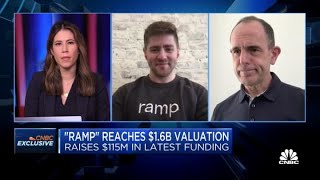
Ramp CEO Eric Glynn raised $115 million, pushing the corporate card startup to a $1.6 billion valuation, New York's fastest unicorn. Unlike traditional cards that reward spending, Ramp's platform helps businesses spend less. Investor Keith Rabois argues incumbent banks push regulation to protect market share against fintech competitors.
Chapters
Corporate card startup Ramp announcing this morning that it's raised another $115 million placing the company at a $1.6 billion valuation. Joining us now on the announcement is Ramp CEO and Paribus co-founder Eric Glynn as well as investor and Founders Fund general partner Keith Rabois. Thank you both so much for joining us. Eric let's start with you. Tell us what makes Ramp different from all the other corporate card providers and what will you be doing with this investment money?
Of course, thanks so much for having me. So what makes RAMP different is we are the first corporate card that is designed to help businesses spend less. It sounds like an obvious thing, but most credit cards are designed with points and incentives programs that incentivize employees to spend more money, earn more points. We believe that business owners want to be more profitable and have designed software and credit cards to do just that. With today's funding, we're proud to be New York's fastest billion-dollar company in history. We reached this bar in less than two years from the company's founding, and we'll be using the funds to further grow the team of 100 employees out, doubling in size we intend over the next six to eight months, and delivering more software to help companies spend less.
So Keith, tell us what drew you to this company and why Companies spending less through ramp won't hinder ramp's ability to generate profits itself.
We were extremely interested in this opportunity two years ago because we had the diagnosis that financial services world is basically subject to a lot of misalignment. And I've been investing in lots of companies that fix that misalignment from Square to PayPal and Zoom back in the remote space and ramp had a interesting theory on how to fix this misalignment, where basically you get paid for spending more and that's not really in the interest of executives. So they started the company from the ground up with that vision and it resonated with me based upon my background in financial services. I think most banks, for example, in the US profit upon poor behavior by consumers and the modern sort of replacement banks like Affirm fix that. So Rapp was right down the middle of stuff I've been looking for for 20 years to be involved in. And then secondly, all of the companies were involved in the technology sector and increasingly all of companies across all industries rely upon SaaS software to run their businesses. And RAMP is taking the data, which is really interesting and very valuable, integrating it into the plumbing that all of the modern CFOs use to run their businesses and allow that data to become actionable, insightful in real time. which enables the CFO in the corporate executive seat to do that to perform their jobs better. And they will eventually want to compensate us for that with software revenues.
Keith, that's Deirdre. I wanted to ask what you made of Jamie Dimon's comments yesterday on the fintech threat in his annual letter. He called for more regulation of the space. And in the past, you know, he's questioned some of the privacy practices of fintech. like Plaid. Does he have a point here or do you think he's sounding threatened.
Well he should be frightened. If you look at the market cap of a lot of the fintech companies from Coinbase Square etc. They're going to be larger than his market cap very soon. So he should definitely be paying attention and be less dismissive. I think fundamentally you know privacy practices will vary. But the classic tool of all in comments is to ask for regulation to protect themselves from competition. You see this in Europe which is why nobody has really created interesting European startups for almost 40 years. There's a handful of companies that have broke through because Europe's so focused on protecting incumbents that they don't allow for innovation. So hopefully we won't do that in the U.S.
Eric I got to ask you about corporate spending in general. Given the wild swings we've seen in corporate card especially on travel leisure over the past year is there a sense or a consensus as to When or if corporate travel spend gets back to its high watermark?
That's a great question. Yeah, it's a great question. Ultimately, so one, we're starting to see a return to travel and entertainment spend from businesses already. It is still a far cry from where it was just a year and a half ago, but this is increasing and it starts to map to to the cities and states that have had earlier reopenings, faster rates of vaccination, all that. And so I think the jury is still out as to whether business travel will return to the old levels, but we are seeing this playing out in corporate spend data already.
Shepherd Smith here. Thanks for watching CNBC on YouTube.