Disrupt Backstage: Keith Rabois
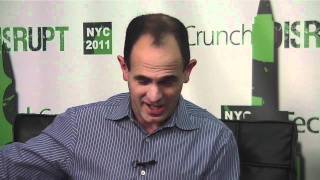
Keith Rabois, COO of Square, explains why the company targets offline payments instead of competing with PayPal online. He argues that finding top talent is harder than raising money, comparing elite engineers to rare baseball pitchers. Only a small number of exceptional people can skip college and succeed.
Chapters
Hi, this is Sarah Lacy, backstage at TechCrunch Disrupt with Keith Rabois of Square, COO. And we cleared up on stage, you actually are the COO, you're not the acting CEO, while Jack goes over and.
Fulfills his issues with Twitter? Nope, nothing's changed at all. We have the same exact roles.
Jack's CEO, Jack will always be CEO of Square. Okay, great. Well, that's more than he could have said for Twitter, so a very different story. All right. So we talked about on stage how how Square is tracking better than PayPal was at this point and the metrics that that you used. And people can, you know, kind of look back to the post if they want those details. I'm curious how much of that is simply the maturity of the web and a billion people being online and people being comfortable. I mean, you guys had to blaze a serious trail with PayPal and how much of it is something this team did better from an execution point of view?
Well, I think, first of all, Square Square is mostly about offline transactions. So we're enabling face-to-face transactions. Like right now, if we were selling something, Square-- you'll have to answer that question. Exactly. Square, I'll pay you $50 if you only ask softball questions. Actually, I really should have tried that one, Mike. I know. It's like you have these really good ideas later. But anyway, so some of that is a function, but we're mostly in the real world. So that's one thing that's different. I think also just we've learned PayPAl made several mistakes. It took us a long time to figure out fraud, took a long time to figure out some other things, did a lot of things that were great as well. But so hopefully we've learned from some, the last 10 years, some of that knowledge has disseminated throughout the Valley and some of it can be repackaged and used to not make the same mistakes. Right.
I've had a lot of discussions with the different members of the PayPal Mafia about a lot of things. But about particularly whether or not selling PayPal was the right thing to do. And I think almost every person has said ultimately on balance it was because It was so dependent on eBay. There were very real problems in terms of frauds and states suing PayPal. And as Peter says, one of the reasons you guys all stayed friends is because you had this great outcome when you look back.
That's true, too.
It was a contentious place to work, which you would expect with Peter and Max starting a company and Elon in the mix as well. But so I'm curious, are there ways that you're building Square so that The answer to that question doesn't mean doesn't turn into, yes, we had to sell because of all these issues, you know, but this could be the big standalone payment company. Sure. So I think it was the right thing to sell.
I was a champion at the time of selling. I think, you know, we lost a lot of sleep at night. And Reid had this great expression of just because someone shoots a gun at you five times and misses doesn't mean that the sixth bullet doesn't land. And so there's a little bit of that that went into went into the calculation. David Sachs wrote a great answer on Quora. I wrote one as well on why did PayPal decide to sell? It's actually a really thoughtful answer by David. So yeah, so we are not derivative with one company. We get all of our users from a wide swath of places. There's no single source of our adoption and that's really powerful. Like so we had a huge eBay dependency. We used to say publicly that it was 70% on eBay transactions, but in fact it was closer to 90%, meaning that a lot of users who used us off of eBay actually found out about us Right. Through eBay. So we were heavily concentrated on eBay and we didn't really have another path of growing to that scale. Like there was not an adjacent market that we could find in a short enough period of time that offset some of that risk. So I think it was a pretty rational decision. But at Square we're doing everything to be a standalone company of consequence for.
A very long period of time. Now you and Mike talked about fees on stage. I mean the issue that's pissed everyone off who love PayPal in the early days is that eBay is just used as an engine to charge more and more and more fees as you know someone who put lifeblood into building that company? Do you think that was a mistake?
I don't know if it was a mistake. I worried more about the destruction of the brand. So the brand itself, it used to, as you remember, have a certain amount of sex appeal and there was a lot of movement and power behind the brand. In fact, one of the reasons why I believe Meg Whitman decided finally to buy PayPal was she saw that at eBay Live, all of the eBay power sellers were actually wearing PayPal t-shirts instead of the eBay ones that they had handed out. So I think the brand was really resonating. but the product has become very bloated. David pioneered an idea that he doesn't get a lot of credit for. He actually really invested in design back in 2000, which was very unusual. We had a huge design team, probably about 10, 12 people, which at that time was considered incredible. And over time, they've just layered more and more and more features. So the product is very, very bloated, very, very difficult to use. And I think I worry more about that. So like, for example, when people know that I used to work at PayPal, they look at the product, they're like, What the hell is that? And I think it's somewhat embarrassing actually.
I think people now who like didn't have that sort of like didn't get the initial 10, $20, you know, from using it and telling your friends, like.
They kind of missed what was cool about PayPal. Absolutely. Like I think there's a definite generation gap. And I mean, I remember doing some consulting for a company in 2007 and the product people there asked me like.
Why would you be proud of this PayPal thing? I know, I know. Okay, so I want to talk about how how easy it is to start a company in Silicon Valley now. It's something I've been hearing a frustration from a lot of entrepreneurs that people are just, that people are just, you know, instead of, basically if it's a guy like you who should be an operations guy, instead because it's so easy and there's so much glamour, he's starting a company. And so like that guy is not going to be the operations guy for some hot up and coming company. And as we all know, a single entrepreneur can't do it alone. I think you're such an interesting role model for kids coming to Silicon Valley because you've never been the founder. And you said on stage, I'm not a product visionary. And yet you've been one of the core management guys building PayPal, building LinkedIn, building Slide, and now building Square for huge companies. So I guess what would be your advice to people coming out of college about how Should they roll the dice on a startup or should they look.
At their skills a little more? So I think the hard part about starting a company is it's actually pretty easy. Like these days to start a company, raise, I don't know, $500,000 to $1,500,000. That's actually the easy part. The hard part is getting the user's attention and building a critical density of talent. So the reason why people talk about the PayPal team is there's a fair number of people, like probably 25 to 30 people that were just exceptional, all within 254 people in Mountain View. And so that critical density of talent is what allows for exceptional outcomes. Right now, if you're one of the thousand companies that start with four to seven people, there's very limited chance to break through and break through with user attention because users still only have 24 hours in a day. So if you launch a new product, you have to interrupt something and replace something that they're already doing, whether it's family, friends, church, or other websites. Or working out and playing soccer. Yeah, no, you've got to substitute somewhere. There's just no way to extend the day. And so people forget that. Second thing is though also to build a company of consequence, you need hundreds to thousands of people and where are you gonna get these people from and how talented are they gonna be? Unless you hit escape velocity, there's almost no chance that you can assemble that incredible array of talent. And I actually had this hypothesis several years ago that Ohm actually wrote about, borrowing from a comment Roloff made, that one of the reasons why we have these boom and bust cycles in the Valley is that in the times of bust, it's easy to assemble a critical density of talent. Like 85% of the people we offer jobs to at PayPal accepted them. Because there was no other jobs. Same thing Google from 2003 to 2005 must have had an incredible acceptance rate. So they were able to assemble that talent and keep them all in one place, in one building or a set of buildings for a very long time. Today it would be very, very difficult to get that group of talented people together. It's like producing the movie that I was referring to with Mike. You need an incredible range of people to produce an awesome movie. From the people behind the scenes to the people in front of the producer, the director, the people in front of the camera, all of that has to come together to create one of these companies. And so if there's two minutes fragmentation, it actually leads to a suboptimal number of successful companies. So that's what I always tell entrepreneurs is, are you sure, you know, how are you gonna go from four or seven people that you know already to having hundreds of people and why are you gonna be the one company that everybody joins?
It's like we've solved the capitalization issue. We've solved how easy it is to get a product out. We've solved, you know, access to capital. But you still haven't solved that you need all these people to build a company.
That's what I think people miss. Yeah, it's like Major League Baseball. There's only so many Major League Baseball could not expand to twice the number of teams because there's not enough Major League baseball level caliber pitchers.
Right.
Particularly left hand pitchers. There just aren't that many in the world that are that good.
And so you can't create an infinite number of companies because there's not an.
Infinite number of A-plus people. That's the problem TechCrunch has.
There's only so many brilliant Tech journalists.
Exactly.
That's why they're all in TechCrunch. All right, last question. Peter Thiel, your good friend, announced his finalists for his 20 under 20. This has been a huge fight at TechCrunch. I think it's an awesome program. I think kids all have their own path. I don't get worked up about someone stopping out of school for a couple years. And I think it's only 20 kids. And people said, you know, you're pregnant. What if your kid did it? I was like, my kid went to go work for Peter Thiel I would be like right on. Yeah, but talk to people who think this is morally wrong. I think Peter's more right than wrong.
I think most, so it's like continuing my sports metaphor for a second. There are people who are prepared to drop out of high school or finish high school and go right to the NBA. Most people are not. Actually, most people aren't qualified to go in the NBA period. Yeah. But it's still better for most people to go to college. But if you're at that level, that dedicated, that smart, There's no reason to be hurted, you know, in a sort of classroom. Like Paul Graham, his first book, Painters and Hackers, has this point about high schools mostly designed to sort of force people and like babysit them. And so I think Peter's tapping into that. A lot of the best people you saw, Ron Conway and David present on stage, a lot of the best entrepreneurs are pretty young in their career. So getting a jump start in that, if you are one of those people, when I first started at Square, actually interesting, Half of our sort of leadership meeting the first day I was there were people who dropped out of school. Really? Yep. Wow.
I made up for one of them.
Because I have two degrees. But I was actually-- you- can only.
Make up for two.
I don't need any more degrees, definitely. All right, we're gonna wrap up.
Thank you again for flying out. I know it's a busy week for you guys at Square, but-- Thanks for inviting me.
Thanks very much.
More from Keith

This Billionaire Trains His Body Like He's Building A Billion-Dollar Startup | Keith Rabois


Vinod Khosla and Keith Rabois on Building and Investing in Enduring Companies | Ep. 40



