EP 68 | Keith Rabois' Key To Happiness: Miami
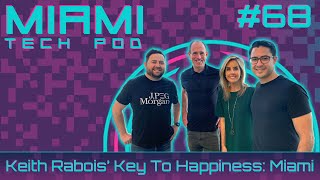
In episode 68 of the Miami Tech Pod, hosts Cesar, Brian, and Maria interview Silicon Valley veteran Keith Rabois. The conversation traces Keith’s path from joining PayPal in 2000—after a call to Peter Thiel—to senior roles at LinkedIn and Square, where he describes the evolving nature of business development and the importance of hiring "undiscovered talent" rather than conventional hires. He explains his day‑to‑day as Square’s COO, balancing structured product reviews with unstructured, open‑office time for spontaneous ideas. Keith then introduces OpenStore, a platform that offers instant liquidity to long‑tail Shopify merchants, and discusses its market size and growth ambitions. The discussion shifts to his work at Founders Fund, where he highlights his asymmetric advantage in assessing founding teams, his legal‑regulatory expertise, and his philosophy on fund differentiation, valuation, and the current scarcity of new venture funds. He offers practical advice on early‑stage valuations, stresses the art‑vs‑science nature of deal‑making, and shares contrarian book recommendations (e.g., Why We Sleep and The Upside of Stress). Keith reflects on Miami’s ecosystem—housing, education, talent attraction, and quality of life—while also commenting on broader industry trends such as engineer compensation, revenue‑per‑employee metrics, macro‑driven funding horizons, and his view of Tiger Global’s market‑timing strategy. The episode ends with a light‑hearted wrap‑up and plans for a follow‑up.
Chapters
Hey everyone, this is Cesar. This is episode 68 of the Miami Tech Pod. This is a big one. We're here joined this week with Brian and Maria and our special guest, the man, the myth, the legend, Keith Raboy. Welcome to the Miami Tech Pod, Keith.
Pleasure to be with you.
Yeah, this is an exciting episode. I feel like it's almost better that we did this you know, 68 episodes in, you're settled into Miami, the economy may be collapsing, who knows. But, you know, let's kind of start because there's so many people that, you know, really are building companies here. There's a lot of operators who are listening to this podcast. I want to understand some of the big lessons that you learned, you know, operating at a high level at some of the most important companies in tech in Silicon Valley. and let's dive into that chapter of your life, right? You were an executive at PayPal. Walk us through how that came about. How did you land that job tactically? How was that conversation like, hey, I want to go run BizDev, Public Affairs, and Communications with Peter or whoever it was? at the time.
Yeah. So I joined PayPal in November of 2000. Peter Thiel had returned as interim CEO of PayPal in September 25th, 2000. And my first startup that I was ever involved in was starting to show signs of failing because the internet bubble was starting to collapse earlier in 2000, late March and June of 2000. So after Peter returned as CEO, I sort of called him just asking for advice. Peter and I had known each other since literally the first day of my freshman year of college at Stanford. And I asked him, you know, what what do you think I should do? Like this company, the CEO is not being decisive enough and making decisions. We're going to eventually run out of money and there are some strategies that might work, but the problem with a 21-year-old CEO is they sometimes get whiplash and don't make decisive decisions. So I was just getting frustrated. And so Peter said, direct quote, I could introduce you to lots of people in Silicon Valley, but you should just come to work for us. And at the time, that was PayPal. They also was PayPal. And I thought, well, there's this kind of crazy bunch of misfits sitting in Silicon Valley, but at least I know a few of them from college. Why not?
And so I want to talk about business development roles in tech, right? Because this is somewhat of a mystical kind of area where it's not super defined. It means a lot of different things in different companies, right? But for the most part, the people that we've seen in the largest companies that have led, you know, really important BD work, have an accelerating effect on growth, right? Was that the case on your work at PayPal and LinkedIn in particular? Well, business development back in the Internet.
Bubble days actually used to be a cool, trendy job. And then a lot of people blamed the collapse of Internet Bubble companies on this sort of pseudo biz dev roles that you weren't really creating value and that there's a lot of these people running around doing deals that weren't producing value and traction, certainly not measured in marginal economics. And so it became a very uncool, unsexy role job title. You didn't actually see many people with business BizDev titles floating around. And to some extent, the logic of that made sense is really you want to innovate with product engineering design and you want sales. So BizDev sometimes is a euphemistic version of sales, although strictly and correctly defined, it's actually not sales. So that was just one of seven or eight things I did at PayPal, but I wouldn't necessarily recommend it as a career in technology because I do think that often the critique that says BizDev is sales without quotas is more true sometimes than false. And so I think you want to build a craft a career based upon a craft where there's very tangible concrete value. Now, there are exceptional biz dev people and there are extraordinary times and circumstances when a relationship with another partner or a large partner can really unlock value. But those are the exceptions, not the rules. Typically, you want a role where every day, every week, every month, you can add value.
How do you think that stint at PayPal and LinkedIn sort of formed your thinking later on for all the stuff you did after?
Well, most of the important stuff I learned in philosophy conceptually about building startups successfully, I learned from Peter Thiel mostly at PayPal. So 2000, 2001, 2002, maybe a little bit 2003, and just applied them. Took 10, 15, 20 years for them to seep into my brain to develop the muscle in terms of applying them. You can understand a concept maybe, but it doesn't mean you can actually execute it. I can understand why Steph Curry is a good basketball player. It doesn't mean I can actually replicate it. So there's a lot of, you know, truisms that Peter taught me that logically made sense, but then I had to learn to apply them. So, for example, the first week I worked at PayPal, Peter and I went for a jog around the Stanford campus. It's about a three and a half mile loop, and we talked about certain principles of building company. One of them was about this philosophy of hiring undiscovered talent. That the way you build a company from scratch to success is you have to hire people that other people don't want to hire, that they don't know how to assess. And so you can state that and The logic of it behind, the logic behind it made sense to me, but that didn't mean I could go find undiscovered talent, correctly assess them, calibrate them, and help mentor them. That took years to prove, to learn how to do and then prove that I could do it.
Do you think that last point, do you think that has helped you here in South Florida?
Oh, of course. I mean, I don't hire people that are conventional hires. I don't want people that Google, Apple, Amazon want to hire. I want people that have less data points on their LinkedIn these days. So these large companies don't know how to assess them or they have something about them that's disruptive that large companies wouldn't want to hire them.
It makes a lot of sense. I mean, for a lot of the talent pool here in South Florida, they suffer from the lack of those data points but have other sort of non-traditional data points in their back.
Sure, but you need to still you need to find exceptional people, like companies, company buildings around finding extraordinary people. And so you still need to be able to find people who are extraordinary and have the potential to be super extraordinary and be able to assess them correctly and assemble them and marshal them together and mentor them. And none of the steps are easy.
Do you think that's something that only like time will really help you learn?
No, time will manifest, you know, evidence of whether you can do it or not successfully. You need to find a technique that works for you. You can learn from Osmosis, the handful of people who are good at it and try to replicate. But what I've also found is the people who are exceptional at this have sort of their own version of it and you have to kind of curate it, create it, refine it for yourself. So for example, in my case, at PayPal, I actually was not very good at it initially. The hires that I introduced into the company initially were what I called random, meaning some perform well, some perform mediocre, you know, in a kind of mediocre way. And so I didn't have the best like I was not perceived to be perfect at my hiring of like undiscovered talent. What I learned to do after making some mistakes in not in realizing I wasn't quite good enough at this is I started poaching people internally. So I looked around the company of about 254 people and found people that I felt were that were more talented and were being under leveraged and would convince them and persuade them to switch to my team. And that worked really well. It had significant benefits right away, business impact, my peers and my, you know, ultimate direct report managers recognized it pretty quickly that this was an effective strategy. So that taught me a lesson, a key lesson, which I could actually recognize the under leveraged talent correctly and I could manage them effectively. But what I couldn't do is meet strangers in interview process and correctly calibrate them. So it isolated the one variable that I needed to learn because you can't steal people forever. Definitely people start noticing when you're stealing people from their team. teams all the time. What was the.
Day in the life of the COO of Square like?
A lot of meetings, truthfully. We had a very structured process for reviewing strategies, product launches. We'd have hour-long reviews with very carefully prepared decks, keynote decks, designed to elicit feedback and approvals. So most of the week was consumed with that. There'd be a fair amount of interviewing. So I interviewed, you know, most people that got offers, how, virtually nobody was approved to be hired that wasn't interviewed by either Jack or me or both. So there's a lot of, a lot of interviews. And then I tried to allocate a reasonable amount of what I call unstructured time. So typically between 6 and 7 30 p.m. i'd sit at a standing desk with an iPad and allow people to come up with questions, ideas, creative suggestions while I'd probably like eat a snack or dinner. And I tried to allocate some of that on a weekend, Sundays particularly, so that people could come up to me where I'd have a very light agenda, not a fully baked calendar, so that there's this osmosis-based opportunity for creativity.
Was that unstructured time more productive than the structured everybody get around conference room and look at it and go through it?
Well, they're both valuable. They just have different goals. So you want to allow for random ideas to percolate. and you want to allow some riffing on some ideas, and that can't be done as well in a structured, very orchestrated, prepared deck and prepared agenda. But the mechanics of running a company with a consistent voice, consistent theme, consistent pace requires some discipline about how do you review products, people, teams. Cool.
So does that unstructured riffing time now happen at Barry's right here in Midtown?
No, Barry's is difficult for that because you're so consumed. It's hard to breathe, let alone chat. Sometimes after Barry's might work. We do have random conversations after class, and sometimes do spark good ideas.
Do you think this has made starting Open Store easier than it would have been for you had you not had a lot of these experiences or?
Well, absolutely. I mean, obviously a lot of work product at whether it's PayPal, LinkedIn, Square, Open Door, affects you and you're trying to borrow the best ideas, best lessons, best people you've worked with. So that part's easier. It never gets easier to be the CEO. In fact, it's probably harder now to be CEO. I'm basically nine years into being a VC. It's been nine years since I ran something day to day, so you forget. Skills, muscles, atrophy, management, leadership, leadership skills are like muscles. And if you don't do them for a while, they definitely decay. There's a lot of devils in the detail stuff. So now, kind of entering my second year as CEO, there's definitely things that are starting to come back to me slowly that I probably would have been better at in 2013.
So for the three folks in Miami who don't know what Open Store is, how would you pitch it to them?
So Open Store provides instant liquidity to long-tail Shopify merchants. Basically, if you start a business on Shopify, and you're not one of four or five that are appropriate for with explosive growth, appropriate for venture capital, you have to decide, are you going to run this business forever? And many people want to start a business and the business can be thriving, but they don't have a 40 years desire to run a business. So we will instantly evaluate just using pure data in the business, give a fair offer to the business owner and buy out the business owner and pay them within a month.
So is the idea to eventually to expand beyond just Shopify stores to other-.
Well, no, Shopify has been the dominant e-commerce platform that's emerged over the last decade. So we will buy a business that has 50% or more of its sales on Shopify. There are some other platforms that compete with Shopify, but they're only going to.
Add like 10 or 12% to the addressable market.
It's easier to underwrite, right? Well, we have a consistent integration. Like we can get data from one of 12 different sources. Like we need Shopify data, we can get like Stripe data or ad data.
Obviously, you can have more platforms, just.
More integrations, more permutations.
How big do you think it's gonna get?
That's how well I do my job.
Yeah, that's why we're asking. Do you think, okay, let's ask this question. Is OpenStore gonna be the Miami startup started within the last two years that reaches a billion dollars in revenue and 500 employees fastest?
Maybe. I hope so. But we've funded other companies here at Miami at Founders Fund. One's run by a very close friend of mine. So hopefully, hopefully Trauma is equally there in the same day and then Mike and I won't have to fight about it.
Great. So you're talking about kind of scaling and, you know, you've been very vocal about open store being built here and everybody being in person. Have you seen any challenges with recruiting talent and what and for our listeners, what roles are you currently hiring for?
Yeah. So no recruiting people to work in person is a future, not a bug. Most people who want to grow their careers, maybe professional successful. learn by osmosis in unstructured environments, and you can't replicate that in a remote environment. So if you're going to hire undiscovered talent, the only way undiscovered talent can thrive is in a culture that's in person. So I mentioned Trauma, run by my friend Mike. They're also in person every day in Miami. And so we find it really easy to attract talent. We've moved talent from all across the globe, but mostly in the United States, from New York, LA, Chicago, a lot from the Bay Area. Escaping, sort of escaping Alcatraz. But we hire from anywhere. We have some visa issues. We've hired some from Latin America. We've tried to get some from Canada, but obviously there's immigration restrictions. But we're pretty aggressive about getting talent.
To move to Miami from anywhere. Let's shift to investing.
Are you doing zero deals these days? Pretty much. I haven't led a new investment in a company that's not in the current portfolio in calendar year 2022. to, which may not seem that crazy or different for many VCs, but last year, so 2021, by contrast, I probably led something like 13 new investments. So halfway through the year now, 13, which would have been six or seven to zero, is basically statistically significant.
What advice are you giving to founders, both inside the portfolio and outside in terms of preparing for this potential or.
Well, inside the portfolio, it depends on a lot of variables. I have access to, you know, their data. It depends on how efficient are they running the business today. There's companies that are very efficient. They have attractive unit economics, they have fast payback, they have moderate Burns. There's other companies that have, you know, run hot, meaning with hot, high burn rates or moderately unattractive marginal economics. And they have to fix those really fast. Like, you need a zero defect business pretty quickly. You need to basically be able to prove that the marginal economics work and that they accumulate advantages over time and get and then they translate to an interesting company financially eventually. You don't have to have an interesting financial company financially in the beginning. In fact, you probably shouldn't. It should be based upon product metrics that turn into financial metrics, but you're going to need to produce ultimately a profitable company that eventually means money. And so the faster you get on that trajectory with the proof points you need, the better off you're going to be in the portfolio. We have doubled down on several companies in the portfolio. So, when I'm talking about not financing new companies, I mean new companies, there's three to five at least companies in the portfolio this year that we've helped catalyze a new round for and we will do that where there's a high leverage opportunity, meaning if I can invest $4 million and then another $4.5, $6, $7, $8, $9, $10 million materializes from other investors, that's a great opportunity for the company to get enough resources to achieve their next milestone or two.
So you've invested in a few Miami companies now. Do you see any stark differences between the founders that were kind of been in Miami for a bit versus ones outside of Miami or?
So in the companies, so we have about one, two, three significant investments in Miami built from the ground up companies in Miami. And then we have about five, six or seven companies that have moved to Miami post, you know, post other financings. The ones built in Miami to one of the three is local, our local Miami founders, Lulu. The second one, Trauba, the founder, was living here in Miami for other professional reasons, but he's not from Miami. And then Open Store basically moved people to Miami with intent to build a company in Miami. So we're kind of all over the map right now.
Do you see that, like, to Maria's question, like a level of just grittiness that may not have existed in the like, I used to be a PM at Google and I've lived in Mountain View my whole life.
World.
I mean, compared to?
Yeah, we're very happy with the Miami company. So the three companies I mentioned that we funded from the ground up, seed round, you know, Etc. Here we're very excited about because they're in person, which we recommend highly. Number two, there's lack of, there's a lack of entitlement, which we're, it's very exciting to us. So we don't have the Google PM entitlement culture, the Silicon Valley entitlement culture. There's a reality and a desire to prove, which is nice. something to prove is usually a really good formula for success, an ingredient in success. So like that, we also think there's probably some alignment with the market, meaning there are types of products and services that having exposure to the real world, like real people, is actually valuable. Like, so for example, Trauma. Mike has this line, I've heard him use in other podcasts where he talks about most people in Silicon Valley have never met hourly workers. and there's a bit of truth, especially in warehouse ultra like industrial warehouse workers. So they don't know how to solve those problems. And I think that like Miami and Florida actually have industrial warehouses and you'd get more exposure to them and have a better insight, set of insights of what to build for both the workers to power their careers and their earning potential and the customers, the business owners.
A question on layoffs, right? We're seeing a lot of tech companies just right size their business, like to, you know, the macro economic trend is kind of causing that. They realize that they, you know, kind of grew assuming that capital would be cheap forever and all of that. Having been through some of this before, some of these cycles before, what is the effect of like, you know, I mean, it adds up, right? Like 50, 100, 200 employees in every single company that are like, go, Where do those workers go? Do they go back to the safe haven of Google and, you know, like large tech companies, Apple, et cetera, Meta? Or do you see kind of like the companies that were started in the last two years that are figuring it out that have their burn in check that are really like, okay, this is an opportunity. We have, you know, all of this talent at our disposal now. Let's just be aggressive and, you know, hire.
I think many of these people will wind up joining up and coming new startups. There's a great refresh rate in startups. which is wonderful. There's lots of published studies about how some of the most successful companies ever were started in difficult economic times, whether strictly a recession or not. So I think there's going to be a lot of opportunities to build new companies from scratch and talent may migrate to those. It may be easier for these companies to build the talent they need because there's people on the market. Going back to the larger companies may be a choice that some want to make, but a lot of the larger companies right now have hiring freezes too. So that may become less of an attractive option.
Do you all look at the valuation collapse in the public markets and say, Man, there's some deals out there. And would you ever invest Founders Fund in your LP's capital in really clobbered public companies right now that you think are cheap?
For two reasons, the answer is no. The Founders Fund, we wouldn't really invest in public companies. One is simply legally we're not set up structurally. We're not a registered investment advisor. So there's very, very strict limits on how often we can do that and it rounds to effectively zero. And it's like 20% of the fund could technically be invested in non-exempt securities, but like 20% of the fund's not going to get you very well, very far over three years in public securities. Secondly, I only believe that we should invest where we have asymmetry, like asymmetric information. Obviously that's illegal to do in the public markets.
So we're definitely not going to be doing that.
Right.
So circling back a little bit to the sort of right sizing the companies and all that stuff. So Ryan Peterson from Flexport the other day tweeted out how he's like, is this the end of the $400,000 engineers and stuff like that? What do you think about that as far as the market?
Well, I think the market was set by companies that may have had, well, did have, in fact, quite good businesses. Google has a monopoly business that mints money. So what Google pays engineers does set some market pricing. But not everybody was taking a second asking themselves a second question, which is, and do I currently, which the answer is almost never, or even in the future, am I likely to have a business that's as lucrative as Google's? Because the only way you can justify hiring people at that level is that you're going to mint as much money as Google. So I think this is very intentional by Google, by the way. I think the people who run Google are not stupid at all. They want people to spend too much money trying to copy their strategy because people do not mint money like Google. So it's a disastrous strategy. So overpaying engineers to some extent helps Google reinforce both either they keep people at Google because no one can compete with them, or the people who do compete and match them for salary are basically going to be dumb because they don't mint enough money to justify that. So I look at metrics like revenue per employee, for example. If you have a lot of revenue per employee, technically you should probably use contribution knowledge per employee, but it's easier to calculate from afar revenue per employee as how much leverage do you create? So unless you're creating a lot of.
Leverage per employee, you can't justify paying employees too much.
Yeah.
I mean, the perfect example that was, what is it? Fast.com, which had like, what, 600,000 total.
Revenue and 300 employees or some crazy Yeah, I mean, there may be gaps in time, like you may need a certain employee base to build something. So you can't just, there's no one size fits all solution for startups, but you want to be judicious about is the marginal input, the cost of an ingredient, an employee is an ingredient in cooking a dish, just like the car, the chef, is the cost of cooking a dish. The cost of that dish, the preparation of that dish can never be more than what the consumer, the ultimate, you know, verdict that they're willing to pay and what they value. So you have to think about your.
Cost of ingredients and a lot of people weren't. I mean, there's a lot of examples, I think, in the last 10 years or so of companies that just didn't understand unit economics and sort of, like you're saying, the recipe economics. And so they were like, well, we'll make up the money on the back end somehow. There was no fucking back end.
Or the time horizon was too long that they were planning for.
Right. Yeah.
And so I think a lot of people are getting this sort of hard knocks, mini MBA lesson for their startups, whether they wanted it to or not.
Yeah, I think there's a lot of reality distortion and I think both of you mentioned some of the causes. One cause was actually not understanding period how economics works. I think those founders I don't feel very sorry for because in fact that's part of the job is like learning how to construct a business that means money is part of the job and role. So we've always given, I've always given what I think to be very consistent advice over the last decade plus or nine years as a VC and 13 years as a board member or 15 years as a board member that there's a way to normalize against any economic environment, just how to think about what you're building, what margin you should have, how do you prove that, what's an acceptable payback period, et cetera, et cetera. There's a second question, though, that I think the time horizon is affected by macro, which is as interest rates go up, the time horizon that people are willing to fund to see progress changes because the discount, the cost of discounting time value of money changes. So, people may have been willing to wait three, five years for proof points, now they're not willing to wait more than one.
Right. And every disperser of debt has a different return expectation in great boom economies versus not.
Yeah, the cost of oxygen. Just imagine, I mean, the metaphor I've used for God, eight years now is, just imagine every time you take a breath, there's a price on oxygen. You would think about, well, should I go jogging outside today when it's 90 degrees? Because that'd be a very expensive run. versus now oxygen is free and plentiful, so you don't calculate it at all.
I'm really curious about your thoughts on Tiger Global.
They pursued a strategy that works in a very hot, sustained market. I tend not to, and we at Founders Fund don't believe in timing markets. We believe in finding extraordinary founders who want to change the world in a positive way, and they're going to do it come hell or high water, and then they have to adjust their strategies depending upon the cost of capital. But we're not market timers. But if you can imagine the Heritage of Tiger, they are market timers by public domain. They tried to apply that and had they applied that strategy five years earlier, a lot of people would have thought they looked brilliant. It's just that there was only two or three years left in a cycle before the world changed back to normal. Actually, we're not in a bad economic environment now. By any historical standard in technology over the last 40 years in technology stocks, things are trading at normal multiples, meaning the average. So things are getting a lot worse too. But we build our businesses here at Founders Fund to be very successful in an average market environment or ideally even in a bad market environment. What is a normal multiple?
Let's call it 10x.
A 10x like EBITDA, one year. But there's lots of graphs you can look at. Over the last 40 years, actually the average is probably 8.6 or so. You can cut it by different verticals like SaaS versus financial services versus e-commerce. But fundamentally around 10x, when last year a lot of private deals were getting done, not just at 30x, but there were some at 70 or 80-100x. top line. Well, yeah, I mean, but true, true revenue, let's say.
Okay. Yeah. Not like, you know, Uber, not gross bookings or something.
Or like actual revenue, but still, that's just an inappropriate multiple over a 40-year horizon.
I only use a community adjusted EBITDA.
What?
I guess it depends on who your community is.
Right, right.
So, Keith, you've been here in Miami, what, almost 20 months now?
Yeah, I moved December 10th to 2020. Not that I'm counting.
So what are some of the things that have surprised you, good or bad, about Miami?
Well, everything's been a positive surprise, truthfully. I can't think of anything other than maybe cell coverage, but I don't make many cell Um, so, that's probably, you know, difficult if one were a cell phone addict, to survive around here, but everything else has been positive. People are healthy, people are happy, there's plenty of things to do, the weather's amazing. I feel like I actually wake up every day in paradise. Like I wake up and the sun's shining, I look out on the ocean and I'm like, why did I do this 20 years earlier?
I heard an interview that you recently gave with Bloomberg about kind of one knock on Miami is the education system and that you have invested in a local company that's kind of doing something around homeschooling and you are doing a side project in the ed tech space?
Yeah, sure. So we invested at Founders Fund in a company called Primer, which is basically giving parents tools to accelerate homeschooling, making them more comfortable, more confident, more successful, and we'll probably launch some version of a real-world complement in Miami actually soon. Now, secondly, as a side project, there are things we can always do to improve education, particularly technical education. So we've moved a lot of people who have families, myself included, have families and we start worrying about schools where, you know, where's the best place to send? So since Miami and Florida have innovation and have laws that are more favorable for innovation around education, I want to double down on that and provide a great set of opportunities so parents can choose what kind of education is best for their kids, including early technical education.
In many ways, the guardrails there are regulations like you alluded to. And even though this is one of the more, you know, school choice friendly states, it's not perfect, right? There's still a ton of bureaucracies in school districts and, you know, DOE, et cetera. Shifting to that, you know, I've heard you say that you, your asymmetry in doing deals is that, you know, you're a lawyer, you understand policy, government, the world. You have been able to really understand ahead of time, like the regulatory risks that companies face and ed tech companies are no different, but there are some you've invested in that are in deep regulated areas. Do you think that that's an area that founders, operators, people that are building companies underappreciate?
It varies. So financial services, healthcare, education are all canonical examples of heavily regulated parts of the world. And I think there's founders in those fields that definitely understand the risk they're confronting and actually can manipulate it successfully to build some moat, some complement themselves with the appropriate people that can help them navigate correctly in build moats, actually. So I think there's opportunities where there's a lot of regulation.
Like Palantir, as an example.
Yeah, sure. I mean, there's lots of, or Anduril, like in Defense Department, you know, is a major important company for Founders Fund, you know, really helping save the United States in the future. And so, I actually as an ex-lawyer though, like things that have natural legal and regulatory risk. Because I feel that most of my competitors certainly won't calibrate it themselves in their own brain, which is a mistake. And then B, may not calibrate it correctly as a result of that. So I can do the legal and regulatory analysis in my own brain and then make a decision that combines business risk with legal risk. And I like that. I also can help often solve it. So there's a several companies where I'm very actively involved in the regulatory legal strategy, because there are some parts of law I actually know something about still despite 20 years of not practicing law. It's amazing. Amazing how you don't forget certain things. So I like the idea that there's an asymmetry I can create. It's not my primary asymmetry. It's one. I still prefer to back undiscovered talent. So my ideal investment day in pitch is someone walks in, I've never met before with a keynote deck and pitches me with it about an unlaunched product, talks about the vision, the potential and the team. And I'd love to write a seed check. That is still my favorite thing to do. It may or may not have legal risk, but more or what I'm doing is calibrating the quality of the team and the founders.
Because then you're invested at A level and then you really dive in at that point.
Yeah. So I think there's two reasons. One is I think I have asymmetric ability in assessing the team. said I'd like to compete when there's no metrics. Because once you get metrics, a lot of investors are smart and they can look at the metrics just as well as I can or better. Second, I think sometimes you can have positive impact by investing early. There's a lot of unnecessary mistake founders make. The grass isn't always greener and you can just point out there are alternatives or there are trade-offs and make them intentionally.
I deal with a lot of super early stage pre-seed people and stuff. And one of the biggest challenges they have is figuring out valuations for themselves and figuring out what's a reasonable deal, right? Because no one wants to be unfair and also every investor wants to get a good deal. So is there any advice you could give a budding entrepreneur on what's the best way to set up that?
I mean, honestly, there's no magic, especially to early stage valuations. They're much more art than science. There is no scientific metric formula. I think to some extent, it is a market willing buyers, willing sellers is fair. I was mentioning to a colleague recently, someone was asking me when I'm going to be excited about reinvesting in seed rounds. I said, well, when someone walks in with the next Airbnb at three and a half million post, which is what I invested at, I'd be very excited. They're going to check right now. You can build one of the most important companies in the last last 50 years at raising money, 500K total round at three and a half million post. So sometimes founders are not thinking about the opportunity the right way either. But yeah, we think about it in terms of risk reward. How we technically price something or value something is mostly a comparable situation where we look at the last five or 10 companies that kind of felt like similar stage and what was the market pricing for them. But again, that's kind of a finger in the wind art. If I was a founder, I would choose on every other dimension anyway, I would choose who do you want to work with, who can you learn the most from, who can you get the best advice from, you know, who can help you the most. And then the valuation should be in a zone of fairness, but you're not really optimizing on that variable at all. They are coming back down as far as I can tell. I saw a tweet this morning from someone who's pretty knowledgeable that said, you know, they're seeing valuations seed rounds, funds back in the 7 to 10 post range, which is much more reasonable than the 12, 15, 20 range.
For those who are investors, there's new funds launching every day. How do you set yourself, how does a fund set themselves apart?
Well, I don't think there's going to be a lot of new funds launching every day anymore. I think that's an artifact of history of interest rate environments, everything up into the right. I think you're not going to see many new funds at all. In fact, most of the funds, I think, will struggle to raise a second or third fund. a lot of them were propped up by either artificial valuation markups and they're going to have to confront reality. And then number two is the LPs that traditionally fund these funds are now overexposed to venture because their private portfolio has decreased by 20, 30, 40, 50, 60, 70, 80, 90%. So they have to take that proportion back down. So I think being an emerging manager is not going to be particularly attractive for all but a very very small handful of folks. These people who want to aspire to be VCs probably better off joining a fund and learning by osmosis for two or three years. And then the environment may change, but also they'll be better at the job, I suspect. But the best advice typically, if one were to start a new fund, is what is my value proposition? Nail it. Differentiation, just like a regular product. Why am I different? Why should you take my money versus anybody else's? The better that answer is, the more succinct, the more powerful. almost surely the better you'll do.
So you're well known for your contrarian views, which you attribute to reading a lot of books. Are there any books that you recommend people who kind of want to develop.
A similar... Yeah, it depends where you want to start. I mean, many of these things have now seeped into popular culture. So for example, I used to believe in the power of sleep and really optimized my life around sleep. 30 years ago, that was considered strange. After the publication of a book, particularly why We Sleep by Matthew Walker, It's now conventional wisdom, like you see school districts even the most bureaucratic institution in the world are like moving their start day back, you know, because they've seen the research about how much better kids perform, how few car accidents kids get in when you move the sleep day back 40 minutes. So like things move from contrarian to consensus quickly. One of my favorite contrarian books is called the Upside of Stress by a professor at Stanford named Kelly McDougall. You can watch a 20 minute clip of her TED that she actually gave a speech she gave before she wrote the book. gives you a feel for it. But it basically argues the more stress you have in your life, the happier you're going to be, the healthier you're going to be, the more successful you're going to be.
It's very rigorously argued. Highly, highly recommend it. I feel that every day. Stress and happiness.
That intersection for sure. I mean, I think I would add to that.
I think it's probably stress and purpose, right? Well, yeah. So there's, it's not just stress. It's how you approach stress.
What's the framework for approaching stress?
Embracing it as a challenge, as a way to grow.
So you've been really vocal about Miami, how great of a city it is. What do you think needs to be improved and what can anyone in the city do kind of even as an individual to kind of help it progress? Yeah, I mean, I think many, I.
Mean, we're obviously building more housing. There's 20, as far as I can tell, there's skyscrapers as we look out the window here everywhere. There's 21 like major skyscrapers residentially being constructed right now. You know, there is a gap between supply and demand right now. Everybody wants to move to Miami. Obviously, you know, rents are going to go up until supply can catch up. It's hard to build real estate overnight, but it's being built fast. So that I'm pretty comfortable will normalize even now. Still, the city's only probably 20, 25% built up. If you just look around like very pristine areas of the city, prestigious areas, Midtown, near where I live on the Venetian Islands, there's vacant lots everywhere. So this is this city has plenty of opportunity to build housing. so I know it causes short-term stress because just construction takes a year or more. It'll eventually normalize in some equilibrium. It'll still be an affordable city. Education, obviously we can boost both the primary education, the secondary education and the advanced education. I care a lot about students learning, children learning math and coding as early as possible. I think one thing the Soviet Union did do well are Russian did do very well back in the day was teach math at a very early age, which is why a lot of the best physics papers and physicists ever created were Russian. It's not like some gene that because you have a Russian gene, you become a smart physicist. It's because you teach math to kids when they're one or two years old and that compounds like any other lesson. If you teach, if you learn math and basic fundamental science at a very early age, you have 50, 60, 70, 80, 90 years to exploit that and that compounds. so I want schools that really will challenge kids to advance at the highest, fastest possible rate that they're capable of.
Keith or Boy. That was amazing. That was like all time, we could all exhale now. We got through that very quickly, like jam-packed episode. Thanks for joining the Miami TechPod, man. This is really neat. We'll have to do round two in kind of a Keith prediction scorecard.
Okay, we'll do the second round. Hopefully as fast paced.
Yeah.
How we're doing in a year, we'll pull up all the tweets in a deck and.
Oh, God, you got 32, 000 to read.
Yeah, that'd be great. Well, thanks. This was an awesome episode, and we really appreciate your time.
Cool. Thank you.
More from Keith

This Billionaire Trains His Body Like He's Building A Billion-Dollar Startup | Keith Rabois


Vinod Khosla and Keith Rabois on Building and Investing in Enduring Companies | Ep. 40



