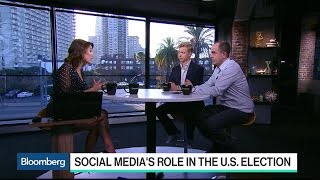
In this interview, the host asks Keith Rabois and a Facebook representative about the role of social media platforms—particularly Facebook and Twitter—in shaping the 2016 U.S. election and the broader political discourse. Rabois argues that technology’s primary effect over the past three decades has been the removal of traditional gatekeepers, allowing people to communicate directly and changing the rules of political campaigning. He likens the shift to historical moments like the Nixon‑Kennedy debate, noting that new platforms create winners and losers based on adoption. The conversation then turns to whether Facebook makes editorial decisions; the host cites criticism that Facebook’s algorithm surfaces click‑bait, misinformation, and potentially harms democracy. The Facebook representative counters that the platform’s role is to facilitate user choice rather than curate content. Rabois adds that populism is often a label for unpopular ideas, and that platforms empower individuals to disseminate ideas globally. He also notes that there is no empirical evidence showing that today’s average voter is less informed than voters in previous decades.
Chapters
Social media has been blamed for the rise of Trump, for the people who weren't so happy about it, but also the rise of an increasing sense of divisiveness across the country. To what extent are Facebook and Twitter to blame for the sort of brutal nature of how this election played out? Keith?
I don't think they're to blame at all. What technology does and has done for 30 years is remove the role of gatekeepers and intermediaries. This is from travel and eliminating travel agents. to eliminating other third parties that get in the way. And now media doesn't have the role where it can screen and filter because people are going to talk to each other directly, whether they do it on Reddit or on Twitter. And that's going to change the conversation because the people who used to control the conversation and structure the conversation and decide what was in and out of bounds don't exist anymore. And that's going to fundamentally change the rules of the road, the kinds of policy debates, the people that participate in politics. and the people who win. This isn't unusual. When I was in history class growing up, we would talk about the Nixon-Kennedy debate in 1960 and how Kennedy probably won the election because Nixon was sweating too much during a debate, which is a ridiculous way to choose a president. But that's what's taught canonically in US history. And any time you have a new platform, people who adopt to that platform and people who don't adopt to the platform are going to thrive and people who don't are going to suffer.
And so you're seeing the first social media president But that's going to change.
The way all campaigns are run.
That said, there's an argument to be made that Facebook is making more editorial decisions than it would admit. Mark Zuckerberg has said we're a tech company, we're not a media company. But I saw one article today that said Facebook is harming our democracy and they should admit it. If you think about the fact that so much of the news that we're reading we see via Facebook and that Facebook prioritizes that information, yes, based on an algorithm built by humans and shows us things that people are engaging most with, Sometimes those things are click-baity, are misinformed, are plain wrong or inaccurate, and that's what people are watching and reading, unfortunately, on Facebook. I think what you're seeing is not.
Facebook choosing the news. Social platforms like Reddit, Facebook, Twitter, the users are choosing the news. And what the Internet gives you now, and this platform gives you, is the ability to choose what you hear and.
With whom you discuss it. But does Facebook have a greater responsibility to curate that news or to filter that news, or especially if the news is quite frankly, wrong.
I think our role to play as platforms on the internet is to facilitate the access to this information. That's what we do best. And so the users can choose what they want to see and that's ultimately what they're going to do.
I mean, ultimately populism is sometimes dismissed, but basically people use it as a label for results and ideas they don't like. But basically people are voting with their feet and with their time and with their attention and these platforms are giving them the opportunity to disseminate views without having to go through traditional gatekeepers, which is actually quite empowering. anywhere in the world and come up with a good argument, good idea, interesting development, and you have the ability to shape the rest of the planet. And that's actually a quite positive thing. There's also no evidence that the average voter today is more or less informed than the average voter 10 years ago or 50 years ago or 70 years ago. There's been no study that shows that people are more confused and are more ignorant in any capacity.