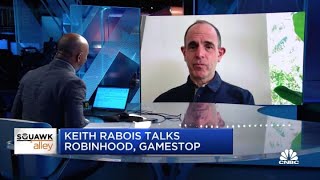
In a CNBC interview, investor Keith Rabois discusses Robinhood’s recent surge, attributing it to stimulus‑check‑driven retail speculation in stocks, crypto and NFTs, while noting the lack of public financial metrics. He compares Robinhood to Europe’s Trade Republic, explaining regulatory differences that prevent a direct U.S. rollout. Rabois emphasizes the growing power of Reddit communities, predicting their influence on investing will only amplify after the GameStop episode. He then shifts to e‑commerce, critiquing Amazon’s lack of serendipitous discovery and outlining a vision to create a unified online experience that stitches together countless micro‑merchants, providing them data, tools, and capital. Throughout, he expresses cautious optimism about Robinhood’s public‑market debut and the broader shift toward community‑driven finance and commerce.
Chapters
Private market investors, they have stuck by Robinhood over the last very turbulent months. How do you think that Wall Street will receive the company and what are public market investors looking for?
Well, it's hard to tell. Obviously, the metrics, the KPIs, the financials are not yet public. So it's impossible really to discern how well the company's doing, but I suspect it's been propelled by a lot of the stimulus checks. I think a lot of Americans are taking money that the government has sent them over the last year and parlaying it into how do I make more money, which is either a speculative investment in Bitcoin, a speculative investment in stocks or equities, and potentially a speculative investment in non-fungible tokens these days. So I think there's an unusual wave that's propelling Robinhood forward. Nevertheless, I hope Robinhood does extremely well in the public markets. I'm an investor in a company in Europe called Trade Republic which basically has a better bigger broader vision than Robin Hood but is basically providing the same value in the short term that Robin Hood provides to Americans. So I'm watching with eager interest. The public markets are very excited because in a trade republic will be a bigger broader better version.
If that competitor has a bigger broader version why aren't you bringing them over here to compete with Robin Hood at a time when its reputation has really fallen into tatters?
Well, Europe's obviously a wonderful market, an interesting market, but in Europe you can do things that you can fuse together financial services in a way that the regulatory regime here doesn't allow. Secondly, Germans, for example, which were trade republicans, don't have the notion of a 401k plan, doesn't exist. To be able to buy into equities is like in the first innings in Europe. So it's a much more exciting opportunity right now. So I don't think we need to rush anything.
Keith Julia Boorstin here. We can't talk to you about Reddit without also asking you about Robin. I'm sorry about Reddit. We can't ask you about Robin Hood without also asking you about Reddit. You of course used to be on the board of Reddit. You departed in 2019. But I'm so curious as you look at this wave of individual investing really taking off the role that Reddit has played there particularly in this whole GameStop saga. What do you think about that role of Reddit? Is it problematic? And do you think that those conversations are gonna be reined in or amplified in the future?
I think they're gonna be amplified. So yes, I served on the board of Reddit for five or six years, and I think the communities of Reddit have always been incredibly powerful across all verticals, from politics, now to finance, sports, entertainment. So I think we're seeing the manifestation of the power of subreddits in a different domain. And I think once that power is recognized, I think there's only one way this goes, which is normal people are gonna have more influence, more power. They're gonna fuse together in a community, and the rest of the world's gonna have to adjust to the power of that community.
Keith, I wanna go out on a limb and ask you about e-commerce. Are you trying to create the IAC of e-commerce right now? Open store, you're rolling up a bunch of little e-commerce names. And if you're still in stealth on that and you can't talk about it, then at least tell me what your view is on e-commerce right now, working under Amazon, Facebook, all these different ways of getting to the customer and what's missing in the space.
Well, I think the thing that's missing in e-commerce is serendipitous discovery. So, Amazon is a wonderful product, wonderful experience, incredibly delightful experience if you know what you want. However, a lot of merchandising has value and the reasons why retail is still the vast preponderance of transactions is people discover things that they didn't immediately know from a utilitarian standpoint that they needed. And that is something Amazon is not very good at at all. In fact, it's actually quite a poor ad. And that's one of the reasons why, for example, when I wanted to find new books to read, I actually go wander through traditional bookstores, even though I obviously know how to use Amazon. I've had Amazon accounts since 1998, but probably in the top 1% of their customers easily. But when I need to find new things, Amazon doesn't work for me. I need to hunt through a bookstore. And I think that's true in all verticals, whether it's apparel, books, health and beauty. And so I think what we're hoping to do and aspiring to do is to be able to bring that experience online through not necessarily an IAC sort of roll off, I think we're thinking of a unified experience, a unified consumer experience by stitching together a lot of very, very small micro merchants that are long tail merchants today and giving them the tools and access to information and data that they don't really have, access to capital that they don't really have at the very small end of the market.
Shepard Smith here. Thanks for watching CNBC on YouTube.