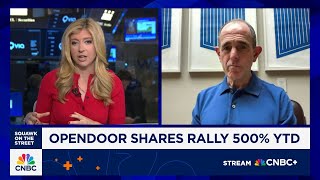
In a September 2025 interview, Opendoor co‑founder and newly appointed chairman Keith Rabois discusses the company’s dramatic stock rally, recent C‑suite reshuffle, and the strategic roadmap for turning Opendoor into a sustainable, profitable business. Rabois emphasizes the massive $289 trillion residential real‑estate market and argues that Opendoor has a unique, untapped opportunity to transform buying and selling through certainty, speed, and convenience—potentially surpassing the valuation of Carvana. He refutes claims that the iBuying model failed, attributing past struggles to competitors’ poor execution rather than a flawed concept, and points to Opendoor’s historical free‑cash‑flow generation. The core of the turnaround centers on slashing bloated G&A, reducing a 1,400‑person workforce to a lean core of ~200, and leveraging AI and technology to improve efficiency. Rabois praises the incoming CEO Kaz (formerly of Shopify) for his ability to drive cost discipline, aiming to bring Opendoor’s G&A expense ratio down from double‑digit percentages to low single digits. He stresses that a resilient cost structure will allow profitability regardless of housing‑cycle fluctuations, and calls for a cultural reset back to merit, excellence, and in‑person collaboration. The interview also touches on activist investor Eric Jackson’s role, the company’s market‑share achievements, and the broader vision of home ownership as a societal good.
Chapters
Welcome back. Online real estate company Opendoor adding to its incredible year to date rally this week, jumping nearly 80% just yesterday after announcing a C suite shuffle including a new CEO and a new chairman. Shares are up more than 500% this year. Joining us now is the company's co founder and new chairman, Heathrow Boy. He's also a managing director at Khoslov Ventures. Keith, this is such an interesting story. Obviously this is the meme stock du jour. What's. How, how did you, how did you get here? How did you come back? Co founded the company, went public, started serve during the SPAC phase, was, was kind of left for dead and now it's all that everyone's talking about. How did you come back to it?
I think it's very simple. Retail investors figured out the potential of the company. Experts, Wall street experts, etc. Missed the potential. Real residential real estate in the world is about a $289 trillion asset. And nobody has transformed the buying and selling of real estate in the world. And Opendoor has the most likely shot on goal of fixing the transaction both on the buy side and the sell side. So the potential of the company is infinite. And it took people like Eric Jackson, the activist investor and normal American consumers to see that one way or the other we're going to transform the way people buy and sell houses and then that company should be worth a lot of money. Many people compare us to Carvana. I think the I used to compare us publicly, you know, on Twitter and X to Carvana. I think the multiple of Opendoor should be comparable to Carvana. I think we have less competition and more upside. So I think hopefully we do better than Carvana. But that comparison easily gets you to where you are today.
I get the comparison given where the stock was trading and how it's now beloved and has really turned around. But Keith, wasn't this always the promise of open door that was going to transform the real estate market? And then I buying really became out of vogue. Redfin exited it, Zillow exit and that's. And that was the business model here.
It was, it was never out of vogue. It was out of vogue because Redfin and Zillow didn't know how to do it. We were always successful. We minted free cash flow every year as involved in the company. However, it's very complicated and very difficult to do I buying well. But the value proposition of certainty, transactional speed is incredibly compelling to Americans. If you list your home for sale, you are going to wait 80 to 100 days and 20% of the transactions that you think you've closed are never going to close. We give you certainty, peace of mind, convenience, that value proposition. We just need more awareness. In many markets we have a double digit market share. Actually, it took Tesla until 2023 to get to a 5% market share in the United States. In many, many US markets, we were above 5%. Last time I was involved in the.
Company, yeah, but wasn't always the thing that the. Once the housing market turned, then the company was stuck with a lot of mispriced inventory. It didn't work so well when the housing market was weak.
That's actually false. So the Federal Reserve raised interest rates six times in an unprecedented, with unprecedented speed. And that did create a cohort, that is one cohort, one month, two, maybe a quarter of mispriced homes. However, every cohort thereafter was actually priced correctly. The problem with the company was bloated gna. So real estate does have a roller coaster rides to it. There are phases, cycles, and they happen every five to 10 years. And you need a resilient cost structure that doesn't depend upon selling 6 million homes a year because it can come down to 4 million. That's basically the zone over the last 30 years. And so the bloated GNA was a real problem because as people stopped transacting, as interest rates went, you know, through the roof, the company's GNA made no sense. And so the burn rate made no sense. But you can fix that. There's 1400 employees at Opendoor. I don't know what most of them do. We don't need more than 200 of them. It's got easier because of the advent of AI and other technologies. This will be a simple problem. One of the reasons why we are so excited to recruit Kaz actually as CEO is when he took over as CEO of Shopify. I believe Gina's expensive revenue at Shopify was 14% last year or this year. I think it'll be 4% and I'm pretty sure they'll be below that next year. So we need to do the same. We need to have the same discipline and rigor in Opendoor. And then when real estate bubbles her, when they go up, we'll make an incredible amount of money. And when people stop transacting, meaning they only sell 3 or 4 million a year, we won't care because we're still going to be profitable.
It's interesting you hinted at cost cuts and the fact that there's, that there are a lot of employees and that there's probably a lot of room for cuts because that's been the other knock on this is that it was hard to make this a profitable business. The margins are very thin and for this year, I mean, I think we talked to an analyst who is expecting a loss, continued losses.
Well, I haven't yet dug into the financials. CAS hasn't started until Monday morning. So when we dive into the financials, I suspect we'll have visibility and you know, we're going to innovate. We're definitely going to not take the forecast as a given. So I won't opine about the future, financial future, etc. I know the strategy. I have a high level view of the strategy of things that can be improved. But there's no way you need 1400 employees. So he's right. The company is completely bloated. The culture was broken. These people were working remotely. That doesn't work. This company was founded on the principle of innovation and working together in person. We're going to restore to our roots. We have a mission. You should read Kaz's post. It's a brilliant mission about how home ownership drives society and that society is only good when people have home ownership. We need to fix that and of that, make it more affordable. And you know, the company kind of went down this DI path. It still, you know, was promoting certain things on its website when I got reinvolved. We're going to fix all that. We're going back to back to merit and excellence.