[PREMONEY 2014] The Final Frontier: Keith Rabois & Dave McClure On The Future Of VC
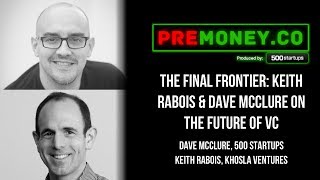
Keith Rabois talks about his time at PayPal, LinkedIn, Slide, and Square, then his angel investments in YouTube and Airbnb. He explains why he moved to venture capital at Khosla Ventures and where he'd put a million dollars: all in Y Combinator.
Chapters
Keith, it's Friday at 5:30, it's the last talk of the day. I've got a beer in hand, I filed general solicitation yesterday. We used to work together at PayPal. I'm not pulling any fucking punches, buddy.
I got the VIP slot, right?
We're going at it. I'll try and cover the bio here. Keith, I met at PayPal in 2001, 13 years ago. Wow, 13 years ago.
You looked exactly the same.
No, we both have a lot less hair. We worked a little bit when you were at LinkedIn, and I was at Simply Hired. You were with Max at Slide. You were with several different folks at Square and had the number two position at Square. You've been an angel investor in a bunch of companies. We're gonna talk about only YouTube, Yelp, Airbnb, sorry, Uber, No, lift. Lift, sorry. Okay, right, right. And now you are at Khosla Ventures. I'm sorry, there's probably stuff before PayPal that I'm not familiar with, but...
I was a lawyer. I was actually a litigator. Oh my God, all useful things.
Jesus. All right, we can forget about that. So we're going to talk a little bit about your time as an operator, your time as an angel investor, and now your work as a VC. That's our three act play. and let's start out with some pretty impressive companies on the operator side. PayPal, LinkedIn, Slide first and then Square, right?
Yeah.
Okay. How about PayPal? What was in the water at PayPal? I think a lot of folks always ask us like why the fuck so many crazy amazing folks came out of PayPal? What the hell was going on there?
Well, so I think there's a couple different drivers of that. I mean, a lot of it's somewhat the result of Peter and Max's sort of inspired hiring. So Max hired all of his friends from the University of Illinois or dropouts thereof, and Peter hired all of his friends from Stanford. And they both had a fairly good eye for people who were kind of hungry, fairly intelligent and ambitious, and kind of put them all together and let them fight. And out of the chaotic fights emerged like something decent. But then when the company went public and then sold six months later, everybody was basically about 30 years old. So the median age of the executive officers on the S1 was 30. And so people still had a lot to do.
And Roelof was the youngest CFO at a public company at 29?
20, maybe 28. 28, something like that. But yeah, so fundamentally I think it was a function of age, selling the company to a company that had a very different culture. encouraged most of us to leave very quickly. So Peter resigned the day the deal closed. David lasted two weeks. I was three weeks. Roloff was four. Actually, Reed resigned also the same day, I think the deal closed. And Max made it somehow for like three or four months.
I think they were trying to keep Max around in case anything blew up.
Yeah, well he had the biggest group. He had a lot of engineers running around. And so he wanted to stay around to protect them.
Right. I stayed around for two years because my stock was still vesting. I think there were amazing people at eBay, but definitely there was a weird sort of, after PayPal was acquired, people still identified themselves as PayPal employees, not eBay employees. Yeah, so I could tell that ironically.
I was in charge of the eBay PayPal integration. So after you get acquired, there's an integration process, and especially if you get acquired into a large company like Google or eBay, there's a very formal process. And so I was put in charge of like matchmaking and setting up meetings and et cetera. So we scheduled the first meeting, which was the product integration, which made a lot of sense. There's a lot of synergies between the.
PayPal product and eBay. PayPal and eBay was one of the.
Most successful acquisition product integrations ever. Oh, it must have been. It made so much sense to users.
Made sense for the company, and increased.
Liquidity to the marketplace. Yeah, so, but anyway, we set up this meeting, and I get a calendar request for a three-hour meeting. And my eyes just popped, because in.
The history of PayPal, I don't think.
There ever was a three-hour meeting.
David made people stand up during meetings, right?
Yeah, exactly. David discouraged meetings completely. But fundamentally, a three-hour meeting was sort of anomalous at being charitable. And then we show up for the meeting, and eBay presents a 114, I think, slide PowerPoint deck, which also we had never seen a PowerPoint except for board decks. And David immediately starts glancing through it really fast and turning pages to get to the meat, and everybody from eBay is staring at him as if they've never seen anybody do this before. Because at eBay's culture, A, everything was governed by a PowerPoint, and then B, it was considered culturally unacceptable to look for, you had to wait for people to present each single slide. And so at that meeting, I remember thinking halfway through the meeting, this is never gonna work, I'm leaving. David walked out of the meeting and grabbed me and said, I think you need to create a PowerPoint team. Start hiring. Totally true story. So he said, Go out and get some McKinsey consultants because the only way we're going to be able to communicate with those people is to produce PowerPoints. So I actually started hiring a PowerPoint team. But fortunately, I left before we had to do that.
So what is striking to me is that, you know, PayPal, you know, I'll talk a little bit about the angel investing and I want to hear your perspective on this. So Reed and Peter were friends. whose politics couldn't be further left and right, like, you know, both ostensibly libertarians, but Peter very conservative, Reed very liberal. And there was a lot of contention at PayPal that was along those lines. And somehow shit got done, people worked together, and then the eBay culture and PayPal culture were somehow not so compatible. So like you'd have, like I used to work with Eric, who's extremely conservative. I went to his wedding and again, politics couldn't be as further apart. Eric wrote a book called Thank youk, President Bush with Aman Virgi, another one of my friends. I hid it on my bookshelf backwards so no one would know that I actually had the book. So what was that all about? Where you'd have really radically different political views and perspectives that somehow worked together at PayPal, but then PayPal and eBay didn't match up.
I think there was a cultural alignment and culture is a way of implied rules. the way you make decisions and at PayPal was very much consistent. People had different perspectives on the way to make decisions in the world globally at a macro level and a micro level, like which product features to do, how to do them, etc. But there was a very specific agreement on the way things were decided. So for example, we didn't have a lot of meetings. David was quite opposed to lots of meetings with lots of people. We did a lot by email. It was a very confrontational culture. Sometimes David described it afterwards as an Israeli culture. So everybody would debate very vigorously and that's how things were decided. And so you had to have the capability of arguing quite passionately with a lot of-- it was a very empirical culture as well. And so, you know, Reed and Peter are both very capable of arguing, very capable of marshaling and assembling evidence. And so that worked really well. But then eBay was a very establishment culture and it was very soft and gentile and one didn't really attack someone else's ideas or arguments. One kind of went around them and sort of crafted a different different PowerPoint. That was the official, you know, record of the meeting. And it was a debate about which PowerPoint was the governing PowerPoint.
Do you think that Meg and Pierre would agree with this assessment or?
Pretty close to most of it.
Okay.
I mean, maybe it's just the language a little bit, but fundamentally, yeah, eBay was a very polite culture.
The thing that I thought I heard was the best assessment of this, Dave Sachs, who were both worked for and talked to a lot, was talking about eBay being a product that was based on the network effects of the eBay sellers and buyers and marketplace. And basically nobody wanted to fuck it up. And so there was like this entire culture that was built around not screwing up anything, not making product changes, because the engine was working so goddamn well, at least until 2004 or '05, '06. Whereas PayPal was this culture that was just like, holy shit, everybody's out to kill us. all day long. Russians, Russian mobsters, sorry, card associations, eBay itself, financial associations, attorneys in general. And so we were just like, holy shit, we got to keep iterating all the fucking time.
I think that explains a lot. We were kind of a wartime culture, if you like, you know, sort of the famous Ben Horowitz blog post about it. We were always in war with multiple people. And the biggest, actually, literally had this conversation with Peter because it was a lot of my job, was never to allow two of the people we were fighting to gang up on us. So a lot of the art of what I did and what Reed did to some extent was making sure that none of our two enemies ever talked to each other in a way that would align against us, because then we'd actually be fairly vulnerable. So we were a wartime culture. eBay was a peacetime culture. They'd created this great monopoly. And just like Craigslist lasted for a very long time with no innovation and.
No real management, you could do that.
But eventually it showed-- Until Google and AdWords came along. yeah, until things come orthogonally. Like you literally need an orthogonal attack on a strong network effect. And so you can last a decade. We used to joke at PayPal that how long would it take the external world to find out if Martians replaced all the employees at eBay, how long would it take the external world to find out? And the over-under was about five years.
Well, I believe Meg herself was quoted as saying any monkey can drive this.
Well, this is the funniest thing ever. So we used to joke about this at PayPal before we were acquired. And then we found out the eBay people made the same jokes. And they actually made it into a Fortune article. It was on eBay and they actually talked about how people used to walk the hallways. and talk about Martians taking over. And it was like insane. This was our eternal critique.
I'm sure we were totally offending Jeff Jordan and a bunch of other people.
Jeff was great. It's not all the other people that he worked with.
All right. Okay, enough of patting ourselves in the back about PayPal. So you moved on to LinkedIn from, you know, yeah, really tough space to another tough place. You were among the first 20 or.
30 Folks at LinkedIn?
27.
And I also angel invested when Reid started in 2003.
Nice job.
You forgot that on the list.
Okay, there you go. So what was it like working for Reid? I mean, working for Dave Sax and working for Reid also pretty fucking different.
Yes. Reid is a very positive, enthusiastic, energizing type and his public persona is very consistent with how he manages. And David's a very critical, more of the sort of Steve Jobs version of management.
Red Men of David Sex, for anybody who's ever worked for him, is a.
Frightening-- well, he has a very good editorial judgment. Users can have any color they like as long as it's black. He would edit specs very, very, very carefully. And, you know, he just had very strong views about things. And so it was a very, very, very different dynamic, which also made it difficult for those two to work together.
Right, yeah, I don't think many people know about that. So LinkedIn, different culture from PayPal or similar?
Pretty different. You know, Reid again, because of some of the things he didn't like about the PayPal culture, crafted LinkedIn, you know, in his own persona and prioritized the things he thought were more important as a kind of reaction. I think everybody always does this. You have some experience and you take the things with you that you like and then you edit the things you didn't like. And so I think LinkedIn was a more gentle culture, it was a more collaborative culture by intent. It was fairly empirical, so he preserved that part. Things were driven by metrics and there's a lot of thought about user behavior and studying it very carefully. He assembled a lot of former PayPal colleagues as well. So he took some parts of it and then edited some. And I'd say the same thing is true of David at Yammer. He didn't just replicate the PayPal culture. He took some parts of the Pay-Pal culture with him at Yammer and then.
Edited and made some other changes. And do you think that LinkedIn, I guess this is an interesting question because I always felt like LinkedIn actually moved a little slow, but they also sort of had a monopoly.
I don't know why, but-- I agree with that. I think that the company did create a monopoly, and it still is a monopoly.
Or not very many people chose to compete with them.
It wasn't-- yeah, I think in 2000, well, in 2003, just a wind about the clock. It was incredibly difficult to start a consumer internet company. Everybody thought the bubble had just collapsed. A lot of people thought there wasn't going to be another wave of innovation. And very few people, like I'd say Peter, Reed, and to some extent, Sequoia Capital, were willing to fund new consumer ideas. So in 2003, nobody else was really doing anything like what LinkedIn wanted to do. And Reed fortunately had enough money to fund it himself, actually. He set aside, I think it was about $500,000 and said, you know, we need to prove that there's product market fit. But not a lot of people could just do that. And not a lot of people wanted to even try. It was a very depressing place to be in 2003. And then the good news about starting a company, and I think this is globally true in a sort of depression or a local recession, is that if you're right, you have years of runway because there's nobody else competing with you. Whereas you start a company in a hot space, in a hot time, there's a lot of other people you have to worry about. And so that's why I think you see the evidence that companies started in these depressions and recessions do really well. It's that People remember the successful ones, but they have no competitors for years.
And I don't think there was really much attempted competition with LinkedIn until maybe 2007.
Yeah, there was a European one, Zing kind of Europe-China sort of play, but nothing in the United States had any traction, any real backing. And then the other thing is the company was pretty slow. I mean, I joked on Twitter about a month ago that they finally shipped one of my favorite features from 2005, and I actually wasn't I wasn't exaggerating. It was actually one of my favorite features from 2005. So I'm hoping that the 2006 features.
Get out next year. I remember sending a lot of emails to Reid and the product team about how much groups sucked and why there.
Was no, there was no pictures on LinkedIn for a long time. So I'll take some of the blame for that.
So because social network, you know, like.
Friendster was very popular at the time. You were trying not to be a meat market. We didn't want to be perceived as a MeToo version of Friendster because Friendster was growing really fast. and we were growing very slowly. So for example, my first day at work was January 2nd, 2005. I was 27th deployed. We only had 1.6 million users a year and a half after launching, which for social network is like very, very, very low. In fact, as an angel investor, every day I used to read like every single user, review every single user profile that joined, like literally every single user profile. And I would send emails to the team about the quality of users that we were getting. so that's how slowly we were growing. So being compared to PayPal, so after.
Being at PayPal where you're like adding hundreds of thousands, if not millions of users a day, you go to someplace else.
We had some very high value users. But in any event, it was growing very slowly. So I thought the worst thing you could do is be compared to this social thing that's a phenom and that photos were the way that people would perceive you. If you put photos up, you would be by definition sort of perceived as a social product. Over the years, we had a lot of debates about this, even up to the board level. And eventually, you know, LinkedIn proved me wrong. But I think I'm not sure I'm totally wrong in the sense of ethos of the internet, ethos of products, people's comfortableness, you know, comfort in putting a photo on a professional identity, actually may have changed sometime between 2003 and 2007 when they sort of added photos. So it may have been the right thing to do at the time, but.
Everybody laughs at me now because it seems like stupid. We're spending a lot of time on the operator and it's fascinating. I want to move on to some of the angel investing stuff. Really briefly, Slide and Square. So Slide was a good story for a while, ended up being a little bit tougher story. Square, maybe we're still figuring that out.
Now Square is a successful story. I mean, Square is going to be somewhere between $6 and $50 billion company. There's no doubt about that in my mind.
And so, yeah, you have $6 and $50 billion.
Yeah, I mean, there's a lot of stuff to do, but it's definitely a very, very, very valuable thing. worth more. I mean, PayPal's worth roughly $70 billion, and Square should be more successful than PayPal for a variety of reasons. Okay. Slide was a classic rocket ship that came back down to earth. Yes.
Although somehow Max and you and other folks seem to find a somewhat modest landing for that. 160 million?
Well, it was basically 220 something, but 187 without employee retention stuff.
Can you raise too much capital? Sure, absolutely.
I mean, I spend half of my time with entrepreneurs, not half my time. Half of my meetings with entrepreneurs where I want to make an investment offer, I counsel the entrepreneur to raise less money than they started, which is fairly counterintuitive. I mean, before I started, I bought into the caricature of big VCs that all the big VCs are trying to throw too much money at entrepreneurs. And in fact, literally half of the entrepreneurs that I extend a term sheet to, I have spent a fair amount of time persuading them to accept less money.
So that was the discussion with Sam this morning.
I don't know if you caught that.
I saw some tweets about it, but I didn't see the actual discussion. We were talking about YC obviously having billion-dollar wins and unicorn outcomes, and Sam suggesting that you shouldn't take $30 million, but $10 million is okay. And I was like, well, high fucking class problem. But let's just say that you have as an entrepreneur the option to maybe do a $1 to $2 million seed stage, sorry, convertible note or seed stage structure versus maybe a 5 million or larger priced round. Should you always take the 5 million?
No.
It depends on the way we think.
About it anyway is depends on what you can prove with what. And so if you're going to build a spaceship, if you're going to build like SpaceX, it doesn't make any sense to raise a $1 million convertible note. You're not going to prove anything. you might as well raise $50 million if you have the opportunity to do it because it just takes that much money for that kind of company. Again, there's a classic like Ben Horowitz blog post on the fat startup, which is really worth reading. It's probably the single best thing written on the topic. But we always ask, what can you prove? What are the key milestones that people will perceive that there's been an inflection moment for the company? And then you calibrate your sort of finance strategy against when those are likely to happen. not against time. Actually, I think the worst thing, the worst piece of advice people give is like, oh, you should have 18 months runway or 24 months. And that's the way to figure out your capital needs. It's against what are the milestones that are going to be perceived to create value. And so if you need $1,000,000 to create a lot of value, then you should raise $1,000,000 and create a lot of value. If you need $10,000,000 to have a shot, like so for example, I'm starting a company on the side and we're buying people's homes. It's a fairly expensive transaction. There's just no way to do that for $2 million. Like you literally want, you'd be better off not trying if you tried to do it with $2 million because you can't statistically validate your models with $2 million. It's like you do $250,000 as the average home, do some math, like it's just worthless. So you need, you know, a fair amount of money for certain startups and.
Then there's things that are somewhere in between. Um, I know you're a big fan of Quora and, are you an investor as well? I am an investor. and you're on there a lot. You answer and ask lots of questions. What's been your best investment that you're aware of? You've had pretty amazing ones to choose from. LinkedIn, YouTube, Yelp, Airbnb, those are just like four that I will name right there. But do you have a sense of what's your best ROI, what you think your best ROI investment will be?
It's hard to tell right now. I mean, I think Airbnb most likely will be, but because I think they should be as big as potentially Priceline. And for those of you who don't know Priceline's market cap, look it up, it'll scare you. It's like 60 or 70. It's like 60 or 70 billion dollars, which is-- and they've bought TripAdvisor. They bought bookings. They recently bought OpenTable.
They announced the acquisition anyway. So Airbnb is roughly north of 10.
Or around 10 right now.
Yeah, they've raised financing, if you believe, like, what you read in the media. I think you have some interesting anecdotes about the Airbnb financing. Could you tell us when you got in? This is also like crushingly painful for me because I saw the guys in 2007, I'm trying to remember when or eight. No, it was during the election, so fall of 2008 and they were carrying around the cereal boxes and I was like, ha ha ha, that's fucking funny, see ya. What a dumb decision on my part. so, like, just briefly, I just want to explain that. So Airbnb bed and breakfast. And they were worried that the people who were offering the whole, the houses wouldn't know how to make breakfast. And so they were pushing the cereal boxes to all the folks to rent so that they would have some breakfast.
Actually, they were also, most investors didn't appreciate them. So they were running out. They had, like, no money. They're making no money. They're selling the cereal boxes at a premium to finance, to finance themselves and allow themselves to make rent and eat, actually. So it's actually a good sign for an entrepreneur. I mean, that's good.
They hustle. Brian was a pretty amazing motherfucker. When did you invest in the company? How much?
Whenever they raised the demo day, YC round or? Well, they didn't do demo day. They actually didn't provide reasons they withdrew from demo day. Okay. But early 2009.
Okay. Probably March, February, 10 million dollar valuation, sub 5 million.
Oh, God, sub five, yeah.
Okay. And obviously they had some success there. And then what was the story around the Series B round?
Well, it's interesting because so invested a decent amount with my friends Kevin Hartz and Javid Karim together as part with Sequoia.
Javid was one of the founders of YouTube. Kevin was an investor in PayPal and founder of CEO of Eventbrite.
And so we invested and They were thinking about raising a B and we were getting the data. It was very obvious that there were starting to be network effects actually kicking in. You could see it in New York particularly. And so we sort of offered to lead the B round, even though we're three individuals and leading a B round for three individuals, it's a pretty impressive individual.
No, no, no.
Leading in terms of your fraction of your net worth that you're actually leading. Think about the big series. Leading a $10 to $20 million B round for anybody is fairly expensive. But we really believed in the company and the company founders thought it might be good in terms of getting it, instead of introducing new risk and introducing a new voice because things were clearly working, then it might be good. But then as the company's metrics just continued to increase and we didn't close, the price kept going up and up and up. And Reed and Greylock decided to invest actually below their normal ownership targets. And so that made sense for the company.
Great fucking decision on their part.
It was a very good decision. And it was a very good decision for the company. I think it was actually the right decision for the company, even though I would have liked to have invested X million, in retrospect, obviously invested X million dollars more at somewhere between a 40 and 80 million dollar valuation.
Life's so rough. Okay, I'm going to skip over the YouTube and Yelp stories, but obviously those are both ex-PayPal. Those are good stories also. Well, I'll tell you one really dumb story. So, when I was at Simply Hired, we did a deal with you at LinkedIn.
I made the mistake of giving you my cell phone number while negotiating a deal.
Is Steve Chen in the audience? Okay, so Matt Kohler had moved from LinkedIn to Facebook, called me up one time and was like, Hey, do you know any great engineers at PayPal you should hire? I was like, yeah, Steve Chen, he'd be awesome. Steve worked at Facebook for not quite three months. I know this because I didn't get.
The referral bonus because he didn't stay three months. If it was stock, that would be really painful.
Kohler calls me up, he's like, Hey, what the fuck? You know, I'm not gonna be able to pay you the referral bonus. And I was like, what? And he's like, yeah, he's doing this other startup.
And I was like, why are you leaving Facebook? But it turned out to be a good decision. So this is a good story that it's like, this is like a network. So the reason why I wound up investing in YouTube was like our former colleague at PayPal, this guy named Mike Greenfield was having a barbecue at his house on like July 4th weekend, 2000, whatever, five. and Javed walked in. I said, like, an old colleague from PayPal that I hadn't seen in, I don't know, a year or two. I said, just like you'd greet anybody else at a normal reaction. I was like, hey, what are you up to? And he said, well, I just launched this website. And I was like, cool, what is it? And he's like, it's called YouTube. And I'm like, what does it do?
And he said, well, it's like video sharing.
And, sorry, flicker for video. Well, he didn't quite, he just said it's like video sharing. And I said, well, I have three questions. And the first one was, is it in Flash? Second one is, is it amateur professional content? And the third one was a little bit about some viral tactic. And he answered them. He's like, oh, it's definitely in Flash. It's fully encoded Flash. And I'd been looking for something in Flash since 2003. When Max Levchin told me the future is Flash. Like, you got to find something in Flash. And I finally found it, like, X years later. And then he said, amateur content is really cool. I said, like, literally as he finished the three answers, I was like, I want to invest. Can I invest? Well, do you want to even see the website? I'm like, yeah, that'd be a good idea. So we borrowed, so he goes up to Mike and says, do you have a computer here? Because back then, we didn't have cell phones and iPads and stuff. So we went into Mike's bedroom and he literally demoed for me every single video on the website, which is how.
There were about 40. When was this?
About July 4th, 2005.
Right, because I, Joe sent me an email in April of 2005. I was like, oh, Cool. Flicker for video. Good luck with that. Then I saw it and I was.
Like, this is the difference between dumb.
Investor and smart investor.
Well, I had been looking for something in Flash literally since January 2003, when Peter Thiel dispatched me down to go back down to PayPal to visit Max and figure out what the future was. This is a classic thing that Peter would do. It's like, go find out the future, talk to Max. So I went down, had coffee with.
Max and we talked about-- it was.
A very Game of Thrones-esque. Yeah, and so I remember this flash and finally found an application of it. And then the other thing was my parents anniversary, which just almost got me in trouble yesterday, was 625. So I'd just flown back from New Jersey to my parents. And when I landed, my dad actually had this crazy thing, device, and he was showing me videos. And so as Javid started saying, like, it's all these amateur videos, I was like, my dad is like the CPA type, is like capturing videos. Like, this actually might be something real people do.
And so, like, it just clicked in my brain. And I think also probably a lot of the cut and paste distribution for YouTube on Myspace was like extremely similar to the-- X-Cliq, we used to call it.
The PayPal-- We literally in my email to RollOff, so when we decided to raise more, we raised money, I sent a note to RollOff, and the email reads the following subject, YouTube. And then it says subject, the entire email is check out youtube.com and he writes back, oh, pretty cool. Why is it interesting? And I wrote back, it's X-Cliq for video, which was the PayPal internal terminology.
For the button that you could embed in your eBay. So it's a cut and paste component.
For PayPal, which enabled shopping.
So as soon as I wrote that back, he's like, oh yeah, I want to meet them. Amazing. All right, so obviously you've had some amazing wins on the angel investment side.
You joined Khosla as a VC a year and a half ago?
Yeah, about March of last year. Okay. And obviously you had the chops to jump in and do that, but What's different or same about being a VC? And let's be real, a big, hard-edged VC, Khosla, not shy about leaning in and sharp elbows. Oh, come on, we're so entrepreneurial friendly.
Vinod's all with everybody. Vinod's a pussycat.
Well, so I've worked, yeah, yeah.
So I've worked, if you look at my professional career, I've worked for Peter Thiel, Reid Hoffman, Max Levchin, Jack Dorsey, and Vinod.
Jesus. Common denominators.
Reid is the pussycat in that group. So I think the biggest changes or differences, obviously it's a super competitive market. When you're an angel, it depends on where you are in the angel kind of food chain, but it's not zero sum competitive. Where being a VC leading around absolutely is, because everybody has ownership targets and it's just difficult. There's usually one choice per round, not always, but usually. And so it is a zero sum game. And I obviously have a lot of friends in the business. A lot of people just named are actually Yeah, GP's at very, roll off.
At Sequoia, roll off at Peter, competing.
With all of your former colleagues. Yeah, like Benchmarks as well. So there's a whole list of them. So that's one big difference. Second thing is of course time. So the horizon is just incredibly long. When we make an investment and we're the lead investor and I join the board, it is a three to 10 year commitment. And when you're an angel investor, there may be spiky times and I was a pretty active angel investor. Yeah, I worked fairly closely with most of the companies I was involved in compared to a standard angel investor. But the time horizon that you're thinking about is not 10 years. You may be thinking about one year, so they raise a series A or product market fit and then, or they have an acute problem or they need my advice and counsel on a specific thing I have expertise. But you don't start saying, I'm committing to this company for 10 years. And so how do you value your time? How do you think about your time? It's just a totally different, zone. And very few people, humans, just don't value their time or think about their time very well. It's not naturally easy for us.
So given that you have these longer time horizons, you have much bigger budgets and checks to work with now, one of the things that's been happening is late-stage financing sort of pushing out or displacing public market financing. And Mark Suster and Scott Cooper talked about that this morning. And that's happening a hell of a lot. Like all of a sudden, probably we're adding two to three more years on the company's lives before they go public. And late-stage capital coming in at 50, 100 million, $200 million from Russia, from China, from like here in the Valley. Is late-stage $100 million financing a good thing?
Well, it depends. I mean, it's great. So we would distinguish. what we do is what we call venture capital.
So real risk. What's the biggest check you guys would write for a typical.
So the median portfolio company follow on? Well, that depends on the company, but the median check, even though we had like, you know, KB4 is a billion dollar fund, I think the median check, the median investment is probably about $15 million.
First check. Yeah. And then follow on, if you do follow on something like that, 30, 50.
Depends. I mean, totally depends on the company and depends on over multiple rounds or one round. like, the way we look at it, each one is on, we look at each one on an ad hoc basis. So this company in, under these terms, you know, how much, would you guys.
Ever write a hundred billion dollar check?
Have you? No, we haven't. Well, that's not true. Not in the consumer it space in alternative energy, which is very Capital intensive, different. The rules are different and the capital needs are different. So we probably have, but I would be shocked if, you know, we would do that, like in sort of a sector that I'd be involved in.
And so the folks that are coming in at $100 million are coming in after you guys.
Yes. So we basically do seed series A and B very, very, very rarely would even touch a series C. Okay, got it.
And just one question on that topic. We're gonna wrap up here pretty quick. Would you sell into those rounds? Would you ever take money off the table in those later stage financings?
You never want to say never, never, never, but I mean, you guys would.
Consider liquidating in a public market round, and these are replacing the public market round.
Well, that's a good question. And what does that mean? Because generally, we actually often hold our public market position for a while.
For a while.
But if that were to become the norm where everything were extended by two or four years, it is interesting when you have a 10-year fund, what does that mean? But we'd be the least likely seller, almost surely. We, like for example, we just hate when companies sell. So I just can't envision a scenario where we would do that absent some extraordinary circumstances, like where the company needed us to for some reason or there was some disconnect between us and the company. I mean, it would be like a very anomalous situation. Got it.
We're between the audience and beer or going to dinner. One amazing question from the audience, you must be amazing. or I will shut you down. No pressure.
That's the David Sachs management style right there.
All right. I think I've scared the hell out of the audience. One. All right. Must be awesome. That's Anand from CB Insights, I believe.
Yes.
What's your perspective on corporate venture? Are they evil, dumb, or just evil and dumb? Sorry, thank you for all of our sponsors.
It depends on the company in the market they're in. I mean, we work with corporate venture in many, many companies. It depends on the stage, too. Stage company market and also the identity. I wouldn't necessarily recommend corporate venture for like a series A, a seed series A and even most series Bs, but there are exceptions to that.
As long as they come after you, they're fine, wonderful people.
If they want to mark up the.
Value, they're really smart.
10X. No, it depends. It totally depends upon what you're doing. For like a consumer technology, consumer application, probably not the best choice, nine times out of 10. For some hardcore technology, absolutely. Like you can be a supplier. There's a whole bunch of business relationships in financial services and payments where I've spent a lot of time. Absolutely. There can be some strategic investments like we took at Square, Visa, JP Morgan Chase as a Series B. strategic investor and Visa as an extension of the Series B investment. So there's definitely times where that can be incredibly logical.
Last question, Keith, you've got a million dollars to invest. You can put it in YC's next fund. You can put it in AngelList main lane, or you can split it between the two. What's your dollar allocation?
I put it all in YC.
Okay. Very good.
You didn't give me a lot of choices there.
Oh, was there another choice? You could put 500 startups.
Yeah, you didn't ask me. The number, you've asked politicians.
We should talk afterwards. Did I tell you I mentioned I was fundraising?
Yeah, but you said you're doing a general solicitation.
Indeed. Keith, thank you for spending some time with us on a Friday late. Good luck to you as a VC.
Thank you. Awesome.
More from Keith

This Billionaire Trains His Body Like He's Building A Billion-Dollar Startup | Keith Rabois


Vinod Khosla and Keith Rabois on Building and Investing in Enduring Companies | Ep. 40



