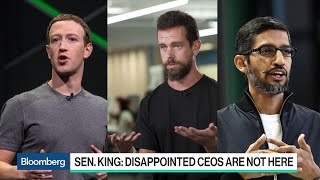
Keith Rabois and others analyze the 2017 Senate tech hearings, where Zuckerberg and Dorsey didn't show up. They discuss Russian interference on Facebook and Twitter, the platforms' conflicting approaches to real names versus anonymity, and why political ads represent only a tiny slice of total ad spending.
Chapters
Do you think it's a big deal that Mark Zuckerberg at Al didn't show up?
Well, I don't think the Senate really wanted them to show up. So I used to work in the Senate, and if they wanted the CEOs there, they would have scheduled it when he wasn't in China. This was a done deal between the Senate staff and the CEOs. If they really Angus King is just speaking for himself, like they violated he probably violated an agreement they had. This happens all the time with public company CEOs where they find a convenient.
Date to schedule the hearings. So this is totally fraudulent. The bottom line is though that this isn't done. They could still be asking for these folks to be coming to Capitol Hill.
Yeah.
I mean I think you know I guess Google's defense is that Kent Walker is runs their policy team probably a little bit more. Speak to it issues more clearly than soon. I might be able to certainly more than Larry. I'm much more involved in the day to day and setting a lot of.
These legal and security issues that they talked about. And Jack Dorsey he was just at a square event in New York City. I just saw him the other day. He's definitely not going to be in D.C. And it is telling that he is running two companies, he only has so much time. And this is obviously not something he was dealing with on the day.
Now, you know, another point that Senator Warner made an effort to point out is that these investigations aren't over. Take a listen to something else from Senator Warner today.
Do you believe that any of your companies have identified the full scope of Russian active measures on your platform? Yes or no? Senator, our investigation continues. So I would have to say no, certainly not with certainty. Mr. Regent? No, and we're still working on this. Mr. Walker? We have done a comprehensive investigation, but as Mr. Stretch says, these are ongoing issues and we continue to investigate.
So, Keith, we still don't know the full extent of this. And do you maintain that it's not important?
Well, I think everybody's just being totally hypocritical. And they're showboating. That's one of the reasons why the CEOs were advised, and they're all advised not to attend. is it just would have brought more attention. Like most people are not gonna watch hearings with general councils testifying. Like imagine like my parents watching general councils, let me board and turn on football. But if the CEOs show up, it's more spectacular event. It's like very newsworthy and people will tune in to see Mark or to see Larry certainly or Jack. And that's not what these companies want. They don't want everybody in America tuning in. So it is a very calibrated decision. They may eventually have to. if they continue to misplay these cards. But everybody's being incredibly hypocritical. More people listen to terrestrial radio today than actually log into Facebook in the United States. Why are we calling all the radio companies?
You have to admit that Facebook has.
A big influence on the radio industry. I'm not sure it really does. Actually, so there's no evidence of this, by the way. Show me one study that shows that the electorate in 2016 was more or.
Less informed than Americans in history. But I mean, I could push back and say, like, Facebook's earnings right now, they're blowout earnings a quarter. Google had their last week. about having 100 million hours a day on watch on YouTube.
Even Twitter has more users.
Google's talked consistently about, you know, their pitch to advertisers, listen, we're better than TV. We have more granular reach, we have more targeted reach, and now they're out.
Here saying, well, actually, the targeting and they weren't that effective. It may be effective, but in the.
Grand scheme of things, all political advertising United States is 1% of Diet Coke's budget. So let's be realistic about that.
As a side, what about posts?
I mean, people are still posting.
In my Facebook feeds, I see plenty of posts.
About political candidates?
Oh, yeah, but do you read them? I see them.
You see them, but then you look.
For the baby photos, which is what everybody's trained to do.
A post that's coming into your own curated feed from people who you think are your friends, part of your community, has a bigger impact than what you're.
Hearing on broadcast, on radio. That's absolutely true, but they're my friends that are sharing this, which is the fundamental issue. My friends have the right to share any content they want unless it violates the law of the United States.
And nobody in Congress, and nobody in the Senate, and nobody in the House.
And nobody in America should be trying to stop that.
I was just looking through the page the House put out of 65 pages long about the Russian bots on Twitter and the accounts that they couldn't identify. And clearly what today demonstrated are these companies are flat-footed, right? Twitter has been aware of this bot.
Problem for a long time for various reasons.
Hasn't taken significant actions. And now it seems like Congress is.
Actually waking up to what's really happening on these platforms. Yeah, well, for Facebook, I think the user expectation is that people are real and it's the real world identity. And so I think there is something that Facebook should do about that because it's inconsistent with the platforms design and the real vision of the company. Twitter has encouraged fake accounts or pseudonymous accounts, as they talked about, to encourage dissidents in various other countries. So Twitter, I think, a user knows that it's not necessarily the real person, and so the expectation is pretty reasonable. So I think it varies by user expectation what the company should do about it.
And what about if what they're sharing is fake news?
I don't think there is a definition of fake news that people are going to agree with, particularly the political context, which is infused with a lot of First Amendment protections. I have the right to say Hillary Clinton's a crook. That isn't fake news. And if anybody tries to suppress that.
This country would be just as bad as Russia. But some news really is fake news.
Whether it's, you know, how many people died in the Las Vegas shooting, for example. Sure. So I think there are things that are purely facts. But most of what people are objecting to in fake news is a mix of fact and opinion, and that gets.
Very precarious to regulate or stamp out or have Facebook edit. Now, I want to ask you one last question, Selena, because another point that came up is that they were asked if there was any overlap in the material posted by the Russian troll farms and the advertising by the Trump campaign. And Facebook said no, Twitter said they.
Have an answer, but they didn't provide the answer. So that is very questionable and that remains to be seen. So it looks like Twitter did find something. For some reason, they weren't ready to prepare that in front of the public hearing. This was the main purpose of this hearing to find out if there was collusion. And over the several, several hours over yesterday and today, we didn't actually find.
All that much about whether there was any sophisticated collusion.
Kate, quickly, you're smiling. Well, I think collusion would be interesting, and that's an angle that the government should absolutely investigate. So I think that's completely different than someone buying ads or friends sharing something that may be true or false. It is interesting that Facebook's come to the conclusion that that didn't happen. Twitter, of course, executes more slowly than Facebook, so I was laughing because it's not surprising that they didn't have an answer yet.