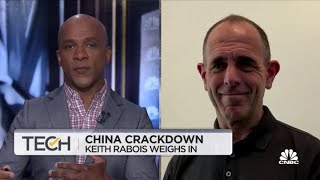
In a July 2021 discussion, Founders Fund partner Keith Rabois examines the ramifications of China's recent tech crackdown for both Chinese and U.S. startup ecosystems. He argues that U.S. startups are not heavily dependent on capital from Chinese giants like Alibaba and Tencent, framing Chinese investment as an optional, non‑essential source of funding. Rabois warns investors who have placed bets on China that they face a "rude awakening" due to moral, legal, and financial complications arising from heightened government control. The conversation then shifts to a broader theme of government intervention, comparing China's state‑driven oversight of tech firms with the United States' antitrust actions against Google. Rabois stresses the legal distinction between Chinese CCP mandates and U.S. judicial processes, rejecting any conflation of the two. Throughout, he underscores the need for investors to recognize the differing risk landscapes and to avoid drawing false parallels between Chinese state influence and U.S. market regulation.
Chapters
China's tech crackdown and here to talk more about it. Let's bring in Founders Fund partner Keith Rabois. Keith, good to have you this morning. Now, the big investors in China aren't necessarily Silicon Valley firms. They're the big Chinese tech giants. Alibaba and Tencent have poured billions and billions of dollars into the startup ecosystem. And by the way, money into American companies as well with the crackdown that we're seeing from Beijing.
What do you think could be the effect on the startup ecosystem? Well I don't know if there'll be an effect in the U.S. startup ecosystem. None of the companies were involved in a really dependent upon Tencent or Alibaba's money. Those are just options that some of the companies have considered as they've explored expanding into new markets or they found price insensitive investors. So it's been like an option for entrepreneurs. It's never been indispensable.
Okay. What about the Chinese ecosystem that I mean it's really the one of the only countries that have seen tech giants even rival ours? And in some cases, in terms of technology, could argue, some do argue ahead of ours in terms of that super app.
Yeah, for those investors who've been investing in China, they're in for a rude awakening. The landscape of investing in China is both morally problematic, legally problematic, and now financially problematic.
Keith, the overall theme here, I guess, is government control. And it's not just a China thing. It's US as well when it comes to this latest case against Google, the sense that at least some feel that these companies have gone too far with their dominance, the way they've rolled out technology and need to be reined in for the market to be healthy. What puzzles me about some of the cases against Google is that the thesis, the narrative, seems to be focused on individual consumers versus advertisers or developers or partners where it seems to me like the case would be stronger. What's your take on the approach here that the states and in some cases the feds are taking?
Well, let's distinguish between two things. There's no equivalence between the cases being brought against Google and the CCP's influence and control of Chinese companies. By law, since 2017, every business in China is armed with the CCP by law. When the government in the United States uses the judicial process to prosecute alleged violations, in front of an independent judiciary, it's a completely different world. So I wouldn't allow anybody to try, like, the connection between those two things. If you want to talk about Google's abuse of its power and potential antitrust violations, we can discuss that. But any connection to China's manipulation, China's genocide, and being a tool of the government has absolutely nothing to do with Google, Apple, Amazon, or anybody practicing business.
In the United States. Oh, yeah, I'm not saying they're equivalent, like, on a moral or ethical basis. What I'm saying is that in both cases, There are governments that based on their ethic, based on what they believe is right for them, think these tech companies have gotten too powerful.
Sure. In China, absolutely, the state doesn't want any powers that are alternative to the CCP. They've realized that wealth creates alternatives to power. This is why the whole policy of engagement has been a complete failure for the last 30 years, is economic success independent companies, quote, in quotes, have not led to greater freedoms for the Chinese. And so that failure in that failure and that policy needs to be completely reassessed and rebuilt from scratch. In the US, there's a set of people who believe that tech companies are powerful. The truth is the American consumer does not believe this. All of the evidence suggests that the most popular entities in the United States are the US military and Amazon. And so this is fiction driven by people who are frustrated by their lack of power, mostly journalists, because now journalists no longer control the world. And they don't enjoy the fact that there's alternative sources of information, knowledge, data that journalists can't control. So they've created this, quote unquote, tech backlash story, which is completely fabricated out of thin air. There is no substance, there's no people that believe in this. Tech is as popular as it's ever been.