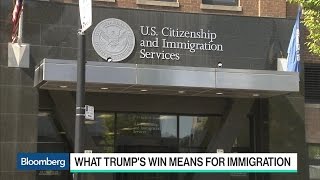
In a November 2016 YouTube conversation, Steve Huffman (Reddit CEO) and investor Keith Rabois discuss how Donald Trump's election could reshape U.S. immigration policy and its consequences for Silicon Valley. Huffman draws a parallel between Brexit’s immigration‑driven populism and Trump’s rise, emphasizing that many leading tech firms (Google, Tesla, Reddit) were founded by immigrants and rely on global talent. Rabois offers a contrarian forecast: the election may actually liberalize skilled‑immigration by decoupling it from broader immigration reform, leading Republicans to pass legislation that eases entry for PhDs and technical degree holders while leaving low‑skill immigration debates separate. Huffman questions the potential repeal of the H‑1B visa program and its impact on Reddit’s ability to attract engineers, noting past hiring losses due to visa bottlenecks. A third speaker highlights the difficulty of balancing low‑skill immigration’s effects on workers with the economic benefits of high‑skill talent, expressing cautious optimism about policy direction. Rabois concludes by suggesting that political data models need new, less‑biased signals—such as Reddit and Twitter activity—to improve predictions and avoid conservative bias seen in traditional models.
Chapters
Now, Brexit was in part driven by concerns around immigration, concerns around jobs and trade, which, you know, we believe is similar to why Trump got elected. Immigration is something that people in Silicon Valley feel very strongly about. Google, Tesla, Elon Musk, these are huge companies that were created by immigrants. You know, what do we think the election of Donald Trump actually means for immigration and the impact that will have on Silicon Valley?
So I have a sort of contrarian view here. I believe actually the election will cause more immigration. and a relaxation of immigration. So if you go back about a decade ago, there was a lot of consensus in D.C. to increase the amount of skilled immigration to the United States. So allow anybody who has like a PhD, anybody who has a technical degree to immigrate pretty freely from all around the world here. And then for a variety of political reasons that may or may not make sense, the Democrats, Obama particularly, linked it to immigration from Mexico under what's called comprehensive immigration reform. And I think what you're going to see is those two policies re-split back apart. And so the Republicans in Congress will pass bills that allow people who have skilled degrees to immigrate freely to the United States. And then there's going to be a more controversial discussion about what to do.
About immigrants from low-skilled countries. But hasn't Trump said he wants to end the H-1B visa program, which allows skilled workers to come in? And what would that mean for a company like Reddit, which, you know, obviously.
You'Ve got a lot of engineers from other countries? It's true. You know, one of the dimensions on which we compete with other companies is on talent. And so that means we need access to the best talent there exists in the world. And we've lost candidates because of the H1B process. So I know it's complex now. I hope Keith is right because that's an area where we always need to do better.
Steve, what are your thoughts on this as someone who worked in the UK for many years?
Yeah, I mean, look, this is the, from a policy point of view, this is something that we wrestle with because the impact of high levels of low-skilled immigration on working people is really tough. And that's really a serious thing that you can't just ignore and sweep aside because it benefits particular parts of the economy where it's not a problem. So I think getting that balance right will be something that they have to strike. But I think that I've heard him talk about things like, for example, the craziness of educating people at universities like Stanford and then exporting them to other countries instead of building their businesses. I've heard Trump say that. So I think that while It's not at all clear exactly the direction that's gonna be taken. I think there are grounds for optimism.
So I also think that we're gonna rebuild data models. I think we need to use new signals to get better predictions. So I think if you only use telephone calls and express content, expressive views, you're gonna wind up, or explicit views, you're gonna wind up with poor models, particularly ones that are biased against conservative candidates, which is what we've seen internationally for the last decade. But if you start using Reddit signals, Twitter signals, like more subtle signals, in building a model from scratch, I think you may be able to rebuild data science pulling into data science.
The other thing I just want to add on the question of data, and you wouldn't be surprised to hear me say that, is that I think that the really exciting opportunity is putting data in the hands of citizens. That's what we're doing at CrowdPac, enabling them to really understand the candidates on the ballot, and also creating a platform that makes it easier for people to participate. If you're sitting there today distraught at this result, there's one really cool thing you can do, which is to take power into your own hands, run for office, get involved, participate in politics. And that's why we built CrowdPac.