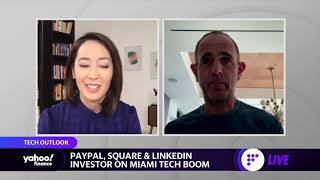
In a Yahoo Finance Live interview, Founders Fund general partner Keith Rabois discusses the rapid influx of venture capitalists, angel investors, and entrepreneurs from Silicon Valley to Miami. He explains that while many investors have already relocated, the true measure of a thriving ecosystem is the creation of new companies at scale, a process he expects to unfold over the next three to five years. Rabois contrasts Florida’s well‑run regulatory and tax environment with California’s perceived mismanagement, highlighting a culture lacking entitlement, a cosmopolitan mix of talent, and openness to diverse industries such as entertainment, real estate, finance, and technology. He credits Miami mayor Francis Suarez’s (referred to as Francis Schwartz) advocacy—particularly around crypto—as a catalyst that signals the city’s receptivity to high‑paying, future‑oriented jobs. Rabois also shares his optimistic view of public markets, praising Coinbase’s mission‑focused leadership and suggesting that more CEOs will adopt similar policies, which he believes will correct Silicon Valley’s “monoculture.” Finally, he reveals a personal side hustle as an instructor at Barry’s bootcamp, describing his long‑standing passion for fitness and how teaching classes aligns with his drive for personal challenge and productivity.
Chapters
Welcome back to Yahoo Finance Live. San Francisco lost more residents than any other city last year. That's at least according to new numbers out from CBRE. The rate of exits doubled during the pandemic with the big beneficiary being the state of Florida. The share of residents there moving to the Sunshine State rose by more than 45% with some big name tech investors making the move to Miami, including our next guest, Keith Rabois, is general partner of the Founders Fund. And Keith, it's good to talk to you. I know the Miami mayor likes to talk about you a lot, as sort of leading the charge as this ambassador of Miami. To what extent have those moves actually led to additional investments being made? To what extent have the VC funds taken hold in the city?
Well, lots of VCs, angel investors, seed fund investors, professional venture capitalists have moved here. That isn't surprising. The key is when entrepreneurs and new companies are formed here at scale, and that started in the last quarter. Obviously, you can't build an ecosystem overnight. Nobody has Silicon Valley took somewhere between 30 to 50 years depending upon how you count to build. So I'm not trying to recreate Silicon Valley in one day, one week, one month. But in three to five years, we were gonna have very successful companies here at massive scale.
Yeah, it feels like there's been so many comparisons made between these two cities. When in reality, there's so many different elements that led to the success of the Valley. What do you see in the city of Miami itself that you think could differ from what has taken hold over in California?
Well, California is just a mismanaged state. The Bay Area is a mismanaged local environment. And so Florida isn't. It's a well-run state with well-run policies, a regulatory framework that allows for innovation, a tax policy that allows for success. And those things are exciting. But more importantly, there's a culture of-- there's a lack of an entitlement culture, which is important. There's a cosmopolitan mix of people from a diverse set of backgrounds, from Europe, from Latin America, from New York, if you include that. There's now refugees from California, left and right. So I think the cosmopolitan mix allows across multiple industries as well, entertainment, real estate, financial services, and now technology, allows for these new custom cocktails to be brewed that turn into interesting and arresting companies that create value propositions for consumers and enterprises all across the world.
And Keith, I mean, when we talk about Francis Schwartz has been on the show multiple times. He's done a lot of things here. I'm not sure which one in your mind has been most impactful in trying to steal more Californians away or even those from New York. But clearly crypto has been a big push for him and obviously it's caught on here in 2021. But in your mind, I mean, how much more can be done on his part or what would you say is the most successful piece that he's implemented so far in trying to boost Miami's standing?
Well, I think just highlighting the degree of receptivity Florida and Miami want high paying jobs. They want to be part of the future. The 21st century is not going to be about legacy jobs. It's about entrepreneurs creating value through the use of technology, through the use of design, and through the use of data. And we want to embrace that here. We want the people who have the most talent on the planet to move here and create the future here. And his ability to communicate that this is the future and that this city, this state welcomes the future as opposed to is trying to retard the future like Europe and San Francisco, has been very exciting and refreshing actually to entrepreneurs, to investors. And that's why you see this magnet of talent just shifting across the globe to actually Miami.
Speaking of Keith, speaking of crypto, I'd love to just have you weigh in on the listing that we saw from Coinbase, because there seems to be a lot of enthusiasm around the growth that we're seeing. If I remember correctly, you were a little more skeptical on Bitcoin early on, what do you make of the huge valuations come to market at? And what does that say about where things stand right now for the appetite for these startups to come to the market?
Well, I've been a fan, long time advocate of companies going public as early as possible in their trajectory. I've written chapters and books on the topic. So it's exciting to see the public markets appreciating the value created by Silicon Valley entrepreneurs over the last decade. And I think more entrepreneurs will avail themselves to public capital sooner rather than later over the next three to four or five years, which I'm extremely excited about. With respect to Coinbase, I'm also extremely excited about Coinbase has had a different type of leadership that's really resonated with the public markets, which is we're not going to have all of these artificial sort of pseudo woke policies where we basically refused to focus on the company's mission. One of the other disadvantages of the Bay Area, other than government mismanagement, has been this monoculture where it's basically a path of least resistance where any employees offended by X, company Y, X, Y, or Z won't engage in a particular topic. And that makes no sense whatsoever. So Coinbase was very clear that if you don't agree with the company's policies, you can leave. And turns out those employees are not that valuable, not that important and the company is very successful. I think more CEOs will emulate the policies of Coinbase, which is we have a mission. The only things you're allowed to do at work have to contribute to that mission. If you detract us from our mission, you're going to be shown the exit door. And so I think that's a very healthy policy for more corporations to embrace. I think CEOs initially were ecstatic that Brian took such a great leadership position, and now they're going to emulate it at scale, which has been a wonderful course correction for Silicon Valley.
Keith, we have to ask you about your new side hustle, which is as an instructor at Barry's, how did you get involved in what other tech names are you bringing on board?
Yeah, so I've been an addicted user. For the last five years, I've probably taken almost 2,400 classes. So part of this is just a reflection of my own personal interest. I find Barry's to be the most efficient workout that one can do if one cares about their body, about their health, about the future of their life. and so it's the only hour of the day where I don't have my phone with me. It's enjoyable. Most of my friends participate. I've learned to appreciate music. The hour flies by. So the combination has been incredibly productive in my own life and I wanted to share that back with other people. I like to challenge myself in different ways. I challenge myself playing basketball, for example, against very good basketball players. I wanted to challenge myself against the best trainers on the planet and learn to teach a various class. I originally started this a few years ago for my friend's 30th birthday. I learned how to do one. This is the first time I've done one in two years and fortunately it went well.