WUEC Fireside Chat with Keith Rabois (Founders Fund, Paypal, Linkedin, Square, Slide, etc)
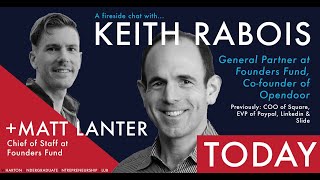
In this hour‑long fireside chat, Keith Rabois reflects on his unconventional career path—from a law‑focused student who coded in sixth grade to a senior executive and investor at PayPal, LinkedIn, Square, and Founders Fund. He outlines a conceptual framework for answering the "why me?" question, emphasizing the importance of a uniquely narrow value proposition, whether as a generalist or specialist. Rabois explains his people‑centric investing style, describing how he identifies founders by an instant, observable "spike" in a super‑human dimension and by assessing intelligence combined with relentless resourcefulness. He discusses the challenges of building and scaling teams, distinguishing between innovation‑focused and execution‑focused roles, and the need to match talent to the appropriate function. The conversation moves to product‑market fit, which he likens to producing a movie, and to capital allocation, where he treats each dollar as a poker chip that must buy information. Rabois advocates early IPOs for accountability and growth, critiques acquisitions as fear‑driven exits, and shares his personal rationale for relocating to Miami, highlighting factors such as travel logistics, climate, talent density, and time‑zone advantages. He also addresses the under‑representation of conservatives in tech, arguing that his investment thesis is ideology‑agnostic and that the market is over‑funded in the U.S. but under‑served globally. Throughout, he offers practical advice for students on networking, identifying "barrels" (people who can drive ideas to completion), and choosing roles that maximize learning.
Chapters
Capital. But a decade, the opportunity cost of a decade is incredibly expensive. So with the hindsight of knowing what I would wind up doing most of my life for a living, I certainly would not have spent a decade preparing for law school. Then you get into subsidiary decisions like, for example, when you start optimizing your GPA to get accepted to law school, you get terrified of taking classes in areas that you don't really understand. So actually when I was in sixth grade, in sixth grade growing up, I actually used to computer program, you know, hacked a lot of interesting stuff together. And then when I got to Stanford of all places, I didn't take a single class in CS or anything really related to CS because I was too afraid of screwing up my GPA that would prevent me from going to law school. So, you know, obviously with revisionist history in hindsight, I would have probably studied more CS and, you know, doubled down on that a bit more, especially because I already could code fairly well. So it's kind of stupid, but, you know, law school is a GPA and LSAT optimization function, you know, for admission. And so I was very consciously aware of the fact that I wanted to be a lawyer. And so, you know, made decisions filtering on that basis, but now clearly would not have done that.
Something that's very interesting is you can imagine being a specialist or being a generalist. And it seems like with your preparation, you've always kind of, and by the way, everyone in the audience, there's, Keith has done a ton of podcasts. You can learn, we only have an hour with him, but just a wealth of information out there that Keith has contributed. But as you think, Keith, about this divide between how important, particularly for this generation, we're talking about Wharton undergrads here, what is the relative, if you had to choose being a generalist along many different dimensions of business, technology, politics, what have you, versus Being really excellent at coding or philosophy or anything else, what's your advice to this group on that dimension?
I don't think there's a unique answer that applies to everybody, but I think there is a conceptual framework, which is where you want to get to is being able to answer the question, why me? And the more unique that answer, the better. So ideally, you'd be able to articulate a sliver and say, I'm the best person in the world that acts. And it'd be very narrow, extremely narrow for most people, but you want to get to this compelling answer about what your sort of unique combination of skills is if let's say it's generalist or a very compelling answer in a kind of deep way, it's domain expertise or specialization. Either can work and you can double down on either and create success, but fundamentally you want that answer and I think that people who don't do well who are smart and talented, but somehow one way or the other never really succeed. It's because they don't have a great answer to that question. And so I started to learn this in high school. I was reading a book, I talked about this recently on the podcast called the Winner Within, written by a famous basketball coach, general manager, player, NBA player Pat Riley, when he was quoting actually Jerry Garcia of the Grateful Dead, where he said, you don't want to be the best at what you do. You want to be the only one who does what you do. And so defining yourself as close to that model as possible. And then, you know, it may take some time sampling different things, combining different things before you know the answer. But the earlier in your life you get to that answer, the easier it is to succeed, at least, you know, I've sort of observed.
I've heard you discuss that there are three types of investors, people centric, tech centric, market centric, and that you're a people centric. What in your own case allows you, what are the skills, what's the preparation that allows you to zero in on that aspect of understanding the skill, the depth, the talent of people when it comes to your investing role?
Well, it's very costly. I wouldn't have guessed necessarily with dialing back decades or years that that would have been the answer. At some point, you pattern match what you do well. And one of the ways you get to the answer in the first kind of response I gave of what do you do uniquely well and what's your unique value proposition is just ask people around you, what's the best things about you? Professionally or otherwise. It's actually an easy question. I like asking people for your weaknesses, which is kind of a painful exercise. Actually asking your friends and colleagues what they like best about you is actually pretty easy. And then you just take kind of a constellation of the answers and look for a Venn diagram overlap of what seems to be a common nucleus and kind of double down on that, either for your answer of why me or your answer for what's your comparative advantage, let's say as an investor or as an executive. So at some point, I had started this process. I remember in November of 2000 going for a jog around the Stanford campus with Peter Thiel, who's CEO of PayPal all the time, And it was my first week sort of after I joined PayPal, and he explained his philosophy of building a company and startup with, and at the end of the day, it came down to you had to attract, recruit, assess, undiscovered talent. But by that was people that the large tech giants of the day, I think Microsoft, AOL, Yahoo, et cetera, would not really know how to hire or wouldn't hire, and then you had to build a startup with those kind of people. And so that if I was gonna help build a startup, wanting to do this, you know, for the rest of my life, et cetera, I needed to get very proficient at this. And, you know, truthfully, the logic of it made sense to me immediately, like why we needed to recruit people that were a different pool or earlier in their career than, you know, the yahoos of the day would hire that. That was, you know, inescapably true. But the ability to do that was not obvious or intuitive, how to do it, how to succeed at it, how to be world class at it. It took me years of trial and error practice, et cetera, to figure out how to do that for myself.
One thing that I noticed and I've read is that you met Peter Thiel very early on at Stanford. I also went to Stanford undergraduate, and I actually graduated the year behind you, also in political science and in economics. We may have taken a class together, I don't know. But one thing is very clear is I'm not part of the PayPal network. and you were, you know, Stanford Review, PayPal Network. For the students that are on this call, is there anything they can do to engineer a valuable social network? I mean, it's arguable that many of your angel investments, many of your business relationships may trace back to some of those touch points that you had very early on. What advice do you give to these students in terms of should they even try to engineer that, or is that completely folly?
It's a great question. And my answer probably is somewhat different than I think Peter would answer this question. I wouldn't try to engineer it, honestly. And the reason why is I think, first of all, even figuring out what kind of network you want to build, how to build it, how to marshal it, isn't obvious even to me now. So I'm not sure it's a good idea. But more importantly, the network we thought we were building back in my Stanford days, Stanford review days, was more calibrated and designed to be useful in law and politics. That was the intent. There was some conscious intent by Peter particularly to assemble a network of talented people that could be leveraged to accomplish things, change in society, et cetera, that we believed in. But it was all designed very consciously to be involved in politics and policy and law. And it would have been completely foreign to any of us. If you had said that we would wind up connecting through business, starting companies, scaling companies, we would have put a zero probability on that. So hence my view about the folly of doing it. Now, Peter's critique would be, well, yeah, the network got redirected as society changed and the highest leverage points changed and blah, blah, blah. And so he'd probably argue that it was one cohesive coherent strategy from the beginning. but having watched it and been a part of it from the beginning, never felt that way to me. It felt like fairly orthogonal. So I probably wouldn't do that. I think it's more important, by the way, to impress people. At the end of the day, how I jumped from being a lawyer and litigator to technology companies was people were famished for talent at the height of the internet bubble in the late '90s. and they really just couldn't recruit people with the traditional backgrounds because all these companies were being started scaling and there's shortage of people. And so some of my friends from Stanford convinced me to jump into the startup stuff mostly because they were desperate. They just needed someone smart and they remembered me and thought I was always smart and worked hard and was tenacious, et cetera. So it was more of the quality of the connection than the specific network. In fact, the first person who hired me wasn't part of the Stanford, Stanford kind of, not even conservative, he's like a liberal Democrat. But he remembered me, you know, through college of having always been insightful and, you know, focused and able to do a lot of things and juggle them. He's like, oh, this seems like you'd be pretty good at this. And, you know, so he was the one who actually convinced me to leave law. I wasn't like the Peter crowd. So that's why I wouldn't over design this and over engineer it. I think at some point, though, it became clear. I mean, I definitely doubled down on my PayPal colleagues when they were starting companies after we were acquired in late 2002, transitioning in 2003, several of my colleagues wanted to start companies again. And I paid attention to who was starting companies, which of my colleagues I thought were talented and invested in many other companies and turned out to build an angel investing track record that way. so I think if you're working with a bunch of colleagues that are successful, that have characteristics that predict future success, I would mean into that and stay as involved in their lives as possible. And unlike, let's say, my Stanford network, truthfully, there's almost nobody who I went to college with at Stanford that was like a friend of mine at Stanford. There's only one or two people at most. that I sort of keep up with on a regular basis, versus PayPal, which is now 20 years later for me, there's several people from PayPal that I keep up with all the time, whether it's in person, text, whatever. Probably just this week alone, I've chatted with one, two, three, four, at least four people from, you know, my PayPal days so far this week. So, you know, it's just that network is much more valuable.
Okay. Now that's, that's a terrific answer. I want to pivot now a little bit into phases of entrepreneurial development, and we're going to go out of chronological order now because we're going to go by startup, And I'm going to ask you about startup phase, scale up phase, exit phase. And then I'm going to ask your perspective from the perspective of the operator and then from the perspective of the investor. So let's start with the kind of ideation founding phase from the standpoint of the entrepreneur or operator. Here, your deepest experience seems to be an open door, which came later in your career. So if you could talk about What were the pieces that came into place that enabled you at that moment in time to say, now is the right time to be really starting up something like Open Door versus some other time period in your life?
Well, Open Door is kind of a weird story and I'm not sure it's gonna give you the insight you really want because in fact, I tried to start Open Door in 2003. That's when I came up with the idea, devised the idea, built a prototype of the idea. I was really excited about the idea in 2003 and didn't get around to really officially doing it until 2013, so it took a decade. And so I'm not sure that either the time, if there's any timing dimension to that, or preparation, I mean, I think in some ways we would have done better if we started in 2003 than we ultimately did. In other ways, maybe it was better to do it later. There were some things that would be easier to do back in 2003 and some things that were more challenging later. So it's hard to tell. I think in 2013, I was frustrated enough with it taking a decade. I've been trying to sell people on working on this in different capacities, roles for a decade. was finally getting frustrated enough that one way or the other, I was like, we need to make this finally happen because it's still a good idea. It still hasn't happened. The world still needs it. And I was willing to be very creative about the path to making it happen versus taking an off the shelf playbook of like, I need to found it. I need to be CEO, blah, blah, blah. I'm just gonna figure out a way to do this given other things I want to accomplish in my life and make it work. But, so I'm not sure I would recommend that as a template. That said, I'm going back to the drawing board. I'm being dumb enough or crazy enough or whatever to go back to the drawing board again. We're starting a company right now in Miami and, you know, from scratch. So, you know, maybe every seven years makes sense or so, but I'm not sure I would, you know, plan on doing the venture capital to starting a company route either. It's a good idea for some people. It's not something I would like direct people to and say, hey, here's a perfect strategy for you to pursue.
Right. It's not, I mean, on the one hand, you have that credibility from your operator experience, VC experience, so that you're going to immediately have, you know, people are going to pay attention, but on the other hand, it's a different job. So maybe let's switch over to the, kind of early stage investor role. And here you're famous for lots of angel relationships, coastal ventures, founders fund, et cetera. Like if you had to kind of maybe generalize, you know, there's the wind column and the super wind column versus the loss column in your capacity there. Are there, what is the common denominator behind those things? Is it merely the people? Is it something about the idea, the right? product market fit. What is it that really distinguishes this at the early stage?
Honestly, the ability to answer this question without the perils of hindsight is challenging. That said, I think I'm pretty convinced that it is the people, it's the founders, and that I knew it at the time. Meaning every time I've had an immediate, almost every time, that have had the immediate, this is amazing. I need to invest reaction. The company's done very well. I can think of one that I really did believe would work and that didn't. But on all the really good stuff, I knew like basically instantly or almost all the really good stuff I knew instantly. Like less than three minutes into meeting with founder or them pitching it or explaining it. So I think it's not totally revisionist history, but obviously you get to a QED company, it was a $100 billion company, so QED, the founder was great. And that doesn't really help anybody, including myself as an investor. But I think that it has always been the most predictive variable is the caliber and characteristics of the founder. and mapped maybe against what they're trying to accomplish. So, you know, Peter has a talking point where you don't really want Elon to be running Airbnb and you don't certainly don't want Brian Chesky running SpaceX. I think Elon probably could pull off Airbnb actually. I definitely think that it would be a bad idea to have Brian running SpaceX. So I think Peter has a view that's the founder characteristics mapped against one of the core challenges for a specific business. And there's some truth to that. I believe in that myself, that you are taking into account what is the degree of difficulty and what are the dimensions of difficulty as you're applying that to a particular person you meet. That said, there are founders that I would have invested in without basically without asking what the hell they're doing, not caring at all or very limited information.
Break this down a little bit. if you could break this down. So it sounds like table stakes, you're smart, right? It's no dummies in the room. But then it's something about the fit between what they're trying to do in personality and gumption or tenacity.
What, like.
Or is it just a gut feel? It's kind of like this person, you know, comes out of central casting and is perfect for.
There's never that. Never that field. What there is is so, I think there is like a intelligence IQ kind of dimension. I think you're right that it's pretty hard to succeed without at least some of that ability partially because at some point you're usually trying to see things that other people don't see and or connect dots that other people don't connect or you're managing people that are pretty damn smart and without some level of intelligence, it's really hard to do those things. But I don't think that gets you all the way there at all. In fact, there's probably a point of diminishing marginal returns where you get a little too smart for your own good, actually. So it's certainly intelligence married with a fair amount of what I used to call tenacity, I used to term it as tenacity. I've now been persuaded that Paul Graham's phrasing of relentlessly resourceful is much more adept and much more apt. And even great might even be slightly better, but relentlessly resourceful really captures it quite well. quite well. So intelligence, relentlessly resourceful, marriage of those two things typically makes a fairly good entrepreneur in any field, you know, whatever they're trying to tackle. I do think then if you understood what the business objective is, you might filter some other variables, weight like different variables or different assessments slightly differently. But there's still one other dimension that is probably the most important thing for me actually. The best I can describe it is every founder I've ever met has proved to be extraordinary with the benefits of hindsight was absolutely spiking on some dimension when I first met them, him or her, and spiking call it one minute to four minutes in the conversation. Now where they spiked, was different, but there was a spike and it was very obvious. So what I mean by this specifically is the founder was off the charts in some dimension, top 1% of 1% on some dimension of all people I've ever met. And I knew it instantly. And I think the reason for that is basically inertia is not your friend as a startup, right? The world is what it is. There's a lot of inertia, a lot of force to gravity, incumbents, you know, et cetera, behavior, installed bases, all these things. So the only people who actually in practice change the world are so ridiculously talented in some dimension that they can make the inertia just disappear. And that is like through some brute force and some superpower that very few people have. And so unless you feel that extraordinary something, the chance that this specific person is going to change the world is basically negligible. I mean, it's almost an unfathomable, when you start, the idea that you're going to change the world or change the entire industry is somewhat crazy. At the end of the day, it's somewhat irrational. And so my experience of 20 years of doing this, certainly in the business world, is the only people who actually succeeded in changing the world are fairly crazy and have some unique superpower, like literally like the superpower of the cartoons, you know, I've watched growing up. And they're different superpowers, just like in the cartoons. And so you don't stereotype like, in lists, like you have to have this superpower. But if you don't feel some superpower, the chance that this person is gonna wake up and literally change the planet It's like zero. Normal people don't change the world basically at the end of the day. You're pretty weird in at least one dimension.
Awesome. Let's get to scaling now. So that we're out of the startup phase, we're going to scaling, we're putting on our hat of the operator. Here you have deep experience at companies like PayPal, LinkedIn, where, like if you consider the challenges at this phase of operation as opposed to other stages, what would you say are the key attributes or things that say these students could prepare or foreshadow in skills that would allow them to succeed in that realm?
Yes, I think it is a different skill set. I think when you're hiring and scaling, you're more at the extreme ends of a bell curve distribution of talents, but you're not at the top one basis point or something. Founders who succeed are like they better be in the top 1% on something, top 10 basis points, top one basis point or something. When you're hiring a company, you really can't have too many crazy people running around at the same time. So you're kind of getting a little bit more homogenized part of the bell curve. And then you really are decomposing what is the skill set in DNA. that makes this role successful? And where do I go find that? Like what pool of people has this experience or skill set? And then how do I recruit out of that pool? So sometimes you might need designers, go find centers of excellence in design and figure out what the formula is. Or almost term I like to use is I sort of like to clone LinkedIn profiles. So if I know somebody who's like extraordinary at ads, I'll go find their profile and then go try to find 10 other profiles that look like that. Maybe, you know, shifted earlier in the career trajectory. So that's a little bit more like, it's a little bit more like being a general manager of a baseball or basketball team actually. So it's like, I need a second baseman. Well, I don't really want a six foot four second baseman typically, although there's one that's pretty good, but like fundamentally that's not what you're usually looking for. And so you're kind of like, well, do I need an outfielder or a second baseman? Do I need a pitcher or catcher? and where do I find those people? What are the attributes that make someone a successful catcher versus pitcher? And they're pretty different. And so you're matchmaking more in an organization. It still comes back to if you wanted advice as an individual, the advice at the end of the day is still figure out which position you play really well compared to other smart, talented, tenacious people. And to be able to define why you're like a great pitcher, catcher, or something.
So it's something about low variance. You're doing something with lots of predictability and you're doing it like day in, day out, you're getting the job done. And so you want to really have very little surprise that this person, if you hire and trust this person, that they're just gonna out execute everybody and just get the job done.
Mostly, I think there's two kinds of roles in a startup. or two main tasks, one's innovation and one's execution. And I think the key conceptual framework and my former chief of staff now principal at Founders Fund, is writing a pretty good blog post on this, is every time you're hiring, you're trying to assess first, do we need innovation or do we need execution? And you want to hire someone with a different skill set if what you really need is innovative breakthroughs. versus if you need to optimize and predictably achieve something. A way to sort these two things is if anybody in the world has done it before, it should be execution risk, meaning like there is a person on the planet, there are people on the planet that can absolutely do this. It's been proven. And then innovation is there's literally nobody's ever done this before. So you can't go hire somebody who's done it before because it's never been done before. The skillset that tends to lead to solutions of innovation is somewhat different than the skill set that leads to execution excellence. By metaphor, I like to use a football metaphor for this, which is, it's like a little bit like running the ball and passing the ball. And even down to decomposing to the offensive linemen, most offensive linemen are better at running, run blocking or pass blocking. And if you know your team's going to lean into one or the other more, you would change the composition like the weight even the weights of the offensive lineman vary in football. So part of it is like, as CEO, what do I need? More innovation or more execution? And then how do I go find people that are excellent at that? And then I started an interview, whether I'm an ambassador on the board or as like a CEO or COO or something, what am I looking for? Is this an innovation where I want 10x breakthroughs? Or am I doing error protection even, like asymmetric downside protection, kind of different prism of how I'm evaluating someone? Right.
Okay. Now, I imagine some of what you talked about is also true now you put on your investor hats in looking at companies that are scaling and you're really pouring the money in. What do you think about this conventional wisdom After the company is down, product market fits, it's now time to really pour on the gasoline, throw the money. In your experience, is that a good framework to think about from the investor standpoint as to when to really start pouring in the money on ventures?
Yeah, my perspective is slightly different both from operating side and certainly from an investor standpoint. They're not exactly the same, but I think they're somewhat different. My view is you don't find product market fit, you create it or you forge it. So it's not something you discover, it's something you create. And the way, it's like to me, the metaphor I always talk through is, to me, product market fit is like producing a movie. There's not a pre-existing movie that's in someone's, like, that people are waiting for, you're unlocking it. you are actually finding a script, casting the right actor's talent against the script, finding the right director, and stitched it all together, producing it, meaning financing it, and then you're creating a trailer and you're marketing it and you're selling tickets. That, I think, is the job of an entrepreneur. Not, let me go hunt around like with a metal detector and kind of look for product market fit under some rocks. which is how it's more commonly taught, which is probably why more commonly people fail. But, and so for an investor, now the difference is the amount of money I'm willing to provide somebody is predicated on whether they have proven they can sort of produce this movie or not. There's a limited budget I have in the back of my brain to giving someone the ability to assemble a cast, and start putting a script together or writing a script or matching a script against a cast. And then as they prove that there's a really cool trailer they've created, willing to write, give them more money. And if they show that they can sell tickets, even better, they don't write lots of money. So there is a sequencing and a scale to when at least an investor, I'm willing to provide more money. A different metaphor I use for that that we used to KV, a little bit less so at Founders Fund, but similar is I think of it as playing poker. But unlike, well, like poker, actually, every card has an informational content to it and every card has a cost. And so what I'm thinking about is the amount of money I need to give somebody for the informational content that's likely to come back. Is that a good trade or not? So sometimes you can, Give a small amount of money and get a lot of information content. I do that all day long. Sometimes you have to give a fairly big check to get that extra card. And the information content is maybe not even that great. That's a very bad investment in my view.
That's fascinating. Let's now turn to the exit decision, IPOs, acquisitions. And let's combine both the operator and investor perspective and tell me if there's distinctions. But Is your advice to entrepreneurs, as soon as it's feasible, take the money off the table, do the IPO, or you served on the Yelp board and have many vantage points on this. So what's your general advice in thinking through this exit timing decision?
My general advice is to IPO as soon as possible. I have a whole chapter explaining this in more detail for those of you who are interested in in Eliot Hill's book called High Growth Handbook, whole chapter on when IPO, why. But fundamentally, it's not to take money off the table 'cause in fact, usually IPO, CEOs, et cetera are not selling. And historically they've been locked up for six months, so it's not like a short path to liquidity at all. And investors typically we don't sell for years after. We're still holding. Lots of companies, we bought into our firm's IPO, literally bought more money, spent more money. So it's not a path to equity of why it's attractive. I think the accountability, the discipline, transparency of being a public company is a feature, not a bug. Second, I think the resources that you unlock when you're a public company can be often highly leveraged into more oxygen for propelling the company, Acquisitions, you have sticker price, what your equity is worth, and that allows you to make strategic acquisitions that are very painful to do as a private company. There's just a lot of benefits. And I think all the downsides are excuses. So to me, it's always a good equation once you reach, call it like $50 million in revenue, some degree of predictability in your business. But anyway, you can read more about it. I have an answer on Quora, or you can read the chapter in the book. So I think that's important. I'm not a big fan of acquisitions. Truthfully, when I start a company anyway or get involved with my time, the goal is to create a durable independent company that persists, that has sustainability for a long time. The typical way to do that through history has been as an independent public company. If you sell, you're basically giving up and you're giving up control. of the vision and the probabilities of success because someone else is going to make all the decisions. So I only tend to, I believe people sell out of fear. There's some fear. It's fear of some risk. It's fear of some people's stuff. It's fear of something. So none of my best companies have really sold prior to IPO other than, I guess, YouTube. That is a tricky, complicated situation, but I think every other company that was really working hasn't sold or at least didn't sell until after IPO.
Great track record. We're going to start pivoting to the current environment, entrepreneurial environment, but as a segue, there was a question from a student, what's it like working with Elon Musk and Peter Thiel? Give us some insight.
They're very different. So they're extremely different. So Peter is a macro decision maker and he thinks of his job as CEO, that's holding constant sort of as executives, as making three to four big decisions a year and getting them right. Should I hire this person, promote this person, go IPO, sell, raise prices, something like that. Elon is obviously a macro thinker, but he's a detail obsessive. In 15 minutes or less, we'll die very much by this loss, die to the bottom of exactly how something works. Peter never does that. And so, I never worked for Elon directly. Elon had been fired as CEO on September 25th, 2000. And I joined PayPal in November 2000, six weeks after Peter took over as interim CEO. Even though we're still on the board, so we had like various dialogues about particular topics. And when he was joining, when he started SpaceX, actually he was trying to recruit me to join SpaceX, but at the time didn't really want to move to Pasadena, unfortunately. But so I got some insight into how he works, and so I've hired people, et cetera, that have worked with him, and half my PayPal colleagues worked for him. Yeah, as CEOs, a lot of information there, but fundamentally about as distinct as CEOs as you get.
Okay, that's a good segue to now current state of entrepreneurship. Obviously, remote work, COVID's out there, and we have Palantir moving to Denver, Elon Musk, Joe Lonsdale moving to Austin. Apparently, you've moved to Miami. What's going on here? What's the future? Companies like Twitter or Slack, remote only. What's the future of Silicon Valley? Or is that just a notional concept? What is the future of tech hubs in places like, talk about Silicon Valley, talk about emergent ones like the Sunbelt cities and Miami? What's the future here?
Great question. I mean, there's obviously a couple embedded questions there. The future of work, I don't think anybody really knows. I think you're gonna see pioneering experiments over the next year. And, you know, Silicon Valley type of companies tend to copy each other. So Facebook created a growth team and Facebook did well. So all companies like we should have a growth team. There's a bit of a herd mentality. So if a company breaks through with some hybrid model, which is more what I expect, then most companies will be in some variant of a hybrid model. Everybody in quotes, meaning like a lot of companies will quickly try to copy. that model without really rethinking from first principles, what should they do? I think there are disadvantages of all these, you know, anywhere on a spectrum from fully remote to fully in an office. And so to some extent, depending on what you're trying to accomplish and what your natural talent pool is versus your aspirational talent pool, you might dial it somewhat differently. Also, how predictable is your kind of roadmap and competitive advantage versus how much innovation are you expecting? There's a lot of variables there. So I don't think there's a one size fit all like, Hey, you should run your company this way where there used to be very strong cultural bias among VCs to base your company in the Bay Area, put everybody in one headquarters, et cetera, et cetera, et cetera. And truthfully, there are a lot of virtues to that. I think what post COVID, I think you're going to see more experimentation all along the spectrum. and there won't be a consensus view about what the best thing to do is. And it may take, you know, a year to three years to see if any of the formulations tend to have a better, you know, sort of trajectory before people like sort of recommend. You know, my team of staff and I occasionally jointly work on a substack post about like top CEOs ask us. This is actually one of the top topics in my 101s and CEOs they want to talk about. And the reason why we haven't written on this yet is I don't think either of us have a particularly unique insight yet of like what the right answer is. I think so we can walk CEOs through the various trade-offs that might be more subtle, but I don't think there's a formula that I would say, yeah, this is definitely the right way to do it. And it may be company specific or state specific as well. On the future of cities and Silicon Valley and stuff, I mean, obviously, I moved to Miami, escaped Silicon Valley. I think a lot of people are trying to escape the Bay Area for many reasons actually. I think what COVID has done is certainly lowered kind of minimum, I think this is non-controversial actually, lowered the friction or lowered the opportunity cost of experimenting in new places. Because people were working remotely, basically without fail, without exception in technology, For the last year, the cost of experiment went down significantly. And as people tried these experimental different places, some of it resonated with them and they realized, oh my God, why am I suffering through X, Y, or Z, whatever their pain point is? It could be crime, it could be homelessness, it could be taxes, it could be culture, like monoculture, lots of reasons. But as they were experimenting, because they could without significant cost to themselves, they realized, oh, I don't have to put up with this weird mix of stuff or maybe I don't. And that's what really unlocked a lot of unleashed a lot of this, hey, I'm gonna go here, I'm gonna go there, and try this. And so I think that's what's basically called this fragmentation. Now, at the end of the day, I still think critical density of talent matters to some extent. It doesn't clearly, clearly you can produce outlier results. I mean, Shopify is an Ottawa, Canada. If you rank cities by desirability of living, Ottawa would be very, very, very low on that list for almost anybody. So it's not Toronto, it's not Montreal, it's not even Vancouver. So you clearly create 100, it's one of the most important companies of the last decade, 160 billion or whatever it is trading out today in a third, fourth, fifth tier city. So obviously it can be done. One of the best companies I work with today, maybe the best, is in Berlin. Very cold, not a lot of history of super success in technology. Germany quite, Germany has more success, but Berlin, not really. And this company should be returning our fund. So I think there's clearly evidence that you can produce heroically produced and amazing company almost anywhere. There's companies in Australia that have done phenomenally well. The consumer side, you have Canva, you obviously have Atlassian. These are great companies, you know, so I don't think you need to be anywhere for specific company. Can you create repeatability in the ecosystem? I think absolutely is somewhat different question. I think you do need critical density of talent all assembled roughly in the same time horizon in at least a constellation of places. So that's what we're trying to do on this Miami initiative that I've been working on is get enough of the critical ingredients all in one place. So create a true ecosystem versus just a breakthrough company here and there. I mean Chewy is in Miami. It's a 40 billion, 43 billion, 40 billion dollar company. It's pretty good by any standard. So you clearly create an individual company, but all I want to create is a system that sustains creating important iconic companies.
Okay, that's great. And I'm going to ask one final question, and that's a cue for everyone on the call to start thinking about your questions. Okay, so one last question for me, and then it's over to you guys. So my last question is, it seems like from your last answer that it's that there's a little bit more democratization by geography at least, in the recognition that talent There's no monopoly of talent in Silicon Valley, both on the investor side as well as on the operator or founder side. What do we do about this issue of access for underrepresented minorities, women? A, do you perceive it as an issue? And B, what can we do to rectify the situation?
Yeah, we at Founders Fund don't really think that way. We're in the business of backing the most extraordinary founders on the planet, wherever they are, and whoever has the combination of ambition and talent. And truthfully, it's a very small pool of people. So, like, even if you try to apply statistics, we even use the term N of 1 companies very importantly in our dialogues. SpaceX, well, Tesla is actually a better example. Tesla is an end of one company. There's really only one founder in the world that you should have backed to do that. Anybody else try to do that? Truthfully, it would have been a bad investment at least back in 2005 era. So trying to apply demographic statistics to is this Elon or not is like a fool's errand. Like mathematically it's a fool's errand and I'd argue ideologically a fool's errand. So we're not in the business of scaling things. Like you can arguably apply some of these questions to a scaled organization that has 1,000 to 10,000, 100,000 people, because then you are looking at a pool of people and statistics can be relevant on a pool. But my job is to find the top 10 founders on the planet. And if I back five of them, I've had a heroic decade. And, you know, that I don't really care what their background is. I sometimes don't even ask them what their background is. Sometimes I know it, sometimes I don't. Some VCs do care about background. They use that as a filter. So it can be more relevant. It's never, I'll never the tell me your life story kind of investor dialogue with the founder. I even get somewhat annoyed when the founders start telling me their life story. Occasionally they do hit some highlights that are actually pretty interesting. So it's not like I'll let them go with it, but my eyes start glazing over when they want to start that way. But in any event, yeah, that's not the model that we use. I often don't know the demographic or historical background of people we've backed until much later. Once in a while, I do work with most founders that I invest in quite closely over years. And so I actually over time usually get to know them quite well and then can tell you the whole life story and what's important to them, what's not, how they got where they did. But it's mostly a function of spending years with this person. So anyway, we just have a different approach to that. I think in the US though, the US is overfunded, meaning there's way too many funds chasing after way too many companies in the US as a whole. I think there are parts of the world that do not get as much access to capital as the quality of people or ideas might merit because there are pockets of places that there aren't 55 VCs chasing after it. Like if you went to Stanford and God forbid you have a technical background, there's a billion VCs trying to chase after you. That is, so it's over efficient where we're gonna, there's some better term put out, but I would admit globally that there are almost surely inefficiencies of talent against like work where the VCs are looking at some level of scale, if you can sort of brute force your way, people will find you, especially more now in the last decade than before, last five years more in the last decade. But you may have to figure out how to create some lift before the traditional VCs find you in some places in the world. But in the US, there's so many people chasing after so many, like, I mean, I've been competing all day long all the time. in all different dimensions. So you can be in Alaska and find VCs, you can be in Ohio and find VCs, you can be in North Carolina and find VCs. You can usually get some attention here, but that's definitely not globally true.
Okay, thank you. Let me turn it over. Is it you, Sabrina, or Vivek? Let me turn it over for the student M&A or Q&A. Portia and Keith, thank you.
Thank you so much, Professor. And Keith, I loved all the analogies from football to movies to superpowers. That was great. Yeah, turning over to, I guess, everyone who's here. Dhruv, can we start with you? I'll meet you now and feel free to ask your questions. Dru?
Yeah, can you hear me?
Yep.
All right, perfect. So, Keith, you've talked a lot on podcasts and given lectures about barrels and ammunition and also value creation versus value capturing people. So, what can we look for in our friends and classmates? who are like college age to identify people who are like barrels and value creators? Yeah, it's a very good question on the, certainly on the barrels point. I think if you're part of like called student organizations, but an organization of multiple people, you can start identifying some of the barrel characteristics in all, maybe any organization from like a sports team to a fraternity to some other student organization. like a competitive club of some sort. I do think barrels, though, are culturally specific. So the definition of a barrel is someone who can basically take an idea from conception all the way, you know, sort of across the finish line and bring everybody together that is required to get there so they can identify what's missing, who they need to persuade, who they need to influence, who they need to attract, what are the blockers and they can navigate For them, that skill is somewhat culturally specific, like the definition isn't culturally specific, but some organizations, the skill that would allow you to do that flawlessly might be different in the skill that would allow you and enable you to succeed in another organization. So it's a little tricky to have a global definition of a barrel, but there are some characteristics of that that you might be able to identify in any organization of people. because there probably are some common denominators on, yeah, I think that's probably the best you can do early. If there's people that you would probably ask for advice on complex topics that you don't need to ask, that's probably another predictor because by definition, if you're truly asking them for advice, you believe that they can be insightful. So there's probably a little signal on that. as well. Like if you have three major decisions in your life and you wind up asking the same person when you generally want their feedback, that's probably a pretty good signal. And if you see other people also doing the same, it's probably a pretty good signal.
Amazing. Jess, do you have a question? I've given you permission to speak. Just Trey. Can you hear me?
Hey, yeah, sorry, can you hear me now?
Perfect.
Great. Keith, I remember reading on Twitter that you've been historically hesitant with funding students who graduate into conventional paths like the Google APM program. Is that still the case? And if so, what do you recommend students to do instead? Yeah, well, I do think to be successful, you need to deviate from seeking approval from too many people. And so the more conventional path you're on, you're probably subject to a lot of people's feedback and it probably constrains you. And so what you're really looking for is signals that the person isn't going to be too derivative, that's kind of a Peter term, but fundamentally, you need to think for yourself. Like, there's a reason why, like, most people don't believe your startup's gonna work, right? And, like, basically, everybody thinks your baby's ugly. And if you get, if you get too caught up and everybody's telling your baby's ugly, you're probably not gonna succeed, and you may not even create the right baby. So I think what we're looking for and what i'm looking for is someone who shows that they can independently. have conviction about something and whether or not it's immediately popular with their peers, colleagues, whatever, isn't the critical dimension for how they evaluate themselves. Great.
Thank you. I really like that definition. There's, I think, a very fine line between conviction and kind of stubbornness. that's a great way to put it. Okay, Nicole, here, you have a great question. I've given you permission to talk.
Hello, can I be heard? Perfect. I'm a junior. And so it seems like a lot of my senior friends this year looked for jobs first, and then after kind of like thought about where the job was located and factor that into their decisions. I'm kind of different. I do really care about where my job is located for a number of reasons, like network, taxes, like critical density talent, like you were talking about Keith. But I was wondering what were the reasons that Miami was your best choice and your next move? And if some of those reasons could be transferred over to, you know, senior undergrad deciding like where she wants to go.
Yeah, I mean we filtered on a couple of dimensions. We cared about like some professional stuff like is there an international airport? We need to be able to travel to people for part of my job. I need to be able to, people need to build a travel to me, et cetera. So that's kind of, and that filtered some cities actually in the US, like Nashville doesn't, Austin doesn't really. As an example, I personally like warm weather, prefer warm weather as does my husband. So we didn't want to go to a cold weather environment, whether that's, you know, necessarily like Denver, which is sunny but cold. So at least that sun, Seattle has no sun. Yeah. So we looked at, like, weather. It was pretty important to us. We filtered on, you know, some things we like to do as Hobbies. Right? Like, so we like I like certain kinds of workouts, Jacob likes certain other things. So we filtered on like, hey, what do we like to do with our free time? And does it, you know, how we're on scale one to ten is kind of the city on those kind of things. And then we filtered on some version of people, diversity of people, diversity of roles, fields. There's a little softer dimension. Many of these other ones, we have like either binary exclusion criteria or like empirical criteria. This one is a little softer. And very quickly, you get to very small rest of cities actually in the US. We did think about non-US cities, but there's some time zone, other issues associated with that, like in terms of continuing to be involved with the 12 boards I'm involved in California, my partners, at least historically, I've been in California, be able to participate. There are some time zone limits where that's a very practical thing. Being on the Eastern time zone is actually better. Like, I wake up in the morning, I can work out, I can read, I can have a leisurely breakfast, then everybody else wakes up. So I've actually found it an advantage in terms of thinking, free time, discretionary time to be on the East Coast and, you know, deal with people who are on the West Coast and then have Some, you know, a company in Europe is pretty important. So it's better to be here than on the West Coast. Even these Israeli companies would be better to be here than on the West Coast. So we sort of like looked at it that way. Then we really made the decision somewhat independent of what would be a tech, baseline tech community. We sort of said, where do we want to live within the constraints that could be successful for me, given my job and my intended career path for the next 10 years, I'd say. And then we filtered in my husband's professional aspirations are more political. So it doctoring a little bit of where could he do what he envisions doing for the next eight decade as well. And actually, Miami is a pretty good place for that as well. And then after we made the decision that Miami was going to be placed, then I reversed engineered okay, well, what do I need to do to make this successful as a technology center? So it's first, like, we're going to Miami. Then it was like, okay, now what are the moving pieces to make this work for me and for technology generally? So it's kind of like more like the question of where do you want to live first? Then how do you make it professionally successful? But we had some exclusionary criteria that would have made it really difficult to be professionally successful if we didn't apply those criteria. Got it.
All right. Thank you so much.
Amazing. Jonathan Kogan, do you want to jump in?
Oh, hi.
I just had two quick questions. One was, how do you suggest founders sort of look at evaluation, for example? And like as a company's growing, if a company has like 10,000 daily revenue, for example, how much is like the max you can see raised or And also how does sort of different sector affect it? And then also different topic. I know that you're sort of famously conservative in Silicon Valley and that's very rare. It seems like only the PayPal team is. So sort of why aren't there more conservatives? And also how do you, are you actively trying to increase it? And do you have any suggestions for.
Someone who's somewhat conservative in tech? Okay. So the first question is the lens is for where would you want to join as an employee? I actually think you should forget all the business metrics. and find the place that you can learn the most and from the people you can learn the most from. And so I basically evaluate your boss or who can, who eventually, like, who you're going to basically report to and what can they teach and how fast can they teach it to you? Like, steepest possible learning curve versus and versus the company evaluation, which is very hard to do, even for professional investors. So I would really focus on, like, what am I going to learn and the faster the growth, the better, because it kind of creates a non-zero sum atmosphere. When the company's growing really fast, there's just lots of opportunity for everybody. So if you develop a reputation for being proficient at things, people will throw challenges at you and then you'll learn faster anyway. So I think the combination of who's my boss and what can I learn from him or her, and then how fast is the company growing that's unlocking new opportunities that maybe take advantage of and develop skills faster than I would otherwise. that's the lens for choice. On the conservative stuff, I think, you know, what I basically try to do is share information that people may not have seen before, right, just in the end of the day, there's kind of a monoculture in technology, certainly Silicon Valley based companies. And if I can take content and share it, then people can grapple with it, critique it, but they have to at least understand that exists. So I try to do that, you know, with my free time as much as possible. There's some other, I think some of the companies not in Silicon Valley have been more, have more conservative roots. They probably intentionally selected not to be in Silicon Valley. Like we have a company that we really love called Andera that we helped co-found. One of my partners found it, you know, co-founded it. It's a defense innovation meets defense technologies. A lot of non, a lot of standards that come out of people would not have, wanted to found it, invest in it. So it was intentionally built in Southern California. But I think there's others. I think Coinbase and Brian's more libertarian at least. And I think you see it in some of our policies that have kind of ended up in the public domain. But I think there's not that many and it's a smaller crowd. I think hopefully that'll change over time. And, you know, if insofar as I can help educate or positize, I'll try to do it in the few moments I have, you know, that are free every day. Perfect.
Thanks, Keith. I think that's all the time that we have. I'll hand it over to Vivek for closing statements.
Yeah, of course. And I just have to say this has been an absolutely incredible Discussion and I don't think I've learned more in an hour ever before. So I have to thank you Keith for taking the time to being here with us today and really like bestowing your wisdom and experience upon us. It's not just me, I'm sure all of us have learned a lot and who knows this talk may have like changed the trajectory of our lives. Like I'm not exaggerating there. So in addition to that, thank you Professor Xu for the fantastic line of questioning. And a huge shout out to everyone who's made this discussion possible, including everybody who's attending right now. So thank you all of you. This has been a great event.
Thanks, it's been a pleasure.
Thank you so much.
And we hope to see all of you at the-- Thank you, thank you. We hope to see all of you at our next WLUAC event. Hopefully it'll be just as incredible as this one was.
Okay.
Wow, that was crazy. That was pretty awesome.
Oh, my God.
Awesome job, guys.
Oh, my God.
That was so good.
Oh, my goodness. wait, some of my buddies are here. I have some of them.
Oh, yeah, we are the.
Oh, my goodness. I keep on.
More from Keith

This Billionaire Trains His Body Like He's Building A Billion-Dollar Startup | Keith Rabois


Vinod Khosla and Keith Rabois on Building and Investing in Enduring Companies | Ep. 40



