Building Your Pelvic Health Practice In A Rural Area with Dr. Amanda Thompson
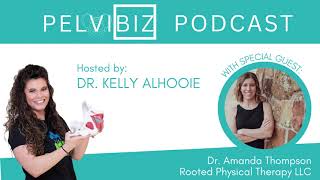
Transcript of a Pelvi Biz Podcast episode (host Kelly Alhooie) interviewing Dr. Amanda Thompson, a pelvic health physical therapist who built a successful private practice (Rooted Physical Therapy LLC) in a rural area near DFW, Texas. The conversation covers Amanda’s clinical background, challenges of rural practice (insurance mix, staffing, geography), advantages of direct-pay/flexible care, collaboration and community-building, steps she took to leave a hospital job and scale her practice, and contact/branding details.
Chapters
Hi, welcome to the Pelby Biz Podcast. Are you a pelvic health PT or OT struggling to start your own practice? This podcast helps pelvic health PTs and OTs get out of debt, gain the income they desire, be able to treat patients without insurance restraints, and learn how to create time freedom for yourself and your family. I'm your host, Dr. Kelly Alhui, founder of Ortho, Pelvic Physical Therapy, Pelvic health Business Grower and Pelvibiz. Over the last two years I went from a solo entrepreneur to a seven person team in counting. I'm here to help provide a clear path to grow your pelvic health business as fast as possible so that you can gain the time freedom, decrease debt, increase income and live the life that you desire. Before we get started today, make sure you click the link in our bio to grab your ticket for Pelvi Biz. Now let's get into today's episode.
Hi guys, welcome to Pell with Podcast. I'm your host Kelly Alhui. Today I have a very special guest, Amanda. She is one of my Mastermind students and I'm so happy to have her on. Amanda, go ahead and tell us a little bit about yourself and who you are.
Thanks for having me. I really, really appreciate it. So My name is Dr. Mehta Thompson and I am a physical therapist. Yay. I am originally from Houston, Texas, or near Houston. And then I met my husband in college. I went to Texas A and M and I live an hour northwest of the DFW Fort Worth area. My husband and I are farmers and ranchers. It's hard to find those people these days, but I have been in the pelvic health world for like 8 years. I graduated from PT school 10 years ago, but I've been in this area of northwest of DFW since 2007. So I've slowly made my transition from 04 to 07 from a big city to rural life. I've been practicing, like I said, For 10 years and I actually started in a rural hospital at the Bowie Hospital, which is even further north. If you look on the maps, it's between Fort Worth and Wichita Falls. And I was getting into the world of public health early on in my career just because it was an area that was weird for people to treat and I had a lot of new grads working for me. I quickly became the director where I was at and then lo and behold, I'm nine months pregnant, my hospital shuts down. The hospital literally shut down. I ended up delivering a week later, which was three weeks early. Shocking because I had to discharge 150 people. But I ended up starting to work at another company called Wise Health System or Fit and Wise, which is in the town south of where I'm at. And I started working there full time right after I had my, my son. And the pelvic health world really kind of kicked in from there. So I've been practicing for 10 years, public health mostly for the last eight. And I just, I love what I do.
That's awesome. And, and let me ask you this, Amanda. This is a big question that we get a lot is being in that smaller town, people are always telling us, or people are always telling me. I guess, like Kelly, there's no way I can start a pelvic health practice in a small town. It's never going to make it. What would you say to those people?
I would say first of all, that was my, literally my biggest limiting factor was that I'm in a rural town. It's, I'd say the majority of my town is Medicare, Medicaid, a lot of government insurance, lower income than if you go a little bit further into the city. When I say I drive 45 minutes to work, it's 45 minutes of highway, not, not commuting, travel, travel traffic or anything like that. So it is 100 possible. There are people out here that are seeking help that actually don't seek help in the traditional model. Because in, in since I've started my own practice, it's mostly for two reasons. They don't have time for it. And most of them are actually either self employed themselves, they have really high deductibles insurance because they're young and they, they have small children. Their husbands may or may not work. They may or may not work. And you would be really surprised or I was really surprised about the amount of people that reach out to me that are, are not in the traditional model. Another thing is the traditional model, the insurance just tells us what to do, how many times to see the patient. Then you'll spend extra hours doing paperwork to prove to these insurance companies that these patients need to be seen. You know, if somebody comes in with pelvic floor dysfunction. But that this morning I had a girl who I've been treating for pelvic floor for a while today. She walked in, I laid her on my table back here and she was so dizzy she could not lay down. She tried to lay down, sat up. And in an insurance world, I would have to have a new prescription from a provider and in Texas you have to have another prescription. Well, our hospital required a prescription. In Texas you can have, you can treat for 10 business days without one. So what did I do today? I treated her dizziness, I got her out of dizziness and gave her homework. And so it was 110% opposite of what we typically do, but in an insurance model that typically wouldn't have been able to, to happen. So rural area is an underserved area to begin with. It's very hard for me to find staffing, most of these people that are wanting to work out here from this area. It's hard to find people to move out to a rural area. But the patients are there, they are there and they are desperate for care 100%.
I mean, I love this. I think this so debunks the belief of no one's going to come see me. And I actually love that you pointed out, Amanda, that the patients, you're right, they don't actually maybe want to go that traditional route. And plus if they do, they may have to drive two hours, three hours into the city. And so just by you being there, you're saving them so much time and that time is worth so much more. And they're like, hey, whatever you want me to pay you, I'll pay you.
So the other thing is, is, you know, January 1st just happened. So we're recording this early January. Everybody's deductibles and out of pockets just started over. And I had a girl, I treated her once, she had a surgery, treated her yesterday. She actually messaged me yesterday and said that she went to a lymphedema specialist that is wanting to see her for three days a week because of some lymphedema going on. And I don't have a lot of training, but I have some. And she, her Insurance is a $3,000 deductible. That's pretty standard. The because it's a hospital based outpatient facility. Her charge is $900 per visit and they want her to be seen three days a week for four weeks at least.
Look at that, guys. Look at that. She will be paying more. Let's just point this out for a second. She will be paying more to have worse or it's not even a word, but worse care. Okay. And, and it's, but it's in network. So this is the stuff that we really should be pointing out to the patient, that you're going to spend more time with her, you're going to give her better care. And my point out One more thing, Amanda, that you said, guys, listen to what she said. She said I don't have. I'm not the best at this, but I at least know something. And I think that's so, so important because so many other pelvic health PTs or OTs or PTAs, you know, what they would have done? Well, I'm not officially certified, so I don't think I can help this person. Right. But for you, the mindset is, you know what, I have some training or, and. Or I can look it up and I'm going to help this person because I know she's better off with me than being stuck in this hospital system.
Correct? For sure. For sure.
And that's, like, so amazing that you can just be like, you know what? I'm going to just do whatever and help this person no matter what their issue is. And I think the biggest takeaway here, too, is, guys, you could have one Herman and Wallace class. You could have one small lymphedema class. You can learn lymphedema for someone else, but as long as you're willing to try and just listen to the patient and be able to understand what truly their needs are, that's actually the best con Ed course that you can have, is your listening skills, because that's going to get you a lot further than some, you know, con Ed course, for sure. So that's awesome. I mean, I applaud you for that. So that's great that you're just saying, you know what? I'm going to try this. And. And hopefully. Is she coming to you now? Like, yes.
So yesterday when she messaged me what they said, I've only seen her. I saw her once last week and I saw her this week. And then she was going the same day to them for an eval, and then she had to follow up the next day because they didn't actually do the lymphedema stuff because they just did the eval. And in my eval, I was able to get her in a lot less pain. And then in one session with me doing some pelvic floor work, she was able to decrease her pain from the time she walked into the time she left. So she's willing to come see me once a week. And I told her, you know, I can get you out of pain in four weeks, and I can't necessarily get rid of some of this lymph stuff that's going on, but I'll do my best. I think another cool thing to point out is someone Told me a long time ago. And I tell this to other PTs and students. The pelvic health world, PT world is really small. PT OT therapy world is small. But the pelvic health world is extremely small. But what's so much more powerful, maybe it's because I'm in it, so I'm a little biased. But the public health world, we are all about helping each other. So if I reached out to other public four therapists or just posted on my Instagram story, hey, guys, I have a patient. They are needing this, this, and this, I can guarantee you I'll at least have five or six people message me personally and be like, I will teach you how to do that. Let's set up a zoom meeting. We are all about helping each other, because the more we help each other, the more we're impacting other people in our own communities.
100%. It's all about freaking community and building up that community. I love that. And if people are not building community in 2023, they are really losing out. I mean, even just in our mastermind, you and Jennifer are collaborating on a Pete's collab. Right. And so can you tell them that both of you guys are, you know, doing this together and you're going to promote it out and the world, we're just helping each other. Like, you're going to both be uplifting. They live in two separate states, and they're just going to be helping their populations and cross collaborating to get the word out that we can even help peds. How cool is that?
Yes. Yes. I've been treating all kinds of public floor, but pediatrics, anything from developmental delay, I'm in the middle of nowhere, so I treat literally everything. And I have been treating pelvic floor, pediatric incontinence, constipation, bedwetting of all ages. So I see babies that are constipated, but all the way up and just trying to normalize that conversation as well. So she had someone approach her, and in the mastermind group, she was like, does anybody treat peas? So we're going to do an Instagram live and we're going to try to record it and send it out, because it's going to be touching on all the basics that I honestly feel like every human needs to know. Some of this stuff is going to be geared towards pelvic floor providers that can then take some of this information if they're interested and kind of dive into that world. But a mom or grandmother or aunt that hopefully is listening to anything that we're Talking about will be able to take some of that information and implement it immediately and see if it's beneficial. If it's not, then we're going to try to get the tools out there so that more people are helped with this conversation. For sure.
Phenomenal.
And she's in Alabama and I'm in Texas, and we are just trying to collaborate in all the ways.
Guys, this is. We're talking about growing your practice. This is what's going to grow your practice is collaboration. I've been telling. I've been saying this for a long, long time. This is what grew orthopelvic is. Collaborate, collaborate, collaborate. Collaborate with your community, collaborate with your peers. And if together we can actually bring awareness to pelvic floor and bring awareness to actually how many things that we can help. I mean, think about what Amanda just said. She helps pedes, she helps lymphedema, she helps pelvic floor. She does orthopedics. She is in a small town. And that actually is another positive about being in a small town. Why you should actually start your practice is because you could be the go to and treat all these different conditions if you wanted to. So collaboration is so. Is so key. And you hopefully anyone that's listening to this podcast, start thinking and making a list of who you can connect with that someone that is in your field, someone that isn't in your field, someone that you're like, hey, I really look up to this person. Or like, who else can you bring in your world to cross promote? It's. It's so big. Yeah. I love it, I love it, I love it. So, Amanda, let me ask you this, okay. Over the last year, what has helped you most in your growth that you've had? I mean, maybe you can kind of give the people, you know, what you know, tell them, actually, when you started your practice, I think that would be good. And then kind of, you know, the path you've been from there. Yeah.
So my business, I was working in the hospital system, and actually I'm coming up to the anniversary of my last day.
Wow.
So mid January 2022, I was my last day, and I actually thought I'd be there forever. And I opened practice February 1st of 2022. Within one month, I was able to reproduce my income that I was making at the hospital. And the first week we were open, there was a snowstorm in Texas. And I know everybody makes fun of people having snowstorms in Texas. I'm in north Texas, so we do get snow, but it's not snow, y'. All. It's ice, right? It's ice. Plus, yeah, it's ice. So we were shut down for a few days because although I have four wheel drive and I can get places, schools were closed, most businesses were closed. So to say that at the end of February 2022, I was still making the income I was making at the hospital is, is impactful. And I was working at least half the hours that I was working at the hospital. Having two small kids, I was still having to try, try to be at work at 7, never at work at 7. All my 7am patients knew I'd be rolling in at 7:15. Sorry everybody. I would have to leave work because daycare closed at a certain time. And so I Covid, Covid burnt me out. I was working too many hours in too many departments, too many jobs not to serve. It wasn't to survive. The hospital was in survival mode. And so everybody that wasn't salaried was furloughed or put on part time. And so my kids know no different for Covid than anything else because we were still in, in go mode. We were seeing patients. I was doing inpatient rehab, acute care. I was doing all of the things. And when things started opening back up and Texas was one of the things that opened back up first, we don't follow the rules of anything, but we. I was so burnt out and exhausted and there was still the go factor. There was no let up. They were still micromanaging and I couldn't treat my public health patients like I needed to. And I was seeing, and all my patients can tell you I was still seeing three to four patients an hour at the same time. I was trying my best to get some individual one on one time, but it's not long enough. I was not able to like dive into them. So I'll tell you two things that happen. I took a course in December of 2020 so in Colorado. So it was still peak ish Covid by Lynn Schultze from the Institute for Birth Healing. And I did her track. That was my last course to get certified. And that last course was life changing for me. It opened up a lot of doors that prior to that, all my limiting beliefs of like self worth and I, I just have to keep going and follow this path because that's what the path is supposed to be. I took that course that opened my world. But my limiting factors were still I work in a hospital, I can't do this. I work in this place. My boss is this. And it was nothing individual that anybody ever did or said that kept me from doing it. It's the hierarchy of a hospital system that you can't grow this type of practice. So then I. I don't. I don't typically do things. I'm a very reactive person. So a course popped up during COVID that was half off. And I thought I was joining this coursework for nutrition. I joined Jessica Drummond's health coaching certification, so Women's health health coaching certification. And I thought that that program was going to give me the nutritional value of the things that I also needed to implement with a lot of my patients. And I was going in it for the nutrition. Little did I know that during that program, you coach. You have coaching calls with groups of people, and during those coaching calls, you are coaching each other. So after you have to do one, then you do the next. Well, there was a girl that was in the group that we were in the same course twice and we somehow got connected together. She lives in the uk. There was a couple other people that I was. I was. That were pretty impactful. But during that, you coach each other on real life things. So that course, during that process was when I had my like, oh, crap moment of I'm in a position where I'll never be able to grow. I won't ever be able to do what I'm supposed to do. And I sat on that for about six more months knowing that I had all this impact in my brain, all this knowledge in my brain, and I really couldn't do anything about it because there wasn't a setup for it.
Wow.
So my best friend is a CPA and financial counselor locally. Her name is Taryn and she's been my cheerleader. She was actually the person that just like pushed me off the edge and told me, you have to do it on your own. You're never going to be happy unless you do it on your own. You're never going to get your time back unless you do it on your own. So I opened February 1st, and with her help, her guidance on the financial aspect of it, I was able to grow my practice to a point where I needed more space. So I actually moved locations within a year, which seems insane. So October 1st, I moved into my current location and from the. I went to Pelvi Biz in October in Tampa. And just by adding a few tweaks and tools of the Pelvi Biz conference, I was able to double my numbers from before October to October. There's still a lot of systems in place that I'M working on. There's a lot of goals that I have, but in general, I was able to become from par to above par. And right now I am booked out almost to the end of January with no lunch breaks, working longer hours than I want to. So right now I'm hiring. I'm hiring. I don't know when this will be broadcast, so I'm not going to mention who it is.
Okay.
But when I share it, I will hopefully be able to tag who I'm hiring. Great. So when. Yeah, when I first started with Pelvi Biz, it was just a kind of a. Like, I need the systems. I need somebody directing me because I have all this like, brain power and I can't focus. I need somebody to help me focus. So that's really why I got into it. I feel like our personalities clicked really well and just the accountability and the quickness that you respond to some of our emergency calls is. Is really good. But that's my long story in a nutshell. So I did not think where I was at a year ago when I quit my job. I quit my job. One of the other triggers was my oldest son started kindergarten. If you have kids in school, you realize that no longer does daycare let you drop off whenever you want and pick up whenever you want. School holidays are a brand new thing for my life. Teacher work days are a brand new thing in my life. Parties. Kindergarten parties were out of control. Field trips. I missed a field trip in the fall. It was my trigger that I worked so hard to get where I am at. And I am missing all that family time. And so now. And all my. Most of my patients are moms.
Yeah.
So they understand. Or parents of some kind or grandparents. So everybody understands. So I jumped ship. My last day was January, mid January of 2022. And I'm almost a year into starting my business and I've moved locations to a bigger space. I already need more space and I'm hiring. So I'm in a rural area, in a. In a. A growing rural area. But I'm. We farm and ranch. We have cattle. You'll see Instagram posts of my cows. And I live in the middle of nowhere.
It's great, guys. I mean if this is in freaking inspiring with it, I'm serious. Within one freaking year in a small town, guys. And she was able to replace her income within one month. And not only that, was able to move locations two times. And she even needs more space right now. Okay. She hired in less than a year. Okay. And she's able to treat the patient. She went the way she wants and she has a wait list for, you know, a month or so if there's not a need in these small towns, and you guys keep telling me that there's not a need, all that's not going to happen. She's proof. Amanda should be your inspiration. She's 100% proof that it can happen. And this, to me, I mean, I know Amanda fairly well. This is only the beginning. Like, just watch, just wait. Just, we're going to do this podcast in a year and just wait. I cannot wait to have her back on next year and maybe even in six months from now and give you guys the update. No joke. Because you guys better watch her, you better follow her. I'm not kidding. She'll put her, you know, stuff down below. But. And we'll tell you it. But I'm just telling you, you just better go follow her and watch out because she's doing amazing things just for the pelvic health world, for her community, just together, inspiring other pelvic health therapists. And, you know, I don't know, I just couldn't be more proud of you, of what you've done and, you know, where you're headed and it's just, it's just awesome to see. So, you know. Yeah. Okay. Can you, can you tell people where they can find you, Amanda, and like, your website, your Instagram, can you give them all the details?
So my business is called Rooted Physical Therapy LLC. So my, my website is www.rooted physicaltherapy llc.com. and then my Instagram right now is Dr. Dramanda Thompson_pt. The reason for underscores is I'm not as. Hopefully I'm older than you would think. And I didn't know when I made my Instagram that if you made a space, it makes an underscore. So there's that. I had a student one time tell me that I was hashtag before electricity because I didn't know what the hashtags meant back then, but I do now.
It's okay. I can relate. I mean, some of us are not good at technology, so we can relate.
I have a YouTube channel. It's my name, Dr. Amanda Thompson PT. My TikTok is Dr. Amanda ThompsonPT. And my, my Facebook is Rooted Physical Therapy. So. And I'll tag all of that on here. The. And I'm So for now, my Dr. Amanda Thompson PT is staying, but I'm honestly trying to switch to rebranding my business instead of myself. My employees that I plan to bring on. I don't want people to think that they're scheduling with somebody that's not Dr. Amanda. Right? Oh my gosh. I'm scheduled with so and so I'm not scheduled. Dr. Amita. They will get the same care because I am picking and choosing who I'm hiring for, who they are and what I will be training them on. With the help of your training and then my personal training, these people will be copy paste and better. They will be able to provide different things than I'm currently able to provide and it's truly going to be a really good, impactful thing for this community. So.
No, that's awesome.
I know what that name is going to be.
That's okay.
Amanda Thompson PT is the Instagram, my TikTok and my, my YouTube channel. And my website is Rooted Physical Therapy LLC.com.
Great. And I, you know, I want to say one more thing on that. For branding purposes. I do think that's great, Amanda, that you're thinking, you know, outside of you and you know, taking away the ego sometimes because people think, oh, I have to name everything about me. And that's just kind of sometimes ego y. But not that you, you know, you didn't purposely do that. That's just what it is. But growing outside of you and not being afraid to grow beyond you, a lot of people are afraid of that. And rebranding to whatever the name will become, it will be amazing so that people know that this brand is top notch and that's what you guys strive for. And I have no doubt that whoever you hire is going to be, you know, top notch and really be able to, you know, impact the community for sure. So that's awesome. All right, well, thank you so much for coming on, guys. I will put all of her information below. So make sure you go like follow, subscribe to Amanda and we'll talk soon.
Thank you.
If you are ready to change your life, click the link in the show notes to get your ticket to Pelvibiz. Let's go.
More from Kelly



The providers stuck the longest aren't broke, they're just waiting #coaching #mindset



The death of traditional pelvic PT clinics #physicaltherapy #businessgrowth #trends



Cash Based Practices | Hospital Job vs Private Practice and the Math Nobody Shows You


Stop letting fear run your physical therapy practice #cashbasedpt #mindset #shorts