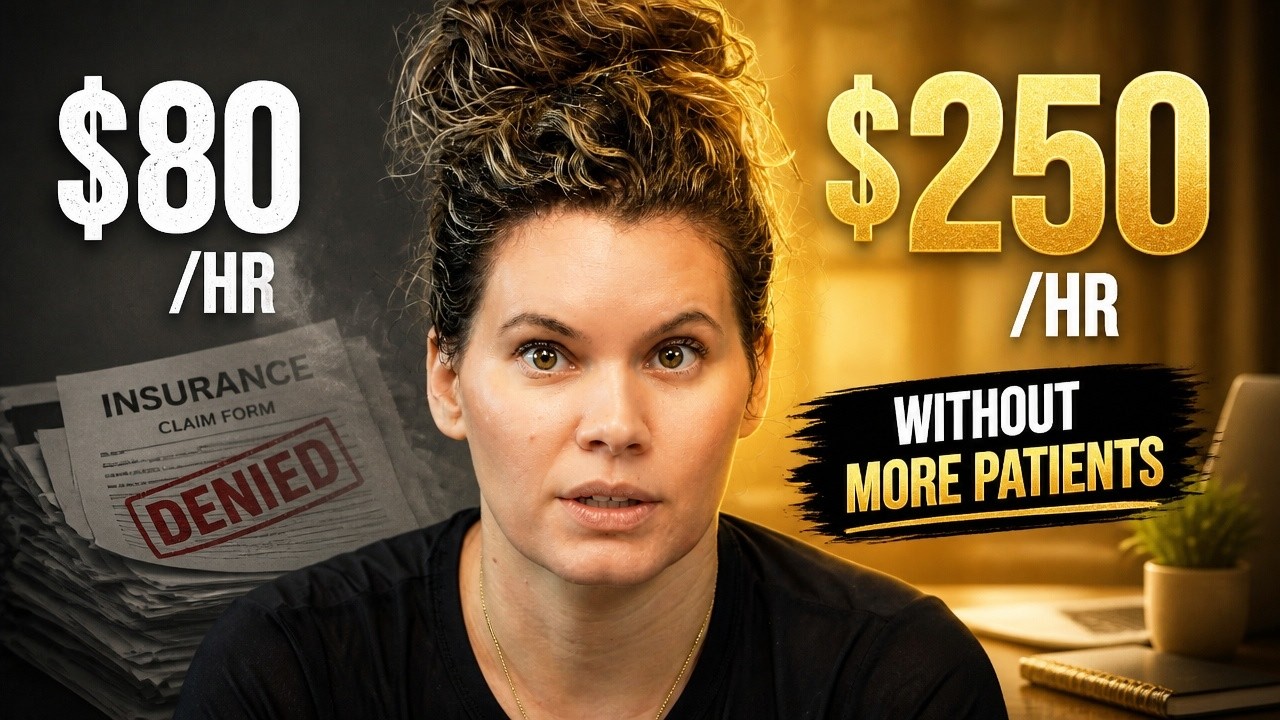
In this solo talk, Kelly Alhooie recounts how she transformed her cash‑based health practice from offering free movement assessments to charging $250 per hour. She begins by describing her early strategy of providing free assessments on running trailheads, leveraging her orthopedic background to attract clients without any branding. During COVID she taught from her balcony, using community feedback to build confidence. As demand grew, she incrementally raised her rates—$80, $120, $150, $185, $230, and finally $250—backed by strong proof points: over 250 five‑star Google reviews, roughly 500 patient visits per month, and countless success stories. Alhooie emphasizes that pricing should be based on the value and speed of results, not geographic location, illustrating this with examples from roofing services, on‑set treatments for movie stars ($700/hr), and luxury hotel clients. She argues that rapid problem resolution commands higher fees, especially among affluent clients. Central to her model is superior communication and listening, which foster client trust and enable premium pricing. The core lesson she shares is that building confidence through free work, gathering proof, and understanding the sweet spot of pricing allows practitioners to charge what they’re truly worth.
Chapters
From $80 an hour to $250 an hour, the exact framework and shift that I needed to make to change my practice, and I'm going to tell you about it today. So here we go. Um, when I first started out, I actually treated people for free, so it was actually even less than $80. I treated them for free. I was running, I was on running trailheads, and I was like, hey, I didn't have a table, I didn't have a shirt, I didn't have a logo, I didn't have anything, I didn't have a company. And I said, let me just do free movement assessments. So I started to do free movement assessments. By the way, I was not a runner, but I had an ortho background and I just figured out like I could look at the knees, the hips, the ankles, and give some feedback. So that's what I did. I used the skills that I already had, which is why I believe we don't need more con ed. Okay. That being said, I needed confidence. I needed to even though I was treating for eight years before I started my practice, eight years I was treating by myself individually in five different states, like doing amazing, got amazing results. I still something about doing my own thing was like almost like a practical all over again where I had to be like, can I do this? And I had to stall belief in myself. And so I then besides the running trailheads, all my neighbors it was during COVID I would literally be teaching from my balcony with my megaphone and yelling down to them like, lift your leg higher, do this exercise. And I would like coach group workout classes and they would give me feedback like, oh my God, this is so freaking awesome. Like, we got to continue to do this. And like, you know, and, and when you hear consistently like, oh my God, this is amazing. Like, this was so cool. Like, let's do this again. It starts to build your confidence a little bit. Some of us, we can build our confidence a lot quicker, and some of us have— we need more reinforcement. And as I started to give this stuff away for free, people are like, damn, like, this is so good. My free stuff was just amazing, and I got amazing results. So people wanted more of it, and they're— and literally I had people being like, well, you should charge for this, or, you know, I'm gonna send my friend to you, or whatever else. And because of that, you're like, okay, well, um, $100, $80. Like, you just throw out random numbers and hopefully they'll be like, yeah, sure, I'll pay you. And they started to pay me. And then I was like, okay, well, I'm charging $80. Let me go up to $120. Let me go up to $150. Let me go— at one point I think I was at $185. Let me go up to— I think I went to $185 to $230. From 230, I went to 250, and the price just kept going up. I stopped at 250 before I sold, but you know, the price goes up because I was able to not only have proof—we had over 250 five-star Google reviews—that's massive amount of proof that we are legit. Okay. Um. What else? Not only did we have that, we had, you know, over 500 patients coming in, or 500 visits a month in a clinic. That is— that's proof right there that what we're doing actually, you know, helps people. Otherwise those numbers would be lower. So that's key. Um, what else is proof? Proof that every single time I treated someone, like, I would get amazing feedback and hear their story about how we changed their lives and like changed their family's lives, and now they're— and so I had— I kept building stories after stories after stories that I could reference of like, wow, damn, like we are really helping people. Uh, and, and that was really cool. And so that right there allowed me to build confidence to say, no, they will pay this. People will come to, to us for this price point because we are worth it. I did have one lady, I remember one time she did leave us a review and was like, these are DC prices and they're in the suburbs. And she was just basing— which is very interesting psychology— she was basing our pricing on where we were located versus the value that we brought. And I'm like, that's so interesting. The pricing should always be based on not the location, whether or not you're in a big city, not city. It should be placed on the value and the results that you get people. And the more that you can get people the better results the fastest, the more your price goes up. So, for instance, if some of you guys have Shockwave, your price goes up because that thing heals things faster. So, your price per visit, if you're doing that, Goes up. That's just, that's literally just the math to it. You're solving people's problems faster and they will pay more. Let me give you another example that's non-medical. If I had a roof leak, let's just say, and I called roofing companies and they were like, hey, like, I can come over in 3 days. One company said that, and the other company said, And by the way, I come over in 3 days and I charge $500 for initial consultation. And the other guy says, I can come over today and I charge $1,000. Which one do you think I'll go with? Uh, yeah, the, the $1,000 one, because my roof is leaking. And if my roof leaks, what are the other things in my house that are going to be affected? I needed ASAP. So if he can come over and solve my problem I'd be willing to double what I would pay someone because he can solve it the fastest. This applies 100% to medical and all realms. People will pay for speed, especially rich people. Rich people— I'm one of them— rich people will pay. They pay for speed because they know the game. Poor people will pay for the slowness and pay for the They won't do the Amazon 2-day thing. They'll be like, oh, I'll just wait 5 days to get my package. Like, that's what poor people tend to do. These are just buying patterns, okay? And you pay for speed. Well, guess what? It's double. Conversely, I used to treat movie stars and movie— I used to go on movie sets and treat people that you all know, very well-known people. And, you know, those people per hour would pay me $700 and something, and this was like 20 years ago. Was it 20 years ago? No, sorry. It was like, but it was still like 14 years ago. It's like 14 years ago. $700 an hour was still a lot of money. Because I came to them on set in their hours of the night. I would be treating at 1 and 2 o'clock in the morning. Yes, my husband would be calling me like, where the heck are you? And I'm like, I'm still waiting on set for them to be done. But the value came because I came to them and I delivered it in 2 seconds. I used to go to 5-star hotels and treat kings and queens as well. And because they were traveling in town, they didn't know anyone, and the hotel knew me, they would call me and the service would be, again, very high price because it's the speed, the speed to the problem. So you pay more. And I need you guys to understand that if you can solve people's problems, and it's not about knowing more clinically, it's about actually communicating and listening. That's how you solve people's problems, by communicating and listening. If you can do both of those skills well, if you can improve your communication and you can improve your listening skills, then you'll win. And you can charge whatever the heck you want because you'll get the results and people will feel heard and they will feel like you're supporting them and taking care of them. That's key. So that's what I would say is how you shift The shift that changed my practice was just building up my confidence, and the faster you can get your hands on people and treat them for free, the faster you can build your confidence to get the stories, the reviews, the successes, the all the things so that you can charge actually what you're worth. And that's the lesson of the day: charge what you're worth. But you've got to do that through building up your confidence and treating a lot of people at different price points to know like what that sweet spot is. All right, guys. Bye bye.