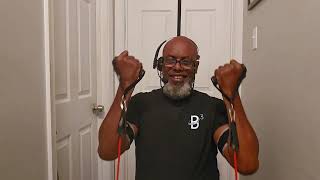
Tawny-pilaster demonstrates a full-body blood flow restriction workout with a 30-20-10 rep scheme, sharing how BFR training helped him rebuild strength after atrophy from congenital neuropathy. He covers band setup, pressures, and sizing, plus his journey toward BFR coaching certification and overcoming discrimination while building a martial-arts business.
Chapters
Tawny-pilaster.
Today I'm gonna share with you one of the kind of new school workouts I do, and I say new school because I was introduced to this way of training in December.
I have to laugh because when I was introduced to the system and I figured, well, you know, they're just bands How difficult could it be?
Because I've used bands before. I went all out on the workout.
Well, I suffered the next 4 days with atrophy because it was too much for me at the time, and I realized it was something that I had to ease into. Well, since I restarted working out again with the bands and as long as I stay consistent with it. This has been the best way that I found to work out of any way I've ever done when it comes to weight resistance, weight training, weight gaining, however you want to, you want to summarize it. I have the headset on today because there are times that I'm going to be facing away from the camera.
I want to make sure that clear. But ever since I started doing this workout, I have no desire to go to the gym.
I have actually made better gains in strength with these bands than I ever have before because it's not just using bands, it's also using BFR bands, which is blood flow resistance bands, and I will show them to you. The cool thing of it is it comes in a great travel bag. So this, this whole unit is very convenient. Throw it over my shoulder and away I go. So even when I'm traveling, it's not an inconvenience.
Something as simple as a chair and I'm in a hallway, that's all the room that I need, and that's all the room you'll need.
You don't need to go big when it comes to this.
On the door behind me, the strap I found that online and it's been just one of the critical pieces of helping me, you know, with my exercise routine because you don't always have grandchildren where you can say, you know, have a seat or stand there and you can wrap a band around them and use them as resistance.
So when I found these, these were perfect and I'm not in a facility, you know, like a gym that may have a pole that I can put the bands around for the added resistance, you know, so that way I can structure things the way I want to. So that, that has been essential with what I do. Now most of the time, like, you go to, you know, to use bands and you're working with a physical therapist and they'll give you different types of bands. Well, this is the kind of bands that are in the kit, and there are different colors of different weight tensions, etc., etc. You know, today I'm going to use a 15-pounder, which is more than essential. And it would be easy to just say, okay, you know, put these on. Now, even with doing curls, because I'm sitting in the chair— because there are some days I'll stand, other days when my balance is a little questionable, you know, I'll sit in the chair and use the chair kind of as a post. And I can do curls this way. So I just may extend my arms further out and bring them back, which causes good tension, but it's better if you stand. That way you get the full measure of the actual exercise while you're doing this. Now I like to incorporate what I use And these are BFR bands, and this is what they look like. I'll end up putting one on each arm. It's a pretty simple task, and I have two separate ones for legs that I don't need at this time, so I can put them aside. Now, these BFR bands are really cool because you actually inflate these, and these are waterproof, so if you want to use them in a pool, you can. There's no damage to the band at all. But there are air chambers that are inside, and these air chambers expand to create restriction on the muscle. Now, I don't want you to think that the muscle is being suffocated because it's not being suffocated. You're just restricting some blood flow to initiate growth hormone. The cool thing about this is a lot of times I would have to work out really hard in order to achieve the kind of burn that I achieve with just a few repetitions using these bands. A great friend of mine, Lana, introduced me to these in December, and instantly I was like, you know what, I definitely want to give them a try. And it was one of the best decisions I could have made. Now these come with a pump. And it's really cool. What's difficult for me because of what goes on with my hands is to put the bands on and then try to connect this little fitting. So instead, I will connect the fitting first, and then once I connect the fitting, then I will slide this on to my arm and I'll show you that whole concept. These come in different sizes, you know, depending on, you know, what your size of your arm or your, or your legs are. You know, you take a measurement, and when you have the bands come in, then it's easy to say, okay, this is the right size, that's the right size. Now with these, you want the nozzles to point in that way you're not catching the nozzle accidentally when you're using the bands or any outside movement. So it protects the actual nozzle, but you just secure them just so that way they do not slide. That's a little loose. So once you connect everything There we go. That way it's a nice little fit. Now on these bands, there's a recommended air pressure that you start with. On mine, it's 200. So it's just a simple test. You just squeeze it and you can feel it expand on your arm. And I'm right here at the 200-pound range. And you just release it. Like I said, me and my fingers that are not the hands of a surgeon, takes a little longer, but it's just that simple. So you can feel the restriction on there as well. It actually is— it feels— might be a little bit low, but it'll be fine for today. And you do the same on the opposite arm. And like I said, I connect it first because it makes it a much simpler process for me, because trying to get this on my arm, I tried that, you know, after the band is around my arm, it was just too much of a struggle. So, and it's not a limitation. People always say, "No, you're limited." It's not a limitation, it's just I have to do things differently. So you bring this up around, same concept, right around the middle of your bicep and secure it. I do the same thing, just pump this up to 200, and then you release it. It's just a little metal clip that releases. You press it in and it releases. But when you have a lack of fine motor skills, it just takes a little longer. Okay, this is done. You can put the pump away. 4 exercises are all I need to do. It's a very simple concept. It doesn't take very long to do these exercises. It used to take me 45 minutes to do the equivalent That takes me 12 to 18 minutes, you know, depending on how I feel. I'm only doing 3 sets on the different exercises, and there's only a 30-second rest in between. And I actually have a little timer down here. I'll set that now so that way every 30 seconds— that way if I get sidetracked, then it's like, okay, Was it long enough, short enough? And you don't want to rest for long periods of time where you have to start, you know, the growth hormone process all over again. So here we are. And like I said, you can even use your feet, you know, whatever, whatever works for you to do the, you know, actual exercise to create the tension that you need. You know, like I said, you can use a chair, use your feet. Sitting, standing, etc., etc. We're just going to start off with curls, 3 sets of curls. You can go as high as 30 reps. We try to do 30, 20, and then 10 reps then. Okay, so here we go. Now, within the 4th to 7th repetition, I can already feel the burn. Oh, it's sliding out from under my feet. Sorry about that. I can already feel the burn just in this first set, just because of these BFR bands. So now going forward, you know, it just, it constantly gets a little more difficult. You have to make sure you maintain control of your breathing because your breathing is essential for everything that you do. So it's something that you need to focus on. And even though I'm talking, I am breathing, you know, through the movements as I'm speaking, and it just makes for a much simpler process. Now, unfortunately, because it slipped out from under my feet, don't know what count I'm on. So that can happen too. So I'll stop there for my first set. I'm only going to take a 30-second rest period and then go to my next set. Just this burn I'm achieving, I may have to do several sets with weights before I achieve the same significance that I feel, you know, just using these right now.
All right, next set.
Very awesome. 30 seconds rest. And like I said, this is something that you have to get used to. If you're not used to doing any exercise at all, you may want to reduce the amount of repetitions you do and build up to 30-20-10, or even 30-20-15. You know, it just depends on who you are. On what kind of condition you're in. I was in very good condition and I still felt the effects of it in a negative way at first. Alright, awesome. My next set is gonna be my chest. Actually, I'm gonna shuffle around what I do. I'm actually going to do tricep extensions overhead. Now the reason why is because one of the exercises you can do is tricep kickbacks. Well, because things don't always feel the same with my arms and my hands and my wrists, tricep kickbacks never benefit me because I just couldn't get the, the right technique That's good. So here, the chair is resistance. I am going to do tricep extensions overhead. That was rough. That was rough, but a good rough.
So sometimes you have to find the right exercise that's effective for you.
You know, there are many people that do tricep kickbacks, and they're a great exercise for them. I had to find something that worked for me. It was the overhead extension. I'm already starting to get a little windy. That's not a bad thing. My triceps are on fire right now, but like, like I said, once you get used to doing this and you kind of appreciate the feeling more than it is something that you dislike. And, and just getting things going in that way in such a short span of time, it's much simpler to do your workout routine. And like I said, just reduce the reps when you first begin because your body has to get used to how this feels. I think I can— I only have 10 in me for this one.
All right, awesome.
Now from here, and the cool thing about this, I'm going to be using The cool thing about this is the loops are big enough. I'm not going to use this one right now. This one's a more essential from where I'm positioned that I'm in. And even with the handles, you can slide it right through. And here I'm going to use these for chest presses. I also have a stool, and sometimes I use that, and that keeps from the back of the chair being in the way. So if you do have a stool, that would definitely work better for you on this particular movement. And because of the position that I'm in, I'm actually going to reposition the chair itself, so that way I get as much tension as I can when I'm doing this exercise. Okay, so we're just going to do just regular chest presses going forward, going for 30. Take a 30-second rest. Let's go move forward a little more, get a little more tension. Like I said, you want that short rest so that way you keep the blood flow going, and it's really essential in how effective these bands work. And believe me, it's well worth it. It is well worth it. And even with the mishaps of the bands, every now and then you'll pull and may not be lined up correctly, or one may come out a little further.
You know, those things are going to happen.
Don't think that you're going to have perfect form with every repetition because that's unrealistic. There are times that it's going to slip or One's going to pull a little more than the other, you know, whatever the case may be, don't get frustrated, just continue through the movement.
It's not even a mishap, it's just that rep was just that rep.
There, 20.
Yeah, this band slipped a little bit, so I have to make sure next time I make it tighter. I'm going to the stay in that position. Now, loosening the band, it doesn't take the air out of the band. I will show you how to release the air, uh, once I get completed. That's it. Alright, awesome. Now we're gonna do our pulls. Or Rose to the back, so I'm going to be facing the other direction. Take my timer, round in this direction, face this way. Looks like my band loosened up on the other side. And that happens sometimes, so, you know, I just have to make an adjustment. Let's adjust the whole other thing instead. And I always squeeze the shoulder blades together when I, when I bring the back. It gives me a better burn and a better feel. Squeeze my shoulder blades on the way back. And you can move your hand in different positions, whether the palms are facing down or facing each other. Everyone has their preference. I've seen people actually do them underhand as well. So whatever your preference is, whatever area you want to target. However you like to do this, you know, you just have to get your own feel for it to see what's effective.
All right, awesome.
2 more sets. There's actually another, uh, exercise I'm going to do, so it'll be 5 exercises that I'll do Sometimes I only do the 4, sometimes I'll take that 5th one and put it with a leg day. Today I feel good, so I'll go with the 5 exercises today. Working up a little burn, a little sweat, but it's been very beneficial. I'm grateful of Atlanta for introducing me to this system because it's the best system that I have used when it came to conditioning. I've actually gained strength where I was told that once it goes away, it never comes back. So this kind of dismisses those theories. Perfect. Yeah, like I said, I have loops. I can adjust this, uh, this horse wrap up and down where if I wanted to have different angles to pull from, you know, I have lower loops where I can come up and out, and if I want to go higher, back and down. So this thing is great because I can make adjustments if I need it.
All right, set.
All right, there's one last set. It's for your shoulder. And again, I go with using my feet as an anchor. Here I don't do as many reps here because I'm already tired in my shoulders just from when I was doing the tricep extensions. So I just go as many reps as I can.
Bring it, sir.
10 is all I have for my first set. So what I've learned not to do is beat myself up over how many reps. If 30 is not achievable today, I'm grateful for the 10. I rest, I do as many on the second, and as many on the third, and then we're done. It's always great to reach those, those levels, but in the early stages, if you do not, then you just keep working at it. thing for me is to keep tension on it to keep it from slipping out from under your feet. But hey, like I said, those things happen.
You just put it back under and keep going. One more set.
I enjoy being as healthy and strong as I possibly can because the only two problems I've ever had health-wise were this nerve disease I was born with and asthma.
I don't have asthma anymore.
It's funny, when I was 6 years old is when it was discovered I had asthma. From age 6 to age 21, every time there was a new medication, a new inhaler, a new Injection, you know, the doctors calling my parents, say, "Oh, try this." I felt like I was a guinea pig. It was one after another. What I learned is it was just helping me live with asthma. When I moved out, I was 21 years old, I stopped taking all medications. And I focused on getting as strong as I possibly could and getting on the exercise bike. I never liked the treadmill. Other, other machines, other devices, skipping rope, to just get my lungs stronger, my body stronger. And since the age of 21, when without taking medication.
I had one asthma attack in my mid-20s.
I'm not against medicine—
medication for others.
I'm not against what doctors believe works.
It just didn't work for me.
I didn't want to live with asthma. I felt restricted by it. Well, no longer restricted. The cool thing about the bands, you can take them off the way you put them on. And that's fine. Or you can take the air out before you take them off, which is just pressing in this little device at the end with your, with your thumb, and lets the air out. And then you take the bands off. A very simple design, but an incredibly effective design for, for growth. It just I don't always have the technical words. That's another thing that I've struggled with was reading comprehension and reading retention. So I'm taking the Certified Coaching course. I haven't gotten word back, but I think I passed. And in doing so, that will certify me as a BFR coach, which I am grateful for the opportunity to learn as much as I can about it to pass this on to others. But I don't always use the technical terms, and it's no disrespect to the medical community or anyone that developed the criteria for it. I just struggle with those things, so I just say it in regular terms. And that's another thing that has happened in my life where people think that because you don't say some things a certain way they deplete your level of education. My education is the same as anyone else that's certified at this level.
I just word it differently.
So I hope you enjoyed this, this part of my workout. It was just the upper body. The lower body workout is coming along with another device that I use that even though it's modern, it's an old school tool design that have been very effective for me and why I'm one of the, you know, multiple reasons as to why I'm able to walk today. So enjoy your time. We're going to take a little break and we'll be back soon.
Just breathe.
This workout's a little different. This one's for lower body. I do not incorporate any calf exercises because I wear the orthotics, so I have restrictions when it comes to calf movement, you know, wearing these orthotics. But for my legs, there's a variation of things that I do that doesn't necessarily incorporate, incorporate the elastic part of the bands, but I do have the BFR bands on my legs.
I don't have a pair of shorts.
I don't have those tights that people wear, you know, but I got sweatpants and they're underneath there. And the exercises that I'm going to do are, even though they're short in duration, there isn't a lot of rest period, you know, from transitioning. So from here, I can use this as a balance, or I can freestand. And you're just going to do short squats. So you get down in a short squat position and you just bounce for 30 seconds. And if I lose my balance, I have the walls, I have the little stool, I have something to steady myself in case that happens. And I can already feel it in my legs from having the BFR bands on them. You know, just, it causes a reaction a lot faster than Metabo. So after 30 seconds, I just relax. Here you can shake your legs out if you need to, or you just move around however it is you want to do. Now from here, they're going to be kickbacks. So my leg's going to go just up and back. So I'm going to keep my upper body up as, as high as I can. So I can go here if I want to, here if I want to. You can bend your front knee a little, you know, whatever the most comfortable position is. It's almost a martial arts stance, okay? And here, the back leg's just going to come straight up and straight back down, and you just do that for 30 seconds. Alright, after 30 seconds you just switch legs and repeat on the other side. Now for me, one hip always feels a little tighter than the other. So how I swing my leg is a little bit different, but I get the same effect out of it.
There we go.
So that's that. And then we can go back to the squatting position again. So I have to 30 seconds. Go back. Some of these things will repeat. There are things that I'm going to mix in along the way. It's a lot shorter workout than the upper body workout, but it's been very effective. There we are, back in the squat position.
Same thing. Feeling it in my legs. Glad I had the walls.
From here we're going to change to a little different variation exercise. Okay, from here we're going to do a step back. Okay, so from here step back in this position, come back up, and then switch sides. Like I said, I use this to stabilize because I have the issues with my balance, but I do what I can to slow the movement down to maintain as much control as possible. If going faster is more comfortable for you, then that's what you do. But for me, it's more about maintaining control and keeping my balance than anything else. I'd rather get 3 repetitions that are good than 10 that are bad.
One more on this side. Good.
I'll go back to squatting again on the next exercise. That's usually my, my chain. You know, I start with a squat, then I change, go back to the squat after that. Sometimes I'll cycle the exercises around, and I may only do the same one or two other than the squat. We'll do one more for today. That one is more related to a back kick. Okay, so here you're actually going to hold on to something if you do not have the balance. You're going to come up.
Back, come back. Down, right, down.
Now to add intensity to this exercise, I could add the bands that I have that go on my ankles to add more resistance. But not today. I definitely need my cane when I get done, especially if I go out.
That way there's less chance of a Phil surprising us.
Sometimes, like, my legs start to get heavy, I'll drop. Try not to drop. Try to bring them all the way back up front and back. Goes back to maintaining control. It also gets the hip flexors loose. Which can be good because once you're done this kind of routine, you want to stretch. It'll help loosen the hips up to get better grip. Okay, so like I said, my leg workouts are really short because I don't focus on the calves at all.
I just do my martial arts for that because I have the restrictions from the bands— I'm sorry, from the orthotics that I wear. But you just keep going, do the best you can, and we're gonna go to the next segment.
Now, to add to my leg workout, you know, I had mentioned before how I use old school Old school and new school techniques. Well, even though this is a new design, it's a Maxi Climber, it's an old school technique for me. Years ago, in my 20s, I was a member of Gold's Gym, and I used to get on their climber all the time. And one of the owners is a friend of mine, and he said, I gotta ask you, I was like, what's He said, "Why do you get on that machine?" I said, "It gives me a great overall workout and it's really great for my legs." And like I said, this is before I knew about CMT. And I said, "I actually like getting on it." So he goes, "Well, do you have something that that could fit in?" I said, "Well, what do you mean?" He said, "You can take it." I said, "Why?" He said, you're the only one that uses it.
I was shocked by that. I was like, really?
I said, unfortunately I don't. He said, yeah, we're going to get rid of it and put a different piece of equipment there because you're the only one that uses it. And all the days that we've been here, I guess no one else sees the benefit that you do, but I do. And what I do is, is I do 1 minute on, 1 minute off, and when I do that, the benefits of it are just tremendous. But one of the things that I do is I count, I count them as rounds, 1-minute rounds, and I'm off. And then once I get used to doing the routine, then I go up 2 minutes on, 1 minute off, etc., etc. And I just keep increasing whether it's minutes or rounds as I go up, you know. So I'll just do this simple concept of just a 1-minute round. Now I usually change my footwear because it's a little more stable for me to have my sneakers on than the Otomics, but I'll just use the Otomics today. And I just focus on rhythm, you know, so I just focus on rhythm. I'm not worrying about speed right now. I just focus on rhythm to maintain the movement, because for me, that's what benefits me, is just consistency. So having a consistent movement, this is why I love I love the elliptical machine so much, and it's less stressful on my body than a treadmill. And even though I have a treadmill here, I don't use it because an elliptical machine is so much more beneficial. I'm sure one day I'll just replace the treadmill with the elliptical since I stopped going to the gym. But just overall, it's just great because it just keeps me in constant motion. And my legs get tired, I use my arms and do everything I can. Mounting and dismounting sometimes a little tricky, my feet will start to slip, but I'm glad I'm strong enough to catch myself, but I'm aware of that, so I just make adjustments. So these are some of the things that I incorporate into my training going forward. I'm going to focus on more of the martial arts that I use, probably have some of my instructors join in with me and show some of the things that we do. I just have a blast doing what I do, how I do it, and I hope you'll do the same. So just breathe.
Even though sometimes I struggle when I train, I just keep training. No matter what kind of day it is, you know, there are times that I have some of the roughest days training. Just things just don't function well. They don't feel right. It's just a difficult, difficult day. But I'd rather have a difficult day training than not train at all. Those difficult days remind me of, you know, being told that I wouldn't be able to do this, especially now. You know, a long time ago I was supposed to have stopped, and I'm glad that I didn't. One of the people that motivates me is my dad because he's 82 years old and he's still going. And what I mean by still going, he had dual careers at the same time. One he still does to this day.
The first one, he was a police officer.
But for the past 5 decades he's been a stuntman. It's very impressive, you know, to see someone at any age doing stunts. It's just amazing to me, you know, growing up around it. I was just amazed by it, but I didn't want to do it, especially one of his specialties is high falls. I'm not afraid of heights, don't get me wrong. I can go as high as you want to go. We can twist and we can turn, but I don't like that rapid descent. I guess he gets a rush out of it because I didn't like standing looking over the edge of a building and looking at something on the ground. I looked like it was nothing more than a matchbox. And that's where you want me to land? No, thank you. I'll stick with the martial arts. It's a whole lot safer. We had the pleasure of sharing a moment together recently. We were on a podcast called The Good, The Bad, and The Ugly. Hosted by Katrin Becker. She's someone I was introduced to, you know, through one of the books that I was a contributing author. It's actually behind me, The Arctic Connection. And she's just an amazing person, and I'm so grateful, just like my dad is, you know, for having us on her podcast. It was just an amazing time, and hanging out with my dad, and we're going back and forth about stuff, you know. Those are the things that mean the world to me when it comes to the people that I have in my circle. My circle is huge. It's like If we see each other every day or don't see each other for 10 years, it's still the same. It's like we saw each other yesterday. We just pick up from where we left off, no matter what the length of time is. And that's what I love about all my families, because I got a lot of branches on my tree. I'm grateful for the ability that I have with martial arts, and I want nothing more than to everyone around me to achieve more than I did. I'm grateful for what I've done, and I see more things coming, but I always want people to do more than me. It can get difficult sometimes in seeing, I guess you can say, the light. It really can. But because I know it's there is why I continue to go forward. Doesn't mean that it's not going to be difficult at times because that's the way my life has always been. But anytime I start to doubt myself, I think about those times that were difficult for me that I've already gotten through. I am excited to show some of the things that, you know, my team and I do as a martial artist. I will be very happy to reopen my school. When that happens, I do not know, but I know it will because it already has, even when I was told that it wouldn't. It's funny, it's a touchy subject to a lot of people. But I ran into some obstacles throughout the last 4 years when it comes to having an established location for my school. And it's a shame because a lot of people don't want to have that conversation about discrimination, but it, it It exists. It's alive and well, unfortunately. But one of the things that I've always said to people is how not only me, but people in my family, they have some of the most incredible and simplistic way of looking at things that I've picked up a lot over the years. I had someone come to me and say, "Well, you know, what's the problem? Why don't you just get a loan?" And I told them, "Look, I've been inconsistent with my income because Social Security, for whatever reason, they have told me more than once that I'm no longer disabled." And that's because they see that I have ability and I don't define myself as a disabled person, even though I am. But one of the things that I said to them recently was, "I don't know how you define disabled." And they say, "Oh, well, you work consistently for years even though it was part-time, so we don't see how you're still disabled." And once I explained to them that my disability is not based on an injury, they still want to play the tennis game of smashing, you know, serving it over and then I smash it back. But what always stops them is when you say something that they can't dispute. Oftentimes it quiets the room. The last person that I encountered who said, "Well, you're no longer disabled." My question to them was, "Well, as of yesterday, I still have the neuropathy that I was diagnosed with that is incurable as of yesterday." So how am I no longer disabled? And then the room goes silent. And it's no different than people at different banking establishments who, some of them just wanted information because they love my program. But they don't love it for me, they love it for other people that they know. And one particular person who denied me of a loan, I couldn't help but use a line that my uncle has— I'm sorry, my cousin has— that it was just so simple, but again, it quiets the room. People don't want to talk about redlining because, you know, then they talk about what happened years ago with people of my color, and I always hear how things are not the same. So what I said to this person is, When they said to me, when I gave my business proposal and they said, we need 7 things from you. In no time at all, I had those 7 things. And then I did a follow-up appointment with them. Then they said, well, you know what, to secure everything, we need 3 more. I got those 3 things. The next visit they said, "You know what, we just need two more things from you and you can sign on the dotted line." Well, one of those things I was unable to get. And then I learned that this particular person knew someone who has a martial arts school and he was gathering information to benefit them. So what I won't do is decide that it was based on the color of my skin, but it wasn't hard to confirm that it was because I asked that one particular question. And I, my cousin and I always laugh about it. And I asked this person, why do you keep moving the finish line? And there was silence. And I didn't say anything else until this person responded. And then they finally said, well, what do you mean? I was like, well, I was told if I have these 7 things, I would be approved, and I had those 7. And then the second round is I needed 3 more, and I, I got those 3 things and still was not approved. Then I said I needed— that I was told I needed 2 more, and I can only produce 1 out of the 2, and then all of a sudden the deal is off. So my question remains the same: why do you keep moving the finish line? Now, what I used to do when I was younger was get angry, but instead I developed a philosophy decades ago that I live by today. Is I told that person, that's fine, I'll just go be successful without you. And I have been, and I continue to be successful without them. With or without a school at this time, I'm still successful without them because I did not allow them to bring me down. I could have easily just given up, but that's just one person. That one person doesn't define who I am, what I do, what I'm about, what will happen going forward. I would just be successful without them. And that's how I am in life. It's okay that we disagree. You don't have to like it. I don't have to like it. We just disagree. Whether you're right and I disagree with you, I'm right and you disagree with me, those things are irrelevant to me. We just disagree, and I would just move on and be successful without you. There's no hard feelings. It took me a long time to understand that. But I understand it clearly, and I hope that anyone that listens to this understands that as well. You can go be successful without that person or those people or that organization. You can blaze your own trail where those same people that said no are now following you. Don't ever think that they define how things are. They may make it difficult, they may give you more stepping stones than you anticipated, but they don't define your outcome. It's hard to swallow sometimes, especially when you're so driven to get something done in the time that you want to get it done. But you have to understand, you'll be fine. So I hope everyone just has a wonderful and blessed day. Please go check out The Good, the Bad, and the Ugly with Katrin Becker. She's an amazing woman, and I'm just humbled by her. It's just such a pleasure to meet her and to know her, and I look forward to seeing everyone soon. Just breathe.