#119 AVIATION WEATHER TOOLS | can be right on | OR NOT | day 119 cwk
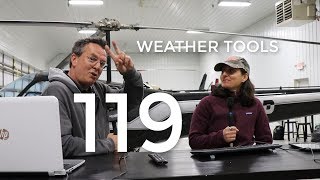
Kenny and Holly discuss why aviation weather reports often disagree with what pilots actually see. They cover MOS, TAF, ForeFlight, and AWOS data during a cross-country flight with low ceilings and poor visibility, and explain why trusting a small VFR pocket in widespread low ceilings can kill you.
Chapters
Day 119 and there's a shot of my beautiful channel. I get to look at every single morning when I wake up and there's a look at the sky. Holly's still in the hotel. She just text me, weather's still not looking good. I'm Kenny Culler, the crater helicopter online ground school and we're continuing the story of Holly's cross country trip. So we shot a piece for you last night before we left the hangar having this discussion about weather and we're going to dive in a little bit into the weather reporting tools. Sometimes the weather reporting reporting tools can be so awesome and ride on. Other times they can fool you a little bit. So we're going to dive into that just a little bit. So I'm going to take you to that clip. After showing my Jeep cup at a 1942 Willys. Had to sell it one time, got tough. Maybe I'll buy it back one day. Alright, so we're gonna head to that clip where Holly's gonna dive a little bit into some of the thought process behind her weather planning and the things that she's been looking at. So let's go to that clip. Alright, so Holly, tell us about today. Where are we at in your flight planning and your trip and what's going on?
Today is day seven of my two and a half day ferry and ceilings pretty low everywhere. A big stationary front between here and where I need to go and got up and looked out the window and couldn't see a whole lot. A few hours later took my friend to the airport in Fort Wayne and if you take a look at these photos, you can see there were towers all along my drive that you couldn't see the tops of. So this stuff has just been hanging around, hasn't really lifted. Hoping tomorrow it will lift enough that I can make a little bit more headway. But for today, still stuck.
And so what we were discussing before making this video, I know over the years I've always felt like weather reporting stations sometimes can be right, but boy, sometimes can they be not right. And what you find out there in the real world is nothing like what they're reporting or even what you're looking at like in the chart that we're showing you. So just elaborate a little more how that relates to your trip.
For one thing, the forecast has been really complicated. So each new iteration of the forecast discussion has a really different scenario. And then depending on whether you look at the moss or the taff, you get a lot of really different information and so that forecast has not been super reliable. And then also just along the way, you know something in particular that we encountered the other day. And if you take a look at this little bit of what was going on in foreflight, you can see that you've got areas with a lot of, to the west you got low ifr, ifr, mvfr. You have the frontal activity there with a lot of moisture and some convection. And then as you go to the west, still some low ceilings and stuff, but you see these little spots of VFR scattered throughout. And if you look at that, you gotta look pretty closely at that and think, you suppose that's really vfr, right.
Because there's probably lots of low hanging aftermath stations are spread far apart. What you're seeing is not what's going to be there in reality, right?
It might be, but chances are when you have that much activity, probably not. So coming through the other day, looking at this and you're seeing, and you're listening to the awas and they're reporting seven, seven miles sky clear. And when you think about it, so as far as ceilings are reported, it's going to be your lowest level of broken or overcast if you want to go into that further. Taz has a really excellent video in the instrument portion of the online ground training and he goes over how that is determined. And you know, the sky is broken up into eights and does a really good job of laying that out. But if you don't have a broken layer or if the instruments are not reporting a broken layer or overcast, they're going to say it's sky clear. Right. Unless it's clearly haze or fog or mist. But in some areas you don't have that. So we were coming across through Chicago, south of Chicago you got this giant body of water to the north. Everything had been flooded for a few days. So there's a lot of moisture in the air, a lot of moisture in the ground. You've got all these plants that are pumping up a whole bunch of steam, exhaust and then you know, a lot of weather around us. So there's air pollution from the city.
Sure.
So you got particulate matter and they're reporting sky clear. And you're flying through there going, it's not clear exactly. Definitely not how that goes.
Right.
So just keep in mind when you're doing your forecasting, you're looking at your route and you see, even if it's like a whole section of it along your route, but you know you're sandwiched, you got weather Here you got weather there, you've got low ceilings around. It's very likely that that's not going to be vfr. So you can't really count on it. And if you get in there and you see that's what's going on, which is what happened to us the other night.
Sure.
You know, you got to divert, you maybe put it down for a while, you hang out and wait for ceilings to lift. But this is a good guideline. Your foreflight or Jefferson or whatever it is that you're using for, you know, your route planning and stuff. But that doesn't, don't take it for face value, you know.
Right. Understand it's a tool that's helping you make your decision. But what you're seeing, I guess what I'm getting from it is, you know, you get hopeful by what you're looking at there. But the real world is it's probably going to be worse than what it's showing you.
Right? Yes. When you have all that other stuff going on. That's exactly. That's like the digital version of the sucker hole.
Sure.
Right. Oh, there's a little blue sky. I think I can make it. And you look at that and you think, oh, we've got VFR along our route, but when there's that much activity, it's unlikely. So just really consider that.
Awesome. All right, well give us a comment down below and we'll go back to Shout out. Oh yeah. And a shout out to Mike Stillman from Erdos. Southern shore of Virginia, Eastern shore of Virginia. Holly and I both have flown with Mike and she had the hat on today and she goes, hey, look, look at my hat. I'm like, oh yeah, Stillman, how cool is that?
So still my favorite baseball cap, Mike. So I take it everywhere with me.
He's a lot of fun. So here's to you, Mike Stillman. See you in the next video. Back to the kitchen with Kenny. Alright, well, thanks for tuning in. Saturday, my favorite day of the week. Coffee with Kenny. Day 119. This has been awesome. All of you have been awesome. Please put your comments down below. We'd love to hear about your weather thought process. Things you've seen, things that are good, things that are bad. It's all a part of the process in these weather decisions, people is what you really, you know, it's life or death situation. Can be making good decisions, deciding to stay on the ground when you need to stay on the ground. I can't stress it enough. Holly mentioned Taz Chrisman in the Video about our instrument online course. Let's talk about that for a minute. 2018 Flight Instructor of the year Dan Taz Chrisman does the majority of the training inside our instrument online course. Taz is an amazing instructor and when he was filming that stuff, he would send it to me. He did most of the filming on his own in Las Vegas and he would send me the files and I would do most of the editing and Taz just blew me away. I sat back and went, oh my God, Taz, these videos are so incredible. He's a good instructor, but he built the presentations all on his own. So not only is he a good instructor, down to Earth has an awesome way of teaching. His presentations are awesome as well. That is our helicopter online ground school instrument course. There's a monthly option, there's a yearly option, and then it's also included in our big professional pilot package. So for that monthly or yearly option, you have a 24 hour test flight where you can go in and check the instrument course online. So we have to think TAs for the instrument course. There'll be a link down below for helicopter and ground school. You can check out any of our courses. But today I want to highlight the instrument course. You know, instrument rating is good for anybody. Whether you think you're going to need it as a career or even for a private pilot. We highly, highly, highly recommend the instrument training. We highly recommend you get the instrument rating. It will make you a better pilot, it will make you a safer pilot, it will make you fly with more precision. There are so many good reasons to pursue that instrument. Ratings go down below to check out our instrument course. Taz Christman, the the lead instructor for that course. Amazing. Absolutely amazing. Alright, so give us your comments down below. Please subscribe to the channel. Tomorrow will be day 120 as the story continues as the rotor turns. This is amazing. Absolutely love it. People gotta thank every single one of you for all the comments. The likes. Please give us a thumbs up today and we will see you tomorrow.










