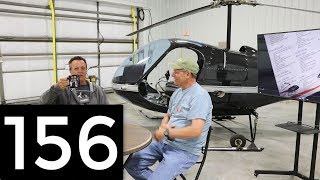
Ray Plum switched from an R22 to a turbocharged Enstrom helicopter for better performance at his 7,500-foot elevation. Kenny Keller walks through the transition training, emphasizing trim and throttle friction, and notes the Enstrom's greater stability compared to the R22.
Questions this video answers
Day 156
One hour (with the aircraft's previous owner)
About 7,500 ft
Four days
Turbocharged engine (for better performance at high density altitudes)
Chapters
That's right. All right, here we go. Day 155, coffee with Kenny. I'm sorry, 156, I can never get it right. Today I have Ray Plum here, helicopter land girls school member who's here to fly the instrument. I'll let you tell him a little bit more about that. Rolling in the background, we have a picture of or a video of his Enstrom helicopter that I saw at Heli Expo 2018. And when I was there, I was like, I can remember publicly stating, man, if I was in the market and was looking to buy an aircraft, I'd be trying to take this thing home with me. So what a beautiful aircraft. So I'm going to hand Ray the mic. Just let him give you a quick description of why he's here and what we're going to do this week.
Thank you. Well, the reason I'm here, I better get this point of the right direction here is I'd. You know, I had a dream of buying a helicopter for many years, ever since I was a kid. So the opportunity came to buy one actually out of England. And after looking at the log books, I turned that one down. And at the same time, I found this machine here. And so once I've got that, I've been watching Kenny's online ground school stuff and his YouTube videos, thought, man, he's talking up this instrument pretty good. So anyway, I purchased it and contacted Kenny, and now I want to come and kind of find out the nuances of this aircraft and basically learn to fly it.
Awesome. We're going to have a good time this week. And this is fun because we're not going for a rating. We're just going to get him comfortable. Private pilot, most of his time in the R22. And I've talked about this in the past and even made a couple videos, but we're gonna do an update video in a couple days after we've went out. And we met real quick yesterday when he got in town, just so we know he knew where to go today. And. And I already showed him kind of the nuances. Like you got to understand the throttle friction, very important part, and adjusting the mixture and just some of the little things. We didn't talk about trim yet. Trim we'll be talking about. Because you got to trim this. You. You don't have to, but it makes life easy the faster you learn to use the trim. And in the R22, you don't have trim, so. And you've flown jet. Jet Ranger time, too, right?
I Did fly my aircraft one time with the owner, the previous owner, for an hour. He didn't let me take off or land for some reason. But anyway, I did play with the trim and it was very, it was a very nice to be able to trim it.
So, yeah, using trim's a big one. All right. In our discussion yesterday, we talked about kit helicopters a little bit. And I've made my. I don't know, I've done some videos on experimental. People ask me a lot about experimental and I just usually say I really can't say a whole lot because I've never flown experimentals or kit helicopters. I've just always stayed with FAA certified aircraft. But Ray's willing to talk about them just a little bit with his experience. So go ahead and tell us what you have to say about the kit or experimental helicopters.
Okay. Well, many, many years ago, I bought a kit helicopter and I got it all together. And one of the problems was a lot of the customers that were buying them weren't really qualified to put them together, let alone fly them. And there were some problems, some people got hurt, and then I quickly realized maybe this thing isn't for me. So I actually sold it. And so I've been without a helicopter for a long time. And that's, that's why I came into buying this instrument is because it was a production made helicopter that, that had some engine, some real engineering in it. So that's where we're at today.
Awesome. So what would be your. You said you've done some research on the instruments, so what do you, what are you expecting without. You've got one hour in instruments, right?
That's correct.
One hour so far in. And you didn't get it in your aircraft, right?
Or you mine?
You did get it in yours?
Yeah, I flew with the owner before I bought it, yeah.
Okay, so you got one hour with the guy that you bought it from. So. And wanting to learn more, kind of just tell us what are you expecting and what do you, how do you think you'll feel after a couple days of going out and flying?
Well, I think I'll feel fine. One of the reasons I bought the instrument is because I live at 7,500ft. So I've been told by many people that in a windy condition, the instrument is a much more forgiving helicopter. And also it's turbocharged, so our density altitude could be maybe, you know, nine, 10,000ft on any given day, maybe higher. Real hot summer day. So I'm expecting that helicopter to perform a little Bit better than some of the other brands, so.
Awesome. Well, I can tell you that yes, after what you've been in, particularly R22, this is a heck of a lot more stable in the wind for sure. Just being a heavier aircraft, the high inertia rotor system, I think couple days you're here for four days. And yesterday I said, you know, weather permitting, we get out flying heck, a couple days, you may be going, heck, I'm ready to go home. I think you'll find it a very, you'll probably transition and get comfortable maybe faster than you think. Just depends on how much we can fly. But I think you'll. In a day or two, we'll do another video and I think you'll be able to be here grinning, going, wow. Because again, the instrument is so freaking stable. And as long as you learn to use that trim, you know, adjust the friction properly on the, on the throttle, understand the minute little movements of the instrument. It's like you just learn, have to learn how to talk to it, is what I always say. It's, it's really just like it almost flies itself and people laugh at me sometimes. But once you learn the trim and how to set everything, the, it's actually so minute. The changes are just so small. And that really is the trick is just not man handling it, but just being really, really super gentle is really the key.
Fly it enough so that you're comfortable with me flying it and you know, when you're ready to kick me out of here, then I'm good to go and, and I can always get some more training, you know, I mean that's not, that's, that's a possibility too. But I do want to be comfortable, so that's why I'm here.
Awesome. Well, hey, we're gonna wrap this up so we can start kind of looking over the cream puff here in the background and, and just kind of talk about some of the things before we pull out and get fuel and go fly. I am Kenny Keller, creator, Helicopter Land Ground School. You can take our Helicopter Land Ground school for a 24 hour test flight. Down below links down below 24 hours. Check out our private commercial CFI or instrument packages. There's also links down below for our Amazon best sellers top 10 checkride tips I did with Taz Christman 2018 flight instructor of the Year and then also helicopter Checkride. Both of those. You can go below for a link. We bought them for you. We just ship them to you shipping, handling. So thanks for coming up all the way from Colorado. This will be fun week. We'll see you in coffee with Kenny tomorrow and then maybe we'll be back on tomorrow. Or maybe we'll a couple days. But we'll get some training under our belt and then we'll come back and revisit. Private pilot with a bunch of R22 time. Getting some good, you know, quality time to go out and really get comfortable and come back in and revisit. So thanks again for coming up and like subscribe, comment down below and we'll see you in day 157. Hell yeah.