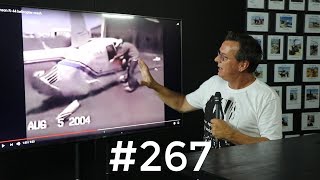
Kenny Keller (Coffee With Kenny, Day 267) reviews a stabilized 2004 video of a Robinson R-44 striking a hangar door, destroying the aircraft but with occupants apparently walking away. He uses the clip to stress situational awareness when changing operating environments, describes a local mitigation (a red pavement line and a rule: no starting/shutting down or operating with doors open near the hangar), and strongly recommends performing a hover pre-takeoff check (clear left, right, and above) — slow, smooth, and methodical control to avoid similar accidents. The episode closes with a brief promotion for helicopterground.com and upcoming episodes.
Questions this video answers
2004
Chapters
Day 267, coffee with Kenny, and we're looking at R44 crumpled up on the ground. And we're going to look at that video in a minute, and you'll see exactly what happens. We're all human beings. We all make mistakes, and we all do stupid stuff, right? So with that being said, we got to always be thinking about our surroundings. Always, always, always. And I'm going to take you outside right now. I'm going to share a video I just made a little bit ago. And there was too much noise outside, so I'm just gonna take out the audio and talk you through it. There's a red line there on the ground. One of our ground school members that was here a few months ago, he was like, hey, Kenny, I would like to paint a red line on the pavement out there for you that keeps your helicopter out far enough from the hangar while the blades are moving. And I'm like, awesome. He was really handy around here. He helped me with the instrument. Change some oil and paint some blades and do some stuff. But anyway, we figured out with doors closed, where the helicopter can land. In that red line is a line that you never let the skids get past that red line. As long as we don't get the skids past that red line, the rotor blades will be clear of the hangar. And during that discussion, we made a decision. We will not start or shut down aircraft here, land or take off with the doors open. And now we got studio walls in here we have to be concerned with as well. So it's a great idea. Anyway, so something that we just did. And coming from an operation where for 10 years, I operated on a ramp where we pulled the helicopter all the way out on a big ramp, never operating close to the hangar. It was never an issue for us. So moving here just a few months ago, once we got here, we had to physically think, right? When you change the operation, you change something that you change your method of operation from something you used to do to, and you change it to do something different. Always think about all the bad things that can happen because you get in one habit, and it can screw you in the next phase of a new method if you're not being super careful. So let's take a look at the video. Luckily, you can see that moving around, somebody stabilized this video. It's pretty old 2004, but I remember seeing this a long time ago. And you're going to see here shortly how the helicopter gets destroyed. So again, as human beings, we got to be Thinking about what we're doing all the time. We're prone to make mistakes. We're prone for things to get screwed up. They're going for a flight on a nice day. Got the door off. There's passengers in the back. This guy goes over to check something. I don't know what he's doing. So he's running up the helicopter. All right, he's got it about ready to go. Here we go. Coming up. No hover pre takeoff check. And bam. Devastating. Now from the looks of it, everybody's okay. Toward near the end of the video, you'll see somebody walking away. And one person might be limping. They're kind of helping them. But appears that everybody ended up being okay. That's number one, right? We want everybody to be safe. But we just destroyed an aircraft. And think how bad you would feel number one for your passengers. And you'd be embarrassed. And look at how many, you know, couple hundred thousand dollars of damage probably at least, if not more. There you can see the big bite out of the hangar door. And here they do go around and give you a look at the aircraft after the fact. The only thing, the critique I would make. And I'm just posing this as a question. Let's back up. What if he was taken off? I want you to think about something. I do see him look to the right. I don't really see him. Clear left. Maybe he did, maybe he didn't. But he picks up and just goes straight up. What if he'd have paused right about there? What if he would have paused and said, okay, hover pre takeoff check. Warning, caution lights are out. How much power we pull in? Everything looks good. Let's clear left. Clear right. Oh, wow. Hangar door. Let's slide out a little bit. Could that prevented it? Not saying it would have, but what if. Slow, smooth, methodical. And something else I know that I always say, clear left, clear right. And occasionally I'll fly with someone who says, what about clearing above? And I always go, oh, yeah, because I was trained. Left, right, left, right, left, right. I never think about clearing above. That's a good one to add to your pre takeoff check. Why not? Clear left, Clear right. Clear above. Hangar door, parachuters and other environments. Who knows? So one thought. Clear left, clear right. Clear above. But I still have to. I have to say, what if he would have stopped? And whether it was 10 seconds or 20 seconds for a hover pre takeoff check. Clear left and right. Look around. Maybe it wouldn't have happened. Let's look at it One more time. Boom. Devastating. Absolutely devastating. I cannot imagine the embarrassment that this gentleman went through after the fact. Again, looks like everybody was okay in the end. That's what we want, right? We want everybody to walk away and we want everybody to be safe. Maybe we'll skip to the end. There's another look of just the damage. I want to show you where they're walking away, seeing everybody's okay. All right, so here you go. Here's where people are walking away. So that's good. So let's use that one as a learning tool again. We are human beings, right? And we make mistakes. So I want to kind of go back to remember when you change a method of operation to really think through it and kind of do our like we did that day when we're like, you know what, we better come up with some rules and guidelines for how we're going to operate here. Because it was a big change moving here. And if we weren't careful, we could do something like a rotor blade end up into an open hangar door. Right? I mean, it could happen to anyone. So slow, smooth, methodical. Check your surroundings. And I want to leave with. I still have to preach the hover pre takeoff check. I'm a firm believer. I do them every single time. I will not take off without one. I just think that 5 seconds, 10 seconds, 20 seconds, however long you make it, pull up to a hover, breathe in and out. Take a look at everything real quick. Clear left, clear right. And try to remember to clear above. Oh, somebody text me. Forgot to turn off the ringer today. So anyway, I'm Kenny Keller, Crater Helicopter Line ground school. You can go down to helicopterground.com below to check out all of our training courses. Private, commercial, CFI instrument, and we have additions for R22, R44 and Nstrom to those memberships where you can not only learn, for example, the private pilot level information you need to know for your checkride, written test for the private. And then you could go through the R22, R44 or Nstrom courses to help you learn that valuable information. The things in the PoH that you got to memorize and you have to know, like emergency procedures and all that kind of good stuff. So go down below to helicopterground.com to check those out. Subscribe to the channel, click the bell. Thanks for joining us, day 267 and we'll see you in 268. Peace out.