#277 - What should be in the Helicopter Safety Briefing?
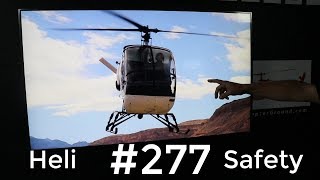
Kenny Keller walks through what a helicopter safety briefing should cover: rotor clearance, approach and exit procedures, seat belts, headset use, and survival gear. He cites the Helicopter Flying Handbook and adds practical items operators learn from experience, then recommends using briefing cards or short safety videos.
Chapters
Day 277, coffee with Kenny. I think there's maybe too many helicopters here, a little too close together. We've got what looks like should be a landing area and then a parking area, I would say designed for two, and you got four. This is from our presentation on heliports. I'll put the link down below. It was an FAA webinar we did on heliports. It's really cool. You should check that out. And today we're going to cover what should be in a safety briefing. I am Kenny Keller, Creator Helicopter Align ground School Day 277, Coffee with Kenny and a member said, hey, Kenny, what kind of things should be in a passenger briefing? So let me start off by saying we're gonna go to the Helicopter Flying Handbook here in a minute and cover a lot of the general things. Now for any particular operation, of course, some things might be a little bit different. So this is going to be kind of a standard of things that probably should be in one. But of course, depending on make, model, where in the world you're flying, this could change. And any organization or company should have their own set passenger briefing. And you can go online and find lots of different ones. I was checking out quite a few of them today, and I thought we'd just go over the one that's in the Helicopter Flying Handbook. So they just mentioned safety around helicopters approaching or leaving a helicopter. From the Helicopter Flying Handbook. First we have do not approach or leave without the pilot's visual acknowledgement. Keeping pilot's field of vision at all times. Observe helicopter safety zones. See diagram at right. And we'll cover that. Just a minute. We'll go ahead and go through these. On sloping ground, always approach or leave on the down slope side for maximum rotor clearance. Makes sense. If blinded by swirling dust or grit, stop, crouch lower, or sit down and wait for assistance. If disembarking while helicopter is at the hover, get out and off in a smooth, unhurried manner. Do not approach or leave a helicopter when the engine rotors are running down or starting up, because of course, the rotors will hang lower. And in some models you can get hit. If you're standing straight up, you will get hit by a rotor blade. Proceed in a crouching manner. For extra rotor clearance, hold on to a hat. Unless chin straps are used, Never reach up or chase after a hat or any other articles that are blown away. Because of course, what could happen, you'd end up running yourself right into the tail rotor or the main rotor. As well carry tools, etc. Horizontally below waist level, never upright or on the shoulder. Makes sense, right? You're carrying something and it's straight up, it's going to get into the rotor blade. So if you look online, you'll see different variations of this. And again, this could depend on make and model of aircraft. So there are other things that could go into play here. But again, this is from the helicopter flying Handbook. So prohibited is in the rear, right? Because we know the tail rotor. You don't ever want your passengers near the tail rotor. And you got to explain that to them. And you got to have people helping you. And there's just so many ways that a person could end up walking into a tail rotor. So then they show preferred on the sides and acceptable in the front. Again, this could vary make and model, but this gives you an idea. So again, different companies need to have their own specific for their aircraft and their operation. Couple additional. Never grope or feel your way toward or away from the helicopter. Protect hearing by wearing earplugs or earmuffs. And then, of course, there's plenty of other things to consider. Where are you located? Where are people going to stand? What are the operations in and around any hangar or airport or fairgrounds or anywhere you might be giving rides? There's all kinds of things to think about. What survival equipment do you have? Do you have a fire extinguisher on board? What are your rules on smoking in and around the helicopter? Then there's two I want to add, from my experience. Make sure you show people how to operate the seat belts, because it is very easy just to jump in and think they can figure it out. But different aircraft have different style seat belts. Some of them pretty easy, some of them are a little more complicated. And it just makes everything go smoother. If you show them before they get in exactly how to latch and unlatch the seat belts, because they're not always easy. And then here's a big one. You'll always assume that people will just know how to put on a set of headsets and how to adjust the microphone. And I find it funny when I've done this, like, say I was giving rides somewhere and we get the people in and I look over at somebody and you know, the microphone is bent up back here on top of their head, right? Well, when you're the pilot at the controls and you're going, you know, engines run, you're going, hey, so and so you need to reach around there and, you know, pull that mic down, you know, to your mouth. And people will get themselves in all kinds of weird situations with the headsets. So very important, make sure your passengers understand how to use the seat belts. Make sure they understand the use of the headsets. Make sure that they understand that if you have a voice activated headset or communications, you must have that mic up very close because a lot of times, again, they'll have it out here and you're trying to talk to them and they're trying to talk to you and you can't hear them, right, because the engine's running and they're going, blah, blah, blah, blah. And you're going, put them, put the mic down there. Right? And it's just if you can remember to do those couple things, those are not in the book right there that I found many times you got to make sure they understand the seat belts. You got to make sure they understand the headsets. So we know the safety briefing sounds pretty simple and easy, but a lot of times things happen in a hurry. A lot of times pilots don't always take the time to give somebody a safety briefing and you really should. So again, for any operation, you need to have your own policies and procedures in place. Most flight schools are going to have something. A lot of flight schools have their own safety briefing card. If you're at a school that doesn't bring that up to your school and say, hey, do we have any kind of a safety briefing card here? Maybe it's something that you'd want to help them put together. Another good idea. I watched an FAA video earlier today. It was like six minutes long. How they suggested for like a lot of operators, build your own safety video, your pre flight briefing safety video, where you can show it to one person or a whole group of people in a room where you could cover a lot of these things in a video is really a great idea. And I just thought that's pretty cool. And that's something you can do at your flight school. Your flight school can do is prepare a video that you could show when you're going to say, do helicopter rides and you're going to have a lot of people going through. You could sit down, a whole group of them at a time, have them watch a video and then still really cover the really important things once you get them ready to go to the aircraft. So give us your feedback on safety briefings. And to wrap it up, Dan Tabs Christman, right There he is in the Schweitzer. This is when him and I were out in the desert, Las Vegas having a lot of fun doing the Pinnacle Landing and Confined Area landing. We've made a couple videos on those. Those are really cool. Top 10 checkride tips. We co authored it together. Dan's 2018 flight instructor of the Year. You can get this for just shipping and handling. Down below, we have a whole ton of them. It's the top 10 checkride tips. We put our experience together of our 20 years apiece teaching and all the things that we see people screw up on a checkride. And Dan went out and pulled Las Vegas examiners to get feedback directly from like three examiners he spoke to and said, hey, what are you seeing when people show up for checkrides? What are really the problems? And that's a bonus in the book. So I'm gonna put that link down below so you can go check that out. I'll also put that link I mentioned for our FAA webinar on heliport safety. All kinds of stuff. A presentation built by Rex Alexander. And it's jam packed with information about heliports, helipads. So subscribe to the channel, click the bell, leave us your comments down below, and we'll see you tomorrow in day 278. Peace. It.










