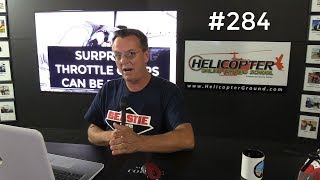
Kenny Keller breaks down helicopter autorotation practice: whether to chop the throttle hard or roll it off smoothly during engine-failure drills. Checkrides require the rotor RPM needles to split, showing power-off indications. He prefers smooth roll-offs over aggressive chops and stresses following your aircraft's POH first.
Questions this video answers
October 19, 2019.
Chapters
Day 284 coffee with Kenny. It's a Saturday. This is going to be a quick one so I can get back home. This is for a ground school member and he's asking about rolling up the throttle and auto rotations and hover autos and the throttle whether you do a rapid chop or a nice smooth roll off. And I did send him the link already from day 138 where we talk specifically about the throttle chop and there's even a safety notice that surprise throttle chops can be deadly. So I referred him to that video. You can go back and catch it. I'll put a link up there. But what I want to talk about today is he also asked about during the auto rotations. He said auto rotations are going well actually like them have a great cfi. That's awesome. Seems to be some controversy about power on auto vs power off, full downs, etc. Comments? Now doing some simulated engine failures with throttle chop then proceed into autos. That initial drop with a throttle chop damn sure gets your attention. Is my least favorite maneuver due to the rapid fall. You'll get used to it. It'll get better. But understand it may be necessary evil to master. Been reading a lot about it and watching videos. Seem to be some controversy with the throttle chop versus rapidly rolling the throttle off, some reports of it causing true engine failure, etc. Yes, if you do a rapid roll off it can quit. But I want to cover the more when he's asking about the throttle power on power off first. Of course I'm going to say depends on the aircraft manufacturer. You have to always go to the PoH first. What does the PoH say about how to perform the auto rotation? And I can tell you depending on the aircraft. Some models they say don't even roll any throttle off. Sometimes it may be just enough to split the needle. Some may call for you to go all the way off. So it depends on the aircraft. Now with that being said, there might be a time where you might have to veer from that and I'll give you an example. I fly instruments a lot, talk to people at the factory. Often they don't want you rolling the throttle off during auto rotation practice. They say you don't need to just lower their collective and the lemos will split. Sometimes they do, sometimes they don't. Now in this case if you're doing an auto rotation for the examiner during your checkride, you have to have the needle split or it's not an auto rotation. So there's one time where you might have to veer from what the manufacturer says in order for the test. And I give you another example. When I first started as a cfi, I worked at the school and I was out doing autos and prepping people for checkrides. And the owner says, oh, hey, we don't do autos all the way down to the hover power recovery. We want you to recover the power at 100ft and then just flare. And I thought, hmm, that's not really an auto if you're bringing the power back in. It's not an auto all the way down to the hover. So I asked the examiner on the telephone when I scheduled a check ride, I said, hey, I just want to ask you a question. The owner here at the flight school wants me to recover the power during the glide at 100ft and then just kind of come down and do a flare. And he says that's the way he wants it done. And the examiner said to me on the phone, well, I understand you're working for a flight school and you most likely, or you should of course, do the things the way that your owner of your company wants them done. He said, but you also know, because you just asked the question, in order for it to be an auto rotation, the needles have to be split or it's not out of rotation. So I'm just telling you, you know, what I'm going to expect on the checkride needle split until the power recovery at a hover. So to sum that up, I would first go with the manufacturer's specifications for autos for whatever you're flying, number one. Then sometimes you have to think about with a flight school instructor's telling you something different other than the manufacturer's suggestion. I guess you need to have a conversation with that instructor and say, well, the manual says this. Why are we doing this this way? And again, with Enstrom, they say, well, you don't need to roll it off. Well, if you can go all the way down the needle split and it's an auto for your checkride, great. But again, if you're taking a test, needles have to be split. And so in his question, he also asked about the fold downs. On the full downs, the throttle's going to need to be all the way off. So there's not really a lot of controversy there other than maybe how rapidly you roll it off. So again, we just kind of covered that. I'm more of a. I'd prefer to roll it off smoothly. I don't do the chop years ago. That was the common terminology and everybody just did it that way. And over the years, different manufacturers and insurance companies and everybody's kind of got together and said, hey, maybe we should stop those aggressive chops. Let's do it now. More as a smooth roll off. Alright, Love to hear your feedback down below, your comments and questions about these rolling the throttle off during the auto rotations. What do you think? Put your comments down below. Subscribe to the channel and click the bell so you're notified of our daily video. When you subscribe, you click that bell. Gives you notification each day when the new video comes out. So do that, leave us a comment and we'll see you in day 285. Peace out.