#48 QUICK STOP Before AUTOROTATION Practice
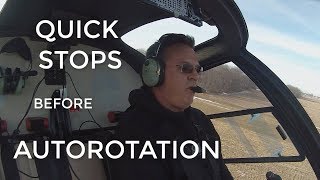
Kenny Keller teaches the quick stop maneuver, a controlled deceleration that mirrors the flare in autorotations. He explains why pilots should master it before practicing emergency landings, and how the technique varies between helicopters like the R22 and R44.
Chapters
So I'm going to do one right now and I'm just going to do it. 1, 2, 3. Enter Down Collective right pedal aft cyclic. I want to flare the helicopter. I want to flare it. Adjust the pedals a little bit. I'm going to keep flaring, keep flaring. Kind of like I'm at the end of the auto and then I'm just going to level it out. Raise collective, work with the pedals, keeping the nose nice and straight. Alright.
Coffee with Kenny's got to be on the go today, but that's okay. No fancy cup, but is consistent, unlike your quick stops that will never be consistent. We get a lot of people saying, oh well, hey, I two different instructors teaching me two different quick stops. That's okay. There's a million ways of doing quick stops, unlike this coffee that it's one of my favorite coffees ever. Just a local gas station, but it's always the same and it tastes great, I love it. But your quick stops are not going to be like that and you're going to see so many different methods. Sorry. So let's head back out to the aircraft and cover this topic in a little more in depth. Okay.
We're gonna go out and mess with quick stops a little bit. Something that we should maybe call slow stop. And I just had a question the other day and a member said, seems like a quick stop is a lot like the flare in the auto. I'm like, yeah, absolutely it is. That's why it's a good idea to always do quick stops before going out and doing autos. And actually years ago at a rotorcraft event, I met one of the guys that was in one of the ones that wrote or did an addition to the rotorcraft flying manual. So that's pretty cool. And I was a brand new CFI at the time. He was like, Kenny, what you want to do or before you start teaching your student autos, go out and teach them quicksteps. And then when I first had a, first had my CFI and had some trouble as a brand new instructor, got scared but got killed in an auto rotation, I hired the more experienced instructor to go out with me. Warning caution lights are out. By the way, gauge is green. Everything looks good. I got it leaned. So he says, let's work on quick steps before we do autos. And he goes, quick stop should be a slow stop. So I'm gonna do one right now and I'm just gonna do it. 1, 2, 3. Enter Down Collective right pedal aft cyclic. I'm gonna flare the helicopter. I'm gonna flare it, adjust the pedals a little bit. I'm gonna keep flaring, keep flaring. Kind of like I'm at the end of the auto and then I'm just gonna level it out. Raise collective. Work with the pedals, keeping the nose nice and straight. Now, there's a million ways of doing a quick stop. That one was pretty shallow, pretty mild. You can do them a lot more aggressive. I'll do one this time around, and I'll be a little more aggressive. When I trained in the R22, early on, that's what we were trained to do, right? Because low inertia rotor system, we really wanted to put that flare in there and wait to the very end to pull collective. So we're gonna go 1, 2, 3, enter. This time, still not super aggressive, but more aggressive than before. Hopefully maybe you can see that in the camera. And I'm gonna level back out. So I'll do a quick takeoff check here before we go on the pattern. While I talk a little bit, we'll come back and do a couple more. So warning caution lights are out. Gauges in the green. Looking good. See any traffic? I'm clear out the end of the Runway from the traffic. Helicopter 59 Foxtrot Sierra departing one zero for right traffic. I check that. Left traffic. Old cop term. Check that. So there's my 60. I'm climbing out. So I found it very helpful as the new CFI to talk to somebody that helped in the Rotorcraft flying handbook and also to hire a CFI as a brand new CFI. Hire the 4000 hour guy to go out and put my mind at ease. You know, almost quit instructing. And what he told me was, Kenny, we're sit down and do a day.
Of ground school before we go out.
And start doing autos. And we did that. And that's where he first introduced me. He wrote it out on the board. Quick stop should be called Slow stop or could be called Slow Stop. Made sense to me because the control inputs we do on the quick Stop are really nice and slow and smooth. And you're trying to quickly de. Accelerate the helicopter while you're slowing it down, but it doesn't mean you yank the controls, right? So we went out and we just. He said, we're gonna do quick stops first. Let's hone this quick stop. And what he had me do was get going down the Runway, do a nice big flare, and then take the top of the dash in R22 and line it up with some Buildings down at the end of the Runway. He's like, hold it there, hold it there, hold it there, hold it there, hold it there. Okay, level. So we perfected the quick stop, which is the tail end of the auto rotation. We perfected that first. And then he goes, let's go do 90s, or let's go straight in autos. Then we'll do 90 degree autos and we'll do 180 degree autos. And he helped me so much. All right, gonna get a radio call in here. Pullman Traffic Helicopter 59, Foxtrot Sierra, left downwind for 1 0. So again, hiring the older instructor helped me so much. And so I've always tried to use that with my students and think, okay, we're gonna do autos. Let's go do some quick stops first. You know, it happens a little faster than for real auto, but. And it kind of depends on the wind, too. Like, if you got some good wind on the Runway, it can fill very, very, very, very, very close to the flaring the auto. So while we're heading back down to the Runway, what I want to tell you is my examiner been using forever, says there's a million ways of doing a quick stop. A million ways of doing a quick stop. All right, let's get some radio calls in. Plumbing traffic. Helicopter five nine Foxtrot Sierra, left base turning final Runway one zero. Plumber. So he said there's a million ways of doing a quick stop. And all the years I've been teaching, there's right. There's so many techniques. And one instructor will show you one thing, another instructor will show you another thing. Doesn't mean the first guy's wrong or the second guy's wrong. Just probably difference in technique. So if you keep that in mind that you are quickly de accelerating the helicopter with really nice, really smooth control inputs, that is going to help you a lot. And I just had a question the other day, and the question was, Kenny, in the R44, how much is how much collective do you move? And I said, whatever it takes. That's my answer to a lot of things. Depends on any given day. The weight, the win, temperature, pressure. You just never know it's going to change from day to day. Whatever it takes to effectively do that maneuver and keep it safe and quickly. DSL de accelerate the helicopter. I can't tell you how many times I've heard the examiner say million ways of doing a quick step. One sky. Just because one guy's method's different than the other, it don't matter unless it's unsafe, right? So we can do a mini quick stop. Let's say here I am and I do a nice pre takeoff check. Warning, crossing lights are out, gauges are in the green. Oh, I got my timer running. I got fuel, got it leaned. Everything's looking really, really good. So I'm going to simulate a takeoff. And around here we have deer and coyote and fox, all kinds of stuff. And let's say, oh, a deer ran out in front of me. So I'm going to do a baby quick stop. It's down, let's say it's down there, down the Runway just a little ways. Instead of making a big hard maneuver, I'm just gonna do kind of a little mini quick stop. I can do a quick stop in the air 500ft if that's what I really wanted to do. I can't stress enough. Quick stop should be called slow stop or could be called slow stop.
Alright. Hope you enjoyed. That helps. Hope that helps. A lot of you, you know, questions come in like that all the time. Different instructors have different techniques for lots of maneuvers. It doesn't mean one person's right, one person's wrong. And you always learn from different people, no matter how different they do things. As long as the maneuver is safe and it's within the standards you need for any testing, you're good to go. So and then of course your poh. Anything that the aircraft manufacturer says about the way you should be operating, of course you have to follow those. But the maneuvers in general, there can be different technique depending on instructors, depending on examiners. Everybody has their certain way they like something. So hope that helps. Please subscribe the channel this is awesome. This is a day like 47, 48, I don't know. Great, having a blast. And I have to thank everybody again for all the wonderful comments and feedback. I think the feedback from yesterday is probably one of the top days. The things that people are saying, I just, it kind of overwhelms me and it's so absolutely cool. So if you're new to this, I'm Kenny Keller with Helicopter Land Ground School. We have private commercial CFI instrument memberships to help you learn the ground knowledge. You can go to helicopterground.com below and you can take a 24 hour test flight. You can check out any one of those courses, 24 hours free of charge. See the whole entire course. If it's right for you, keep it. If it's not, remove your credit card from settings, inside the site, inside your membership site or go to PayPal and end your subscription before the 24 hours. You'll be billed nothing. If you want to keep the training and you like it, just go month to month. You can keep it a month just for a refresher. You're working on your rating and you need it for several months. Keep it as long as you need. And we have more and more members that come in, do the private for a few months, unsubscribe, come back, you see them come back as the commercial and vice versa. You know, come back, grab the instrument membership for a few months. So that's an option. You can join up anytime. You can cancel anytime. Piece of cake. All right, again, subscribe, please click that bell. Keep the comments coming down below and the likes. We absolutely love it. So thank you and we'll see you tomorrow.










