#49 AUTOROTATIONS Engine Failure Practice Coffee With Kenny
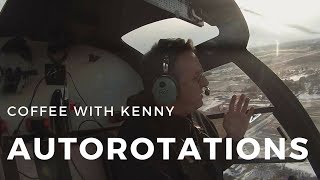
Kenny Keller demonstrates helicopter autorotations in an Enstrom, walking through entry, glide speed, and flare to hover. He emphasizes setup discipline and shares instructor tips to ease student anxiety about engine failure practice.
Questions this video answers
About 70 knots (he typically enters just above 70 and then holds ~70).
About 500 ft AGL ("about 500ft above the ground").
Lower collective, add right pedal, a little bit of aft cyclic (count 1-2-3 then enter).
Treetop level (initiate gentle flare to about treetop, then larger flares, level, then roll on power to hover).
Chapters
And back to hover. This N strum makes it pretty darn nice and pretty easy. All the guys I've had Girls that flew R22s or low inertial rotor systems get in the N strom and go, oh my God, this is amazing. So they were just.
We'll be back in the helicopter in less than 60 seconds. Just bear with me for a minute. You notice the lighting a little bit different today because I'm up before the sun's up. Because I'm excited about this video and my brand new coffee cup. I love this. This is awesome. We're going to go back out and do some autos, play around for about 10 minutes. You can't beat the auto rotation in an Enstrom helicopter. High inertia rotor system is absolutely incredible. More than once I've almost lost my life in a low inertial rotor system during auto rotation practice. You'll never experience that in an nstrom. It's a non event. My examiner of 20 years has been saying, you got to really screw up bad to mess up an auto rotation in an instrument. I'm Kenny Keller, creator Helicopter Line ground school on Amazon, bestselling author of Helicopter checkride and top 10 checkride tips. I'm going to give you opportunity for a pretty nice discount if you hang around to the very end of this video. So let's head back out in the instrument and go do some autos. Oh yeah, and make sure you give us a thumbs up and comment below.
Okay. So let's talk about auto rotations. It's something we all like to talk about every everywhere everybody talks about them. Auto rotation, auto autos. You know, at the time I've been flying and the different aircraft I've flown, it doesn't vary a whole lot. The amount of changes with the pedals or the collector of the cyclic might change a little. The amount of throttle you turn on or off might vary a little. Your air speeds are going to vary a little bit. But in general, not a rotation is not a rotation in most helicopters. So what I found is it's about a good setup. People will say, well, you're not set up in the real world. Well, no, you're not. But in training we have to have a standard to teach you and we have to train you to a standard. And then you go to take a test. You have to train and be ready to fly to a standard. Yes, it's awesome to get real world training or an instructor is cutting the power on you in an environment where you got somewhere to go that's safe to land. But unexpected engine failures need to be practiced. But with that being said, we also need to practice them for training. So I'm just going to come around here and I'm going to do a straight in auto rotation and I'm going to be about 72, 73 on the airspeed. And I say that because I like to use about 70 for my glide. So if I enter just above 70, when I enter, I go down collective right pedal, aft cyclical. I could give a small aft pull to kind of set the auto rotation, pull it back to 70, then hold that 70. And the beauty in this aircraft is the instrument, the auto rotation is incredible. If you set it up nice, it'll be nice. If you set it up sloppy, it'll be sloppy. But that works with anything too. I got that heavy from my examiner as a young CFI and I've taught it ever since. He likes to ask that question. What's the key to a good auto? Good setup. What's the key to a good normal approach? Good setup all the way around. When you're setting up these maneuvers, you want to take your time, you want to feel good, you want to be ready. And he'll tell students, he'll say, hey, if it takes you 10 minutes to get set up for an auto, take 10 minutes to get set up for an auto. He goes, I don't want you to rush it. I want you to perform the maneuver well today. And if you come around and you're not quite ready, do a go around. It's a maneuver anyway. If you do the go around, then, hey, you just took care of a maneuver. Make quick radio call, real quick traffic. Helicopter 59 Foxtrot Sierra, left base, turning final for Runway 10. Okay, so I'm gonna try it from about 500 AGL, about 500ft above the ground. And I'm gonna get my speed. Yeah, about 73, 75. Who can hold 73 exactly? Nobody. Just be a little bit above 70. I want to have zero rate descent. I want to have my altitude stable and have everything ready to go. And then I'll count it. 1, 2, 3, enter. On enter, I'm going to lower collective, add right pedal, a little bit of aft cycling. Then I'm going to do a cross check. Inside, outside, inside, outside. And that's kind of the key is first getting set up nice and then doing a cross check all the way down, entering it nice and smooth. If you enter it nice and smooth, it'll probably be nice and smooth. Enter it sloppy, probably sloppy. So getting everything entered correctly is important. And then judging when to enter, which you get good with. Practice. People say, how do you judge when to enter practice? Learning the wind, windy day, calm day, mediocre wind day. And I know about where I'm, what I'm going to use in here as far as what I'm going to enter. So I'm getting ready now. I'm going to go 1, 2, 3, enter down collective right pedal half cyclic. Good. Entry's nice little fast. I'm gonna go a little aft cyclic.
Just a little.
When I raise collective little, keep it RPM in the green range. I'm looking for treetop level. About treetop. I start our gentle flare. And as I come in and make it bigger, and I make it bigger, and I make it bigger, I'm going to level it out. Rolling the power and back to hover. This instrument makes it pretty darn nice and pretty easy. All the guys I've had Girls that flew R22s or low inertial rotor systems to get in the instrument go, oh, my God, this is amazing. So they were just some quick basic elements with auto rotation. You know, people say all the time, well, what's the. Let me do a quick pre checkoff. Check. Warning, caution. Lights are out, gauge is green, still got fuel. My timer's running. Everything's looking good. There's etl. I'm start climbing up. Refer to your POH number one for the aircraft you're flying. So you have the right airspeeds and any technique specific the manufacturer suggests for the auto rotation. But like I said, they really don't. They really don't vary that much between helicopters a little bit. But that's why when you read the Rotorcraft Flying Handbook or the Helicopter Flying Handbook, when you read it, it doesn't say specifically a helicopter ride. It's telling you the essence of an auto rotation at approximate airspeeds and altitudes and how it should go. So since we're having fun, I should probably go around and do a 180 auto. Everybody loves 180s, right? Some people say a 180 is easier than a straight in. It could be. You know what? I'm gonna do a 90 instead of a 180. Everybody does 180s and that's great because they're required for your checkride and you need to know how to do 180 and reverse to go the other direction if the wind's behind you and you have an engine failure. But in another video, I've talked about how I had an instructor help me in the beginning when I was a new CFI and struggled with autos. We went out, we practiced quick stops and then we started straight in autos and then we did 90s and then we did 180s. And he said a person could do the full 180 degree sweeping turn. Or an option is to do two 90 degree turns. Enter the first turn right, 90 degrees, level out when you're ready and go down to your spot and you can make. You could turn the 180 into 290s if you're having. And it works good. Especially if you're kind of trying to maybe have trouble judging your spot. So instead of setting up for a 180, I'll set up for a 90, right? Everybody does. Everybody on YouTube does 180 autos. Let's do a 90. I'm sure somebody probably out there has done 90s. Not that much different than the straight in. It's really not that much different. The essence of it is the same entry is pretty much the same. You just have to remember anytime you make a turn during an auto rotation, the RPM is going to rise on you every single time. So you just need to be ready to raise that collective as you start that turn. So I haven't done one of these in a while, so I'm just kind of trying to guess about where I should turn. Set up my. What will be my left base. I'll be turning that into a left turn to the numbers 1 0. And hopefully I'll get pretty close so I don't have a camera pointing outside so you won't know how close I really am or am not. That's okay. So I just want to give you an idea about the maneuver. It's nice to do 90s, 180s. I've done 360s. It's nice to vary up your training and do different things, learn different things, figure out different ways of doing things. So in the real world you do know how to handle stuff. Okay. So again, the beauty of the 90s, I can kind of adjust my turn. I can hold it a little longer before turning if I need to. Buno Traffic Helicopter 59 Foxtrot Sierra left base. Practice engine failure to the numbers. Fona traffic. All right, need to slow down a little bit. Like I said, I'm gonna need a little more collective in this one than what I did in the straight in. I'm gonna go 1, 2, 3, enter collective down right pedal. Little bit of half cyclic and I'm delaying my turn a little bit and now I'm gonna start my turn. My raise a little more collective than I did in the straight in. My spot's looking pretty good. Speed's about 80, but that's alright. Back about 75. That's looking good. Oh, there's my spot. Tree top level. Start a flare. Bigger flare, bigger flare, bigger flare. Level it out. Roll on the power. And there you go, a 90 degree auto. And I know these for you. Oh. Warning, caution lights are out, gauge is green, Timer's running cleaned. Feels good. Everything looks fine. So that helps you a little bit. I want to take a little bit of that mystique or I don't know if that's the right word. A little bit of that. Oh, hype over auto rotations. I know when you're learning and you're new, it's a big deal. And even as a new CFI was a big deal. When I thought the weekend Warrior, weekend warrior flight school owner, private pilot. I went out with him because I wanted to do some practice autos and he about killed me because I in my mind I thought he could handle it and I wasn't prepared to take over and I even almost quit after that. And my examiner, legend in the industry guy I love talking about, his name's Jerry, a lot of people know him. And I went to him and told him I was terrified and I was thinking about quitting and he was like, kenny, now you've learned. Now you know you've had absolutely scared out of you. Now you know, you never get in an aircraft and think that the guy beside you is any better than you are. You were with a private pilot. He goes, I don't care how many hours he had, he hasn't had commercial training, he hasn't had CFI training, he hasn't been to the Robinson School like you had. He goes, he did not have the training that had. So he goes, there was. You should have never just been sitting there lollygagging. You should have been ready on the controls, ready to go when something bad happened. And I did grab him and I did save it. But it wouldn't have been a scary. But have been more prepared right there on the controls are ready to go. So I hope that helps ease a little bit of the stress over the auto rotation.
Okay, Hope you enjoyed that. Have a positive attitude and give us a thumbs up. Give us a comment down below about auto rotations, about the instrument high inertia, low inertia or anything helicopter training related. Put those comments down below. You hung around. The code is KK25OFF. You can get 25% off or any of our yearly or professional pilot package. KK25 off in the coupon box during checkout. That's a nice discount. That's for anybody that comes along this video just because you hung around to the end. So go to helicopterground.com below. Check it out. Please subscribe to our channel. When you subscribe, click the bell so you can be notified of our daily videos. Coffee with Kenny. We do it every day. So thanks for tuning in and we'll see you tomorrow.










