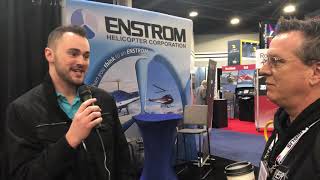
A short YouTube interview (Kenny Keller with guest Cole) about a real-life engine failure in an Enstrom helicopter during training. Cole describes the sudden, instantaneous engine quit at about 1,200 ft (roughly 400 ft AGL), the immediate autorotation into a nearby hayfield, smoke entering the cockpit after landing, and quick egress. He emphasizes human factors (brief confusion), aircraft characteristics (C-model with no governor/correlator, described as safe in autorotation), and an insurance caveat: a seamless autorotation that leaves the aircraft intact may not be covered for engine wear. Cole also identifies himself as owner of P and N Flight and Charter based at Marion, Iowa airport and mentions the helicopter was a 1981 airframe with about 900 engine hours.
Questions this video answers
1981.
About 900 hours.
A C-model with no governor and no correlator (described as an Enstrom F28C/NRM F28C in the transcript).
Marion, Iowa airport (P and N Flight and Charter).
About 60 days.
Chapters
Hey, Kenny with helicopter Land Ground school, got a special treat for you. Cole will introduce himself here in a minute. He had a real life engine failure in an instrument. We all talk all the time about what a great or how it's such a easy helicopter to auto rotate in, especially for practice. He experienced it for real right before checkride when he was doing a helicopter add on. So coffee with Kenny, day 61. And we got more cool stuff coming up today, but this is the first one we wanted to get to Cole first. So, Cole, I'll hand you the mic over and just tell us briefly what it feels like. We don't, you know, the engine quit. Okay. What happens from there?
Sure.
And you told us yesterday about something that I never really thought about when it happened.
Right. So fairly windy day. You know, it's important to know the conditions of the day, I guess. I was working on steep approaches and my instructor, Jan was working on a student in a different or working with a student in a different helicopter. And she said that day, well, don't do any auto rotations by yourself. So, good thing I didn't listen to her. But we were about 1200ft. We both decided, let's go fly over the city because we have two nstroms here. That's cool. You know, let's, you know, loose formation, snap a picture or something like that. And I said, hey, are you guys ever gonna catch up? And she said, well, are you ever gonna come down to 1200? Because that's supposed to be, you know, which is about 400 AGL. And when they talk about the engine's gonna quit when you move the throttle, that's true. So if you're over water, if you're over, don't touch it. And yeah, so, you know, just. It's a C model, no governor, no correlator. Just roll the throttle out, down a little bit. And it was instant. It. Sometimes you hear. It takes four or five seconds, sometimes you hear different things. It was quick, it was instant, and first thing you got is shake it. Just a quick shake. That was the first second of it.
And.
You know, the human factor part of it takes a couple seconds to figure out what happened. And I thought, because the helicopter, you know, just quick first second I thought the helicopter went left. I didn't want it to do that. Maybe something hit the tail rotor. Well, torque. So that's what happened. The engine quit and we started to the left and I was downwind when it happened. So. Got it. Yeah, you got it. You got to go the other Way, Right? Yeah, yeah. So, you know, that kind of helped. There's a little bit of. Maybe a little bit of luck involved, but. Yeah. So we. We're starting in a left turn. I'm a student pilot working on my commercial. It's on a Friday, and my checkride is supposed to be the next Wednesday. And I guess where I'm going with that is it takes a little bit to figure out what happens, you know? Yeah, yeah.
Realize in your head what really is going on.
So if it would have been a helicopter where. If that collective is not down in two seconds, it might not have worked out. The nstrom's really safe in auto rotation. So I would say, you know, maybe by the third second, oh, the engine quit, you know, so it's like 1, 2, 3. Oh, okay. And there was a nice big hayfield. It was kind of confined by a couple buildings. It was right next to the police station, which I think is funny. And I radioed to my instructor, who's watching the whole thing. There's a big trail of smoke from all the oil. And she said, well, can you make it back to the airport? No, no, we can't. Can't make it back to the airport. And so I said, I'm. I said, I'm auto rotating to this field west of the police station. And it was just. I don't remember being panicked. Of course, there's not enough time. It was about, you know, maybe it's 20 seconds or less and just flare it out like normal and put it down. So I. Yeah, know. Then I just kind of sat there for a second until mine. Yeah. And then Jan, my instructor, she said, well, get out of there. You know, I'm like, oh, okay, yeah, I better get out. And then I went back to get my Dunkin Donuts once everything was under control. There is a lot of smoke in the cockpit. It comes up or came up through the. The right side collective where that. That spot is. And this is a 1981, so maybe. Maybe that wouldn't happen in a different one. But smoke came in. So with my left. Once the collective is down real quick with my left hand, I could barely see out. So you just flip the. I just flipped the door up real quick and everything just kind of sucked out.
Cleaned up. Yeah. Get your visibility back.
Yeah, yeah.
Awesome. And before we go, tell everybody what you do and do it at. Give yourself a plug for your.
Okay, Cool. Good. I own P and N flight and charter at the Marion, Iowa airport. And we have a fleet of fixed swing and we operate the NRM F28C model, which.
So people know where to go in that vicinity.
Where you can go find an instrument.
We don't know where they're at. There's a place you can go.
So one thing I want to point out is what we found out the hard way, which is if you, if your engine quits and you make an absolutely seamless auto rotation and you make a perfect landing, it's not covered by insurance. The engine is wear and tear. It had 900 hours on it. It's not bad. But we don't know how it was flown before, of course, you know, because we had just got. We had gotten it fairly recently. However, if I would have just totally wrecked and, you know, flipped it over or something like that, then the insurance covers it. So check your policy. Check your policy and make sure that you either get additional coverage for engine or it may be it's covered and you have, you only have 60 days to get all that figured out. And you know, when something like, like that happens, you have the FAA and everyone coming out. So be careful with the insurance too.
Awesome. Well, hey, yeah, put a comment down below. Give us a like on this for Coal and we'll be in touch with him. So if you've got some questions, we can always forward them on. Or we'll have to check the YouTube video occasionally so he can join, jump.
In and tell you I'll be over how we felt. I'll be over to visit soon. Awesome.
Well, hey, we're going on to do some other interviews. More cool videos coming today. You're gonna like it, I promise. We got good stuff coming. Good stuff. Yes. Subscribe. Click the bell comment below and we'll see you in the next video coming up very soon. See you after bit.