#62 GUIMBAL CABRI G2 Interview Instructors from Precision Helicopters Heli Expo
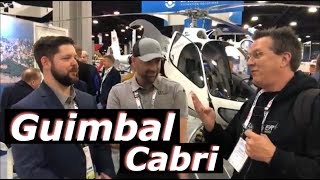
Kenny Keller talks with Henry Saksmith and Jordan Wilburn from Precision Helicopters about the Guimbal Cabri G2. They compare it to the Schweitzer and Robinson, covering how it flies and what makes it different for training.
Chapters
Hey, Kenny, with Telecad relying ground school, we've promised you a video with the Cadbury. We've been to the other manufacturers already, so they get their chance to shine here as the last one of what we call the four. Right. Robinson Instrument, Schweitzer Cabri is now in the picture. All the questions people have asked me in the past, I've said, honestly, I really can't say about the Cadbury because I don't know anything about it and I have never flown one. So it's not fair for me to make really any kind of a comment because I don't know. So these guys are experienced in them. One has flown Switzer's, other is flying Robinson. So they can maybe give you a little insight, you know, from moving one to the other. So I'm going to give them both a chance to introduce who they are and just give their spill on what the Cadbury is all about. And if somebody's saying there's a Cadbury nearby and there's this other helicopter nearby, which one should I pick? Hopefully these guys can give you some insight on why you would pick either. Pick the cavalry. So, Jeffrey, whatever you wants to start, go ahead.
I'm Henry Saksmith. I'm a flight instructor with Precision Aviation. We're the US Distributor of the Cabri.
I'm also a flight instructor. My name is Jordan Wilburn. I'm also the lead mechanic at Precision for the flight school. So been working on these Schweitzers, Robinsons as well as the instruments. Been. I've had my hands inside of all of them, but fly these. And I flew Schweizers beforehand, so that's my experience.
Okay, so who wants to. Let's just get right to the. I can honestly say in my time, I've heard good things. The only thing that's come up from a couple comments is people have made comments about the tail rotor authority. Again, I have no experience, so whichever one of you wants to handle that, that question, I'll lead off.
I do agree. When you first get into these aircraft, I flew Schweitzer's first. Schweizers have pretty good tailwater authority in general for the training aircraft. And when we first got into these, the pedal doesn't feel like it's there. And that's what you hear a lot of people say, especially if they have limited flight time in the aircraft. And it's the. When Henry actually said it, really good. Where you see a linear curve on most aircraft for the pedal input, control versus authority output it's linear. Ours is more of a bell curve. The more pedal you give, the more authority you gain. And the majority of the authority in the tail rotor is in the bottom quarter of the pedal. But with that being said, this has easily twice the tail rotor authority of the Schweitzer. For my personal opinion and Henry and.
I'd say the tail rotor authority compared to the Robinson is very similar. It just takes longer, longer to get there. So the pilot needs to be prepared, have a little bit of right pedal in. They need to be just in a little better control of the aircraft and know what kind of wind conditions they're flying into.
Yeah, I think it really comes down to just getting the feel of the aircraft. I don't think of it, I don't even think about it at all. And we take students out and we'll have them push in as much right or left pedal as they're comfortable either way and have the aircraft spin as comfortable as we allow it to spin and then immediately get in the opposite pedal and it'll stop the turn immediately. It's very responsive, very quick to react. And even in crosswinds, tailwinds, it really doesn't get affected very much. The right crosswind would affect it. But once you get it out of that right crosswind, if you were uncommanded, yaw into that right crosswind, it would exacerbate that and you could go into a low rotor RPM scenario and settle the aircraft. But it's just about controllability of the aircraft.
It's not susceptible to the other forms of LT because of the ducted fan.
Fan acts as an airflow straightener to straighten the airflow as it comes through the fan and stops that like main rotor disc interference that you would get. Or maybe tail rotor's own loss of tail rotor effectiveness due to its own vortices vortex ring state. Because of the airflow straightening design of the Finestron, it's not susceptible to those things.
What else? Give us a little more tell us about actually when you're in there flying, how it feels control wise, sitting in there, visibility, just anything you can think of, what it's like being in there, since we don't know.
So the main rotor is fully articulated. It's basically a mini A star. Very responsive. You hear a lot of pilots when they move on from flight schools talking about helicopters they love. And an A star is top of that list.
Right.
So very responsive, very forgiving, high energy rotor system allows you to make mistakes, you know. You know, as a Robinson Pilot. When I was going through flight training, my instructor was always on that control through private stage one. I don't know if there was a time that I was ever really flying, you know, because you could feel their resistance. You can feel them right there. So that if you do something silly, they have time to react. In this aircraft, as soon as I'm up above 1500ft, I can take my hands completely off the controls and know that even if a student completely lets go that I have the time to respond and control the aircraft because it's not susceptible to low G in the way other aircraft are. What else? Auto carb heat. The greatest thing I remember.
Tell us more about that. I've never heard auto carb heat. Never heard that term.
We don't have a lot to say about it because we don't think about it. You flip the switch and leave it. Honestly, from the, the Schweitzer. It's on, off, on off, on off, on off. And it's so distracting. You have to stop a conversation driving with a student mid flight to flip the car beat on because you can't, you know, sometimes and you get to where you. I guess you do it without thinking about it too much. But this one you don't think about because you don't have to worry about it. You do it. You do a test when you first power up the aircraft before you get into the flight profile, you test to make sure the car beats manual modes are both working. And then you also watch to make sure that the, the car beats doing what it's supposed to do. You put the switch in the auto position and leave it and it does everything for you. And it's very effective. We see it working all the time in the colder weather and we do.
Turn it into, you know, if I've got visible moisture and it's really cold out, I'm going to put it in hot and make sure that I have that because I'm in cruise and I don't need it, right? So I do mess with it a little bit, but I don't trust it in auto to keep it in a safe range. Issue one. One of my biggest fears back when I was in the Robinson as a private student was that collective assist. The carpet assist. As you're raising the collective, it pulls it down. Was forgetting that out on a solo flight, if I go to take off and I just am stressed out making radio calls as a private student or whatever, if I don't raise that all of a sudden, now I have a car buy situation. So as an instructor sending students out, it is much less stressful in that aspect.
Awesome. Yeah.
And I would stand next to them. The cyclic, the cyclic input thing, I never had, I've never had to experience that. What do they call that? T handle or the T bar. I never experienced that. That's crazy to me. But this one is, it's. It has a force trim system in it. So it's got feel springs on the lateral longitudinal control inputs. So once you get the aircraft trimmed, even in a hover, I can take my hands completely off the controls and the aircraft will continue. You don't remove your hands far, but you can release the cyclic and the aircraft to hold a hover without any concerns. Generally a student, he's got all three controls within an hour. And I'm almost hands off completely because you can allow the student to get much further outside the envelope. My current student, actually one of my current students is a Robinson transfer and I had to reteach him the cyclic. He just has this death grip on the cyclical and he's over controlling with his elbow because the cyclic, they're so hard up on those cyclics in the Robinson, I think. And we had to reteach him to be so much softer because it just requires a very gentle touch to move it. You can fly the cyclic inside of probably a donut sized ring and the aircraft is going to do everything you want it to do in there. So it's very tight and really maneuverable. A lot of fun to fly. I love them.
Cool.
So here in the Capri we have no maximum seat weight. Obviously weight and balance plays into a factor. Our maximum takeoff weight is going to be £1,543, which gives you a little more. I'm able to do flight training with students that weigh 230240 pounds and still have enough fuel to complete a flight lesson. Here we've got our MLI or Multiple limit indicator. It's going to give us a percentage of power based on the conditions, which makes it nice and easy for students to readily identify how much power they have available when coming in and doing approaches. It's very similar to the FLI that you have in the A star B3. So the transition from a Capri into an A Star is a lot more seamless. We also have an Aspen here for instrument training. 650 Garmin and transponder here.
Obviously.
All ADS B compliant and everything.
Yep.
Cool.
21St century aircraft and 200,000 hours of fleet hours with no fatalities.
That's awesome. I mean, that's a great record, I would say. Well, thank you guys for both taking the time to tell us about it. Considering you're flying it and you have the first hand experience that helps with people that have been asking us, we can now send them this video, say, hey, here it is, and maybe we'll get a chance in the future to fly one. I know Taz has been interested in flying one, you know, so I would like to try it out too. So hopefully that'll be another video, another day. Anything else you want to add before we go?
We're in Newberg, Oregon. We've got locations all over. We're the US Distributor for the Cabri. Like we said, Try one out. Come see us.
Yeah, come out and see us. We do demo flights. 150 for 30 minutes. Isn't that right? 150 for 30 minutes for demo flight to get you interested. If you're interested in flying them and you'll see me or Henry or two or three other instructors, it's very personal experience. We tend to take care of our students really well and give them one on one teaching all the time. So come out and see us. We'll have a lot of fun.
Awesome. Thanks again. Comments down below, like subscribe. See you on the next video. We got one more to do, I think. I don't know. We'll find something. See you in the next video.
Awesome. Thank you.
Thank you.










