7 Reasons Why I Failed My Private Pilot Check-Ride
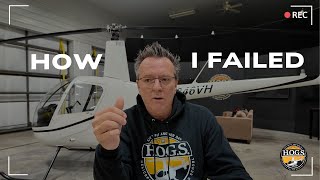
Kenny Keller (YouTuber/instructor) recounts the seven main reasons he failed his private pilot helicopter checkride in the late 1990s: 1) no sleep the night before, 2) uncontrollable nerves, 3) flying to a practical standard but lacking ground knowledge, 4) instructors prioritized flying over ground school, 5) financial constraints causing gaps in training, 6) chose an FAA examiner rather than a DPE to save money, and 7) had never been shown the aircraft logbooks. He describes how this failure motivated him to create a consolidated study notebook (later turned into online ground school and published materials), retest successfully with a DPE, and ultimately build a career in helicopter instruction. The video closes with practical tips, resources (Top 10 checkride tips, Private Pilot 101), and encouragement that failures are common and recoverable.
Chapters
Okay, I'm going to give you the top seven reasons why I failed my private pilot checkride. Let us know below about your checkride failure. We hear a lot of people talking about their successes, but not that many people want to share what happened to them and why they failed a checkride. This video inspired by Jay from Helicopter Training Videos. He's going to be starting a podcast after the first of the year, and he wanted some content about helicopter checkride failures. And he knew about mine from me telling the story over the years, and he wanted to include something in his podcast for next year. I just wrote down the top seven things that I could think of right off the bat. And if I wanted to dissect it more, I'm sure I could probably come up with more. But I just. Gut instinct, piece of paper, sat down. And not necessarily in order of importance, just what came to mind. The first one, no sleep the night before. I didn't sleep a wink. Now, it's common for people to not sleep very well, but with the amount of checkrides we've done here, just even the last year and a half, quite a few of these people that have come to do checkrides have reported that they got a decent night of sleep. So proof that if you're properly prepared, you can sleep the night before. Number two, couldn't control my nerves, which I'm sure relates to. Number one, I couldn't sleep the night before because of my nerves. I couldn't control my nerves. I was just so stinking nervous that it's not even funny, right? So I know that that had something to do with it. Number three, checkride, flying to standard. However, my knowledge sucked. You know, I'm flying a couple different places, flying an R22 and flying a Schweitzer. And I go to this. I'm trying to finish up and I go to a fly the Schweitzer again. And they had a new instructor there and we went out to fly together. And he's like, man, you're flying pretty good. You're ready to be a private pilot. How many hours you got? And I'm like, I got like, you know, 80 some hours. He's like, great, what'd you score on your written? And I'm like, written? I haven't done my written. And he's like, oh, my gosh, you got 80 some hours you're flying to a standard, but you don't have your written done yet? And I'm like, no. And he goes, all right, well, we got to get that Hurdle out of the way, let's go sit down and do some ground school. So he starts asking me questions. And I remember one of the first things was something along the lines of, what type of clouds are out there today? And the answer should simply be, oh, that looks like a cumulus cloud. At that point, I'm like, oh, I don't know, big puffy white ones, you know, and he's like, oh, my God, we've got some work to do. So here I am, like a lot of you out there, people even watching this video. I have 80 some hours of flying. I can fly to a standard, but I don't have the knowledge. I'm not even close. So number four instructors always wanted to fly and didn't push ground. So here's this gentleman who at least got me turned around the right path. At 80 some hours. I'd flown with different instructors. I'd had some really good instruction in the aircraft was flying well. But did anybody ever say, you know, you're really getting, but we're getting behind on the ground school, let's get this written test out of the way, you know, how's your knowledge? Asking me questions. That should have been happen happening with several of these instructors that I was flying with. They should have been pushing me and they didn't. So it's always fly, fly, fly, and. And the ground gets left behind. And that's a problem that you'll find at a lot of flight schools. Because they want the blade spinning. They're trying to make big payments on the helicopter, big insurance payments, big maintenance payments. They don't get to charge as much when you're sitting there and doing ground school. And that's just the sad reality of it. Finances. Of course, I'm at 80 some hours. So through this 80 hours of getting to where I was, it was fly a little bit, take a little break, save up some money, fly a little bit, go borrow some money, fly a little bit, sell something. You know, I'm struggling through to pay for, just to get through private pilot. So of course, the longer you go, you have the problem of the finances comes into play, right? So you start crunching and scrimping and saving and you're trying to hurry up and get done because you're running out of money. So finances being a big part of that, if I would have had the money all laid out ahead of time, I think it definitely could have went a little bit smoother. Number six examiner was FAA and not a dpe. Goes back to finances. Right. The instructor clearly Explained to me, you can take it with our local FAA guy. He doesn't charge you, but he's going to be very tough. You can get a dpe, a designated pilot examiner. He probably won't be as difficult, but you're going to have to pay him. So I chose because of finances, I chose to go with the, the FAA examiner and not pay for it because I didn't want to spend the fee to pay the examiner. I could tell you all these years later, pretty much almost everybody goes to the dpe. Some people still use an FAA examiner, but if you think about it, some people could say, well that's, you know, not fair. Why does it work that way? But somebody that works for the FAA is getting paid to be there. Doesn't really matter how long he's there, he's getting paid either way. A DPE is getting paid for that particular checkride. So a little more in his interest to hopefully get you done. And then I wrote down never shown the aircraft logbooks. We know I'm taking the checkride with an FAA examiner. I didn't have any sleep the night before. I had to jam a bunch of ground in last minute. And my examiner or my instructors tell me I'm ready. I don't feel confident. Again, playing in on the nerves. And when we, as we started the checkride, the very first thing he says is okay, let's take a look at the aircraft log books. Show me the last hundred hour inspection. Well, I'm freaking out of course, because I had never seen aircraft logbooks. Every time that during the training that we would talk about logbooks when we were doing ground, he'd always be like, oh well, mechanics aren't here, they're locked up, we can't get to them. We, we'll look at them another day. And this happened repeatedly. And then we're doing some off site ground as well. So the log books weren't there either. So this got missed. So you could throw this as a bonus. Did we use the practical test standards, which is now the acs, but at the time, the pts practical test standards. If we'd have been going through that the day before we had everything or even weeks before we had made sure that we looked at the aircraft log books. So I don't admit to the guy. At first we have to get the instructor, he goes over. Luckily mechanics are there, they bring the log books over older aircraft. And I start flipping, trying to find the last hundred hour in a book I've never seen. And the examiner of course is Tapping his pen on the table and huffing and puffing. And I finally have to say, I'm going to admit sir, I have never seen these logbooks before. And he's like, really? All right, do your best. So continues to sit there as I struggle through finding the hundred hour, figure out what it says and show it to him. So all the other problems that had led up to that point, no sleep, I'm nervous, the ground was pushed, I'm herding for money to try to get finished. And then checkride starts. And I've never even seen the frickin log books. Not a good way to start off. I get through that part of it and he goes a little bit further, right? And on a lot of the questions I'm just stumbling. For example, I can remember when he asked me, what are the three things combined together, get you in with selling with power. I start kind of trying to spit out the three different things. You know, the rate of ascent, 300ft per minute or greater using 20 to 100% of power, airspeed less than ETL. But that's not how it came out. Not nice and smooth. I'm going, oh yeah, I see this rate of descent like greater than 300ft per minute using full power. There was a couple other things that popped up and I wasn't answering. Very smooth. And at one point he even stopped the test. And he goes, you're very clearly nervous today. Let's go outside, take a little bit of a break and went outside and talked a little bit. And we came back in and he started answering me some more questions and, and he asked me a question, something along the lines, you're out here in a hover and all of a sudden the nose goes to the right. Was that the engine or the tow rotor? And I had to like think through it real quick. You know, I'm nervous, I'm struggling, takes me too long to answer the question. Shortly thereafter he goes, okay, I'm going to have to stop this test. He said, if you wreck a helicopter in this vicinity, I'm going to be the one that comes out and investigates the accident. And when I'm sitting here asking you questions across the table, I need the answers to be smooth and solid. You know, the terminology can be, you know, a little iffy, but it still has to be smooth. And he even said, when I asked you about selling the power, I want to hear 30, 20, 10 rate ascent, 300ft per minute or greater using 20, 100% of power, airspeed less than ETL, and I say the 10 because back in the day, that was the memory aid clear back in the 90s because it was less than 10. Now it's less than ETL. And he said, one of these other questions I'm asking you, you're taking too long, you're struggling too hard, and if you can't answer these questions sitting here across the table from me, what are you going to do when you're in the aircraft by yourself? If you can't do it here, how are you going to do it in the aircraft during an emergency? So I went home with my tail between my legs and of course, was completely devastated. After the time and money and effort, I fell and I don't go back for six months. Something started gnawing at me and one of my buddies said, hey, when are you gonna go back and finish that helicopter thing? And I'm like, you know what? I need to. Right? All that time and effort. And he's like, yeah, you spent all that time and effort and then you didn't. You're just gonna give up. You're not gonna go back. So I knew the ground being the problem, I went down to the local grocery, or not grocery store, the local CVS. It's still here 20 some years later. Because this was the late 90s when I failed that test. And I bought this handy dandy notebook right here. What I did was I knew that I had to get through this ground problem, right? And at that time in the late 90s, there is nothing. There's no helicopter, online ground school, there's no videos, there's no YouTube, there's nothing. So I'm like, I gotta figure out a way to study. So I had lots of scattered notes and different tablets and I had all these books, and I thought, I need one place where I can just sit and study. So I bought this notebook and I just sat down and started writing out all the different notes that I had and things that I knew I struggled to remember. And I just started writing it all down. And I did it in a way that I'll show you just how beat up this thing is. And here's what I did. I just start writing down anything and everything that I think I'm going to get asked on the checkride. So I take the notebook after I have all these pages done and organized, and I just start studying the notebook over and over and over because I was tired of going to so many different places to study. And I would just go over it and over it and over it again because we Learned through repetition. So I go back to retest, go to a different actual examiner. Actually, I go to DPE Jerry Ventrella, who I love talking about legend in the industry. And I go back to retest, go in that day, get started. I don't know, within an hour or two into the checkride oral portion, he's like, I want to take on a break here for a second. He said, you came in here with a pink slip today. And I go, yep, I sure did. And he said, why is that? Right? And I said, the reason is because I didn't know then what I know now. And he's like, what did you do? And so I told him my notebook and how I studied prepping to come back to retest. And he said, well, you're batting 100%. You know, this is going really, really well, and you've obviously applied yourself. And I'm going to reach out to that other examiner that you took that checkride with, and I'm going to let him know how well that you did when you came back. Because I, I, I see this day going really well and we getting finished up today. And I'll make sure that he knows that you did apply yourself and that it was a lot different for you when you came back. So I get through the checkride and finish on with my other checkrides after that, do the commercial, do the cfi, using my notebook the whole time, become an instructor. And of course, when you first get your cfi, you don't have a clue what you're doing, right? You're just kind of, you've passed the test, but you now have a license to learn. So I just went out and thought, you know, I'll just start trying to take the best of everything that I learned from the different people, the things that I thought helped me. I would just do the same stuff, right, and start doing checkrides and became at a certain point we were, you know, using all our normal study materials and we're using the pts. But my last test for somebody before I would actually send them to the examiner, would go through my notebook and I just go page to page and ask them, sample two or three questions from each page. And if I could go through this notebook and they could answer from every single page, I knew they could go in and sit with an examiner and get through the checkride, just how it worked out. And we turned that later into an actual published notebook, a PDF version of it. I don't sell it anymore. I had it on Amazon for a while, but People didn't really understand what it was all about, and. And I didn't like the feedback that came from it. But I use this to this day. This one is all beat up. This is what I'm using now when I get final stages of sending somebody to go see our examiner. This is still my last test. Yes, we use the airman certification standards. Of course, we go through that, and I ask questions from the acs, but this is the last thing I do, is go through this notebook. So that notebook is what we turned into helicopter online ground school. The interesting part of it is what I do today is now because of that failure. So as much as that failure hurt, it cost me more time, cost me more money. You know, it hurts your ego when something like that happens is sucky as it was going through that. It's why I do what I do today. And I became a fairly decent instructor because of that failure. Right when I got to my first job, I was an outsider coming in to a flight school where everybody that was there was local. And I'd come from kind of a different field of training in a different environment. I'd flown in the R22, and this particular company flew Nstroms. And nobody was really a Robinson fan, so they already didn't like me because I was an outsider and I wasn't a Robinson pilot. But it didn't take long before it was more apparent that when people were struggling with ground, they would just start coming to me. And when somebody couldn't answer a question or having trouble looking something up, they'd come to me. And that was only because I studied so freaking hard. Some of the people, they were calling me like a reg expert. You know, I didn't feel I was an expert. I just knew it better than everybody else. Because of that failure, I had to try so damn hard to go back and retest. And I didn't want to fail that second time. I just to fell a second time would have been more devastating than the first, and I'm sure I would have given up. The point of the story is a failure can actually turn out to be a good thing. And when Jay asked me about making this video that's going to relate to some podcast he's going to do, he said, you know, talk a little bit about after the fact, like after retesting or what do you do after a failure. So that's what I did. And that's like an extreme example because I did so poorly on the oral. I didn't, as I already stated, I Didn't want to go back and fail. Actually, the reality of it is the checkride is a lot of hype. If you're going to use a program. And I'll plug helicopter online ground school, for example, we have the hogs wall of fame back there. That's not lit up today, but it has hundreds of people that we've helped get through the checkride with our online courses. And the thing that I can tell you, I've only had four failures now in the past 24 years on checkrides, and we've done hundreds of them. And usually the reason somebody fails is because of something dumb that they do. And the last one, the gentleman, we got him through the oral just fine. But on the flight he had a chart and he had his iPad, takes off on the cross country private pilot rating, and as soon as they leave, his iPad freezes up because it's a super hot day. He had a chart tucked underneath the iPad, but he was so frustrated, the chart didn't seem to do him any good. Where he could have just pulled it out, put it on top of the iPad, had a mark on it, he could have got oriented and it just completely blew his confidence. So the point I'm getting at is for him to retest was really not a big deal in the end because the examiner let him go ahead and fly the maneuvers and he got those out of the way. So when he came back to retest, all he had to do was go prove he could fly to that first leg of that cross country. So we come back and had been my first failure in many, many years. So it hurt my ego. Hurt his ego. We're frustrated. We come back and this gentleman thinks, I'm just going to give up. You know, he wants to go home. And about that time, the examiner calls me about something and I said, hey, this guy's thinking about going home. He's so frustrated and he's like, ah, man, don't do that. You guys have come this far. Are you kidding? All you got to do is come back and do one maneuver and he's done. He's a good pilot. He's got some. He's got good resources and good tools. Gosh, don't let this end the checkride or end him finishing up. So he goes back, you do a flight, goes out and does his cross country thing and you're done so many times after the failure, finishing up is a lot easier than what people think. The other three failures that I had in 24 years, one guy missed his Auto. And I don't mean. Or he missed his spot on for his auto rotation landing. And I don't mean just missed it by a little bit. Like it's the beginning of the Runway. The numbers. He ended up halfway down the Runway. It was. It was obviously not within 100ft or 200ft of the spot. It was halfway down the Runway. Another one was an applicant for cfi, blew an approach that was too steep. She told the examiner it was too steep. It was too steep when she set it up. And as she's flying it down, she's like, oh, this is too steep. And he just sat there quietly, didn't say anything until they got to the end. And he said, what do you think of that? And she's like, it was too steep. And he goes, exactly. So you told me it was too steep. You continued to tell me it was too steep as you were flying it, but you continued the approach all the way to the end. And he's like, I can't pass you on that. That's your perfect opportunity. Go around. So that was that failure. And then the other failure was CFI add on. Doing airplane CFI doing a private helicopter add on. And he couldn't figure pressure altitude by hand. So he's a CFI in airplanes. Couldn't do pressure altitude by hand. And the examiner failed him because he couldn't figure pressure altitude. 24 years, hundreds of check rides. The four that I've had personally for people that I've signed off were all really pretty small, simple things that made the checkride end. Causes a person to be frustrated. It hurts your ego a little bit. You got to make another date and spend a little money and go back. Sure, that's a little aggravating, but it ultimately. Is it that big of a deal? No, it's more of an ego thing. And you getting your feelings hurt because you didn't get through the first time. You know, in tune with what Jay asked me for. For the content of this video, there's the reasons why I failed. And as much as it hurt, in turn, I have a career now in helicopters where I get to mess with helicopters every day, talk about them, fly them, teach ground. And I guess you could say I turned the failure into a big positive. So in the end, it's about the knowledge. Almost nobody has trouble in the aircraft. The problems are usually getting through the ground school. Somebody will call us up and they want to finish up a rating and, oh, but I don't have my written done yet. It's like well, then hang up the phone, finish your written and then call us back and we'll talk about getting you finished up. So going through the ground school, understanding that there is possible, there's always the possibility of a failure, but it's not the end of the world either. You know, successful people fail how many times? Repeatedly, Right? So from a failure, you're definitely going to learn something. And something else that we've produced through all of this, years of hard work and failures and different things. Top 10 checkride tips. We're going to put a link for that down below. Free PDF you can take a look at it. Taz Crispin and I put this thing together. We put our 50 years of combined experience in the top 10 things that we see people mess up and why they fail. Same kind of stuff that we're talking about today in the video, it's usually the simple stuff. We'll also put a link down there For Private Pilot 101, both of these Amazon bestsellers. This is our newest book, tips and tricks and all kinds of things that can help you along your path of becoming a private pilot. Let us know below about your checkride failure. We hear a lot of people talking about their successes, but not that many people want to share what happened to them and why they failed a checkride. So give us a like and a share comment below and we'll see you next. Video video Peace out.
When you feel the pressure to fly, but know the right decision is to stay on the ground, hit the hogs. No go and live to fly another day. Helicopter ground.
Yeah, go ahead and I'm going to film you while you're doing it. And there's going to be B roll that we're going to put in there. Heather running up the stairway to her office with her fingers sticking up in the. Den. Miss america, miss america.










