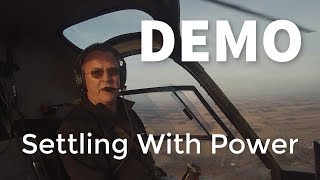
Kenny Keller and Brian Rutledge demonstrate vortex ring state, a dangerous condition where a helicopter descends fast despite full power. It happens when descent exceeds 300 feet per minute with little airspeed. Recovery requires pushing forward on the cyclic to regain airspeed and reduce the sink rate.
Questions this video answers
Greater than 300 ft per minute (VSI) while descending, with little or no airspeed and power applied.
About 2,800 ft total altitude, which he says is approximately 2,000 ft AGL.
March 29, 2019.
Chapters
I slowed even more. Now I'm down to almost zero airspeed. There it comes, there it comes. Shaking sensation, more vibrations. 500ft per minute. 600ft per minute. I'm in it. Okay, starting with power. So I'm just gonna.
We'll be going back to that aircraft footage in just a minute. This is gonna be a demonstration on selling with power. This is something you have to perform for the examiner during your checkride. This is a new video going into Helicopter Online Ground School today. I just wanted to share some more content with you in day 84 coffee with Kenny. I am Kenny Keller, creator of Helicopter online ground School. So just to let you know, these are the types of things that we do. Our website is always being updated. We're always updating video. A member recently commented about the video that we had in the site was actually about 7 years old. And he said, hey, the footage is a little bit grainy and I wasn't really understanding what it was you were doing. So I made a new video that explains better in detail. That's been our thing for seven years. Is continuing to build on helicopter online ground school and make it better and better as we get more experienced and as time goes by. So we do answer your questions in the comment sections Currently you'll see Brian Rutledge in there answering a lot of your questions because he is our operations manager, 30 year aviator, 30 year law enforcement officer, flies helicopters for a sheriff's department in California. Super detailed, super smart, super sharp guy. He's handling majority of the comments at this time. And I showed him this video last night. He was like, I like it much better than the one that we previously had. Again, it was pretty old. So we're going to go back to the aircraft, show you the video. Know that there's a link down below this video for helicopter airline ground school. You can go check out our memberships. So back to the helicopter.
Okay, I'm replacing a video inside helicopter land ground school. It's about seven years old. Time for a new video. And this video is going to be a selling of power demonstration. But I want to cover a few things in here in the aircraft first so you understand what it is I'm doing when I go out in the aircraft. We're going to go out and practice getting this light with power at a 2000ft AGL and then practice recovering. So what we'll do is we'll pick our altitude, let's say it's 2800ft, where it gets 2800ft and we're going to have a zero rated ascent and we're going to start slowing the aircraft down, we're going to start bringing that speed back. Going to a hover. Now if I stay point into the wind, slowing the power is probably not going to happen. So what I'm probably going to do as I'm slowing the aircraft down, going to do maybe like a crosswind. I'm not going to get as crazy as going downwind, but I'm going to not have the nose of the aircraft sticking into the wind. I'm going to have it probably a crosswind. And as I start slowing down and I get the airspeed slower and slower and slower, eventually the aircraft is going to start to settle. And when it starts settling, you're going to get a sinking sensation, you're going to get a vibration and you're going to be looking down here at the VSI. And when it gets greater than 300ft per minute and it's increasing and you have this sinking sensation and the helicopter starting to vibrate, you're in the onset of selling the power and if you don't recover that rate of distance is going to keep increasing, increasing, increasing. The helicopter is going to keep shaking and seemingly go a little crazy on you. So let's go out in the aircraft and do it so that you know what I'm doing. I'll be at about 2800ft, I'll be at zero rate ascent and I'm just going to start bringing that airspeed back. I'll probably with a crosswind, I'm not going to be pointing into the wind. I'm just going to keep slowing down, slowing down, slowing down until the aircraft starts to sink. When it's below 300ft per minute, it's not in selling the power. Once it's greater than 300ft per minute and it's and you're sinking and you have no airspeed and you've got power applied, that is when you'll be in selling with power.
Okay, I'm heading up to 2,800ft which will be 2,000 AGL, right. So I got all kinds of altitude to practice getting into, selling more power and then recovering from it. I'm coming out here, I'm going over nice big open areas, big open fields. In the event I had some kind of failure, something bad happened. Okay, I got nice big open areas to go. Not over downtown, going out here, out in the big open areas. Now the wind is out of the south right now I'm pointing south, which I'm just doing that to climb up and get my altitude. But to get in selling more power, I'm gonna have to, you know, get probably a crosswind. I'm not gonna do downwind. We'll just see. I'm still climbing up, getting my altitude, and I think I'm going to turn a little more this way just so that sun's not right in my eyes. I'd rather be able to see the instruments clearly. Okay, so I just explained at the beginning of the video what it is I'm doing in here and what it is I'm looking for. And I'm reshooting this. Because the video was old, we had a ground school member that didn't quite understand what it is I was doing. So I said I'll go out and shoot a brand new video. I'm up at 2,800ft. I'm going to start slowing the aircraft down just gently right now I got a little bit of a climb, so I need to get rid of that climb. There's zero rate of descent. Okay, now I'm gonna start slowing to a hover. So I'm gonna keep bringing it back. Zero rate of descent. Now I'm down to 50. Show zero rated ascent. Now I'm down to 45. Zero rated ascent. I'm down to 40. Got about 200ft per minute. I got about, just below 30. I'm below 30 now. I got 200ft per minute. Down to about 20. Airspeed, it's decreasing now. Okay, now I got 300ft per minute. Now you're going to start seeing a lot more vibrations in the camera. You should. I slowed even more. Now I'm down to almost zero airspeed. There it comes, there it comes. Shrinking sensation. More vibrations. 500ft per minute. 600ft per minute. I'm in it. Okay, starting the power. So I'm just gonna gently go forward, build up the airspeed. Now that I'm above 40, just random number, I'm now out of power. I'm still descending, but I can easily just go a little aft cyclic, raise some power. More power to get the descent stopped. So I went forward cyclic, raced a little or lowered a little bit of corrective, got the airspeed going and flew out of it. So that's very simply what it is. And I hope that explains a little better than the first video that I just replaced. But hey, that video was seven years old. So this is a brand new video. I explained it all to you one more time. It's basically slowing down to a hover out of ground effect with the wind not off your nose, winds off the side. I wouldn't recommend doing it downwind and you keep slowing the aircraft down trying to accompany to a hover. Eventually aircraft's gonna start to settle. So hopefully that makes more sense. Put your comments down below, let us know. Maybe you didn't see the old video, maybe you did. Let me know if this makes more sense and we'll see in the next video.
So thanks everybody for tuning in for day 84. Like subscribe, put your comments down below about selling with power and I will add some are gonna say why didn't you use the Richard Recovery for this video? I just wanted to demonstrate what it is you're going to have to do for the examiner. You could use either method, the method we've been using for years or the Richard recovery. But at 2,000ft AGL there's no danger of hitting the ground unless we have some kind of a big component failure. So that's why I chose just to use the standard method. So like subscribe, leave your comment down below and see you tomorrow for day 85.