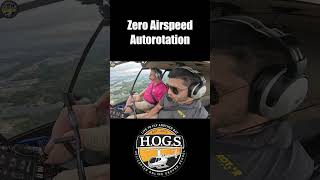
Kenny Keller demonstrates how to recover a helicopter from autorotation at near-zero airspeed, starting from 400 feet with a 60-knot approach. The technique relies on precise collective management, RPM control around 1300, and a three-count flare to regain speed and landing attitude.
Chapters
We're sharing this with you, but it's not something we want you to go do unless you're with a qualified instructor competent in teaching these types of maneuvers. Absolutely. We're not going to fall out of the sky if we don't have the speed. However, we need to know what the characteristics of the helicopter are to get to that condition. Right. So we're setting up for our 00. Well, 040, as I would like to cover, because it's our recovery height, or 400ft will be our recovery height. That's the top of our height velocity diagram. To accelerate, that's what you will accelerate. That's what we will accelerate. 400ft, you'll pick up. So we can do a standard flare. Exactly. We want to pick up that speed. So we're at 60 knots, 2,300ft. We're going to get as close to the Runway as we can, because with no speed, we're not going to be able to tell exactly if we're going to fall a little bit short or not. So we want as much margin as we can. So we want to slow down. And then again our setup into having almost zero ground speed. There we are. Then we're going to enter in 3, 2, 1. Going to lower our collective down, and we're going to stop our nose from falling down. We split our needles, and we want to keep our attitude right. RPMs. There you go. They're building up. So we're gonna raise just a smidge. Tiny bit, Just a smidge, and we keep it that way. We set 1300. We're going to push our nose forward. 1300. Nose forward, collective all the way down. We accelerate, accelerate, accelerate, accelerate, accelerate. There we go. 45 knots. We're going to flare, Flare, flare. Introduce level and pull.