Advanced Autorotation: Mastering 0 Airspeed
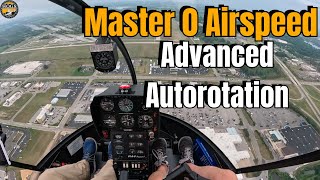
Kenny Keller and Gabriel demonstrate zero-airspeed autorotations for flight instructors. The 2024 SFAR now requires training on maximum glide and descent rate. Entry happens around 60 knots at 2,300 feet, with recovery at 400 feet and a target landing speed of 45 to 60 knots.
Chapters
Gabriel, if you want to lead us in to what we're going to go do now, and the premise of this video or two are you just did your CFI checkride with an FAA designated examiner and there's a couple of things you did with him that we're going to go out and you're going to show me what you did with him and explain the maneuver.
Absolutely.
And we want to say that this isn't for private pilots, this isn't for student pilots. This isn't for average guy, bought his own helicopter, he's going out. We really don't want you doing this kind of stuff.
Okay.
So this is, this is advanced training because he is a now a certified flight instructor and he was with a Designator examiner of 38 years and they. He wanted to go a little beyond the norm.
Right.
To give a little real world kind of what the aircraft can do. So if we do put this out.
There for the world.
No, this is, we're sharing this with you, but it's not something we want you to go do unless you're with a qualified instructor competent in teaching these types of maneuvers.
Absolutely.
So with that being said, you can take it away and explain what it is we're going to go do.
Yeah, absolutely. I believe that the enhanced author rotations have been the sbar for a while now, at least on the instructor side of things. Now it's more explicit with the changes on 2024 that students have also to receive training on maximum glide and on maximum descent rate or minimum descent rate auto rotations.
So it probably is different now.
Right.
Because of that change, they've added a little more of the advance to the SFAR sign off.
Correct. I am assuming that for flight instructors now we need to do this. These are maneuvers that can also be performed at the factory safety course. I was lucky enough to go last year and I was able to perform some of this beforehand before coming here. Warsaw traffic helicopter 181 Mike Bravos turning a right crosswind, Runway niner. Warsaw.
Yeah, I was pretty amazed at the difference between 60 or 70 and doing that at 40. You can see like how steep, how steep you're coming in their left or right.
Warsaw traffic helicopter 181Mike Bravos turning right downwind, Runway niner. Warsaw. Yeah, we have some.
Keep an eye on that.
Doesn't seem to be moving this way, but we'll keep an eye on it.
So in all transparency, what we're getting to do in Ranger is the zero air speed, right?
Yeah.
And I've done them. I mean Hauser have done them recently. Hauser loves them. I'm not a fan. You said you like them. Yeah, I think it's just because.
I.
Haven'T done enough of them. You know, they're just. It just feels so damn awkward to me.
It's not entering, it's not normal. Yeah, it's really not normal.
If I would have started flying a year ago it wouldn't be so weird. But you know, after flying a while and always entering, you know, 60, 70, wherever.
Yeah, I mean and that's what we want to, to have our students do. However you know, from a holistic perspective. I think it's good for the students also to know that their helicopter will keep flying even with no airspeed.
I've wondered why we don't teach it considering you're going to allow a person to go out and do photo flights and they're out there hovering doing a photo flight and they've never standard training. You've never been shown a zero airspeed auto. Well you've never done it and beyond.
Anything else it's just not even a zero, not even a zero airspeed. But a lot of people have some misconceptions especially with Robinsons that if you don't have speed you won't have enough energy to land an autorotation. So long as we are outside of our high velocity diagram shaded areas we should be able as our standard pilots. Right. We're not talking about test pilots yet. We're talking about pilots with average ability. Like all we should be able to gain enough energy to do a successful autorotation to the ground. Warsaw traffic helicopter 181 Mike Bravo is turning right base Runway niner Warsaw.
And if you were at 500ft though you wouldn't have much time. You would need to get that speed going fairly quickly.
Fairly quickly. Correct. Clear left. Clear right. Warsaw traffic helicopter 181 Mike Bravo is turning final Runway niner Warsaw.
So yeah, I have often wondered why in initial training it's not at least shown to someone so they know.
Correct.
This is what you could do.
We're not going to fall out of the sky if we don't have the speed. However we need to know what the characteristics of the helicopter are to get to that condition. Right. So we're setting up for our 00 well 00:40 as I would like to cover. Because it's our Recovery height or 400ft will be our recovery height. That's the top of our height velocity diagram to accelerate that's what you will.
Accelerate 400ft, you'll pick up. So we can do a standard flare.
Exactly. We want to pick up that speed. So we're at 60 knots, 2,300ft. We're going to get as close to the Runway as we can, because with no speed, we're not going to be able to tell exactly if we're going to fall a little bit short or not. So we want as much margin as we can. Perfect. So we're going to start slowing down. Slowing down. And we want our descent rate, of course, to be zero or close to zero. And most important, we want our ground speed more than our airspeed to be zero, like so. Now we're going to enter in 3, 2, 1. We're going to lower our collective, and we're going to arrest that as much as we can. Because of our high descent rate, we're going to see not only that we're falling faster, but also our RPMs are going to try to build up a little bit. But we need to keep our collective down. We need all of that energy around. So passing through 400, we're going to dip our nose forward. Not excessively, however, to gain our airspeed, our RPM might drop down a little bit. And here we're going to flare. Flare, flare. Recover, settle, and pull.
Okay, Hauser, don't want to hurt your feelings, but I like the way you enter that. You're a lot more gentle. He's real rough with it. So when we enter it, it's. That was really smooth. How you entered it. Didn't make me like. He likes to make your stomach come out of your mouth.
Understandably.
And I like the way you entered.
All felt good.
The only thing that was weird to me was that very end when we had to go forward, and it felt like we got so damn close to the ground at the very end.
At the very end. So we need to remember a couple of things. We, at that height, might not be able to reach 60 knots. Again, we might be able. Lucky. Like today at about 45, 50. Right. So we don't have the full amount of energy that we would usually have. We need to do our flare as much as we can and then level. So, of course, the helicopter is going to tend to sink a little bit more because we're not stopping the descent rate as effectively as it usually would and all that.
And the horn never went off once. Doesn't need to go off.
Doesn't need to go off.
Horns.
Okay.
Can be okay depending on the situation.
And here's our next disclaimer. Right. We're doing this maneuvers today with only the two of us and about a half load of fuel at this very moment. We're not attempting this with passengers in the back and we're not attempting this with higher fuel loads because we know that these maneuvers require a lot of precision and a lot of performance to be able to extract the most out of the helicopter.
Yeah.
One, two, three.
One.
Cool.
Anything else that he did?
That was it.
That was it.
Yeah.
Let's go do that again. But I'll just watch you.
You want the zero or do you want zero again? Okay, so we want to slow down. And then again our setup into having almost zero ground speed. There we are. Then we're going to enter in 3, 2, 1. Going to lower our collective down and we're going to stop our nose from falling down. We split our needles and we want to keep our attitude right. RPMs. There you go. They're building off. So we're going to raise just a smidge, tiny bit, just a smidge. And we keep it that way. Then we set 1300. We're going to push our nose forward. 1300, nose forward, collective all the way down. We accelerate, accelerate, accelerate, accelerate, accelerate. There we go. 45 knots. We're going to flare, flare, flare, introduce level and pull. That one was nicer. I would, I would say.
I like that one. I like that one. That, that nose and down to get.
Your airspeed is weird nature, right?
I felt better with at that time. That felt a bunch better. I could see how if we did. Went out and around and did another hour of that, I think I could get comfortable.
Definitely. Definitely. Perfect.
And we have more free resources like this free video. Private pilot 101 helicopter training blueprints. Our Amazon number one bestseller. We'll put a link around this video where you get a free PDF or the paperback copy. Privateblueprint.com all kinds of free info in there to help you get started on your flight training journey.
Peace out.
Peace out.
When you feel the pressure to fly.
But know the right decision is to.
Stay on the ground, hit the hogs. No go. And live to fly another day.
Helicopterground.com.










