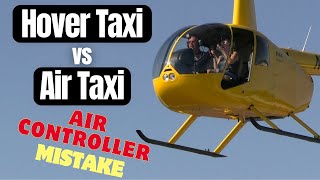
YouTube instructional video by Kenny Keller teaching helicopter taxi techniques. The clip contrasts hover taxi (slow, low, skid clearance ~3–5 ft, keep nose straight, use pedals to counter weather-vane tailwind effects) with air taxi (use normal takeoff/landing, maintain no more than 50 kts and 100 ft AGL for short transitions). Demonstrates an engine-failure simulation from hover with the verbal steps "1,2,3, enter" and emphasizes staying slow/low and on the pedals to cushion landings. The video is part of a Private Pilot training series and includes member/community mentions.
Questions this video answers
The book says three to five feet (many cheat to 2–3 ft).
No faster than 50 (kts implied), no higher than 100 (feet AGL implied).
"1, 2, 3, enter" followed by pushing the right pedal and cushioning the landing.
Chapters
1, 2, 3, enter. You push the right pedal, cushion the landing and onto the ground you go.
Hey, we're going to get right back to that clip and show you why we want to slow, hover skid, straight, parallel. And also I want you to understand the difference between air taxi and hover taxi. And sometimes people, even a tower, don't understand that. So we're going to take you back to that video, let you see the full vet video how to cover taxi and air taxi. This video is one of 12 brand new videos inside Private Pilot with more coming. Every single flying video inside Private Pilot's getting a fresh video. You can go down below, take the 24 hour test flight for Private Pilot, take see all the videos that I've shot so far along with all the new ones coming in. So right back here I want to mention Hogs Wall of Fame. These are our members. If you're new to Hogs, there's over 300 people now in the Hogs Wall of Fame. That's private, instrument, commercial and cfi. All members have passed our courses. So we're going to roll the video at the end. I'm going to tell you how you can get one of these for your flight school, a no go hogs no go button, and how you can get Private Pilot study guide. We'll come back at the end. Go ahead and roll that video, Heather.
Okay, we're going to demonstrate a hover taxi. And a lot of people get confused between hover taxi and air taxi. Hover taxi is what we're going to show you.
Forward cyclic, going to use my pedals.
To keep parallel with that yellow line. Likely to control the speed. And we want the speed of a brisk walk. And the book says three to five feet. Skid clearance. A lot of us cheat down to more like 2 or 3ft. This is a proper hover taxi. What people do is they get in a hurry at times and they get going too fast, which isn't a big problem if you're into the wind. But if they've got a tailwind, the faster you go, the more squirrely it's going to get. So I'm going to turn around here, we're going to go back and we're going to do it the other direction. Now we're going to have a tailwind, winds directly out of the south. I'm going to be facing north and I should be a little less stable going this way. Not sure how the camera will show it, but now the winds behind me. So when I'm hover taxi in this way. Yeah, you can see it. I'm pushing left pedal, right pedal, left pedal, right pedal. Because that wind is coming into the tail rotor and we're getting that weather veining effect. And the tail wants to go left and right. So it's a little bit harder going this direction when the wind's behind you. And if you start going faster, then you keep moving into that disturbed air and it gets worse. So getting in the habit from the very beginning to use the speed of a brisk walk helps you keep it under control when you get the wind behind you. Now, the other thing that we preach is keeping the nose straight. And a lot of times people want to cheat. Here's what I'm going to do. I'm going to turn the nose this way, and for, let's say, because of the wind, somebody wants to hover taxi like this, they'll go. A student will go, well, I'm just going to do this so I can be pointed into the wind with my nose pointed into the wind. Right. There's a problem with that and I'm going to show you. Problem is, what if the engine quits? What's going to happen? You're going to dig that skid into the pavement and you're possibly going to roll that helicopter over. So I'm going to back up here a little bit, and we're going to do a hoverada. We're going to simulate the engine quitting.
And why you.
The nose to be straight. We'll get a stabilized hover going here. We're just going to start moving forward. So again, if you're always going slow, staying close to the ground, staying on top of those pedals, when the engine quits, 1, 2, 3, enter, you push the right pedal, cushion the landing, and onto the ground you go. That is the reason why we're always harping that we want you to go slow, staying low to the ground, stay on top of these pedals. Moving forward is for that exact reason right there. It's in case the engine decides to quit on you. All right, so the next thing we're going to show you an air taxi. I basically just do a normal takeoff and a normal landing. Some people like to do a normal takeoff and then turn it into a quick stop, which, that's fine, too, for my purposes. Well, we'll do that.
We'll do that.
So let's say we want to get from here down the other end of this taxiway that you see out ahead of us. So we want to get moving forward we get a little airspeed and altitude. No faster than 50, no higher than 100. We're going to transition down there to the other end. And the other trick is you do not fly over persons or property on the surface. Get some altitude and airspeed. I think I said I'd do a quick stop.
So let's.
We're gonna go down here to this field and we're gonna do a quick stop in 1, 2, 3, quick stop, half cyclic, a little bit of right pedal. Keep flaring, keep flaring, keep flaring, keep flaring, keep flaring. I'll level it out and down to the grass. That's just a short. Simple air taxi could be used for longer distances, shorter distances, but again, you want to make sure that you do not overfly persons are properly on the surface and a proper air taxi is no higher than 100ft and no faster than 50. Live to fly another day.
Helicopterground.com reach out to Heather and flight schools that are sending us members we already know because members tell us that, hey, I heard from straight up aviation or Lone Star helicopters. So reach out to Heather if you will. Display this in your flight school where pilots make weather decisions. Students, pilots that is making a decision on whether to go or no go. Go or no go. We'll send you so email heatherellicopterground.com so hope you like that video. Plenty more to come. We're shooting videos daily right now. October 2023 private pilot study guide. If you want some real serious help, this thing is a badass. There's 400 questions that you could be asking here. And if I was going to a checkride tomorrow, I'd be going through this thing because examiners ask you the same stuff. What do you have to have on you? What do you got to do to be current at night? You know, category, class, all that stuff they hit you with immediately. Every single checkride. We'll put a link down for that down below. So and something else too. We have affiliate program. Now if you're a flight instructor or Hogs member or student, we share 50% of the sales. If you become affiliate, we'll put a link down below for sign up on that. If you're a flight school, we'll make you. We'll build your own webpage. So ABC flight school in conjunction with helicopter and ground school. It's all tracked. You can go in as an affiliate and you will see exactly what you're earning per month. And we pay once per month so you can check that out at the link below. So come back tomorrow for another flying video. Peace out.