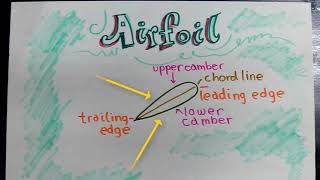
Lecture excerpt explaining helicopter rotor blade airfoil parts (leading edge, trailing edge, upper/lower camber, chord line) and fundamental aerodynamic terms: symmetric vs. asymmetric airfoils, plane of rotation, relative wind, angle of attack (lift source), induced flow (reduces AoA and lift), and pitch angle (mechanical angle between chord line and plane of rotation).
Chapters
So, real quick, here are the parts of an airfoil up front. Here we have the leading edge. And you just think about it, it leads the airfoil through the air. Back here we have the trailing edge, which just trails behind the leading edge. The upper camber is the upper curvature and the lower camber is the lower curvature. Now, if you take a line and go straight from the leading edge to the trailing edge, this is the chord line. Now, what I have drawn here is a symmetrical airfoil. And in that, the upper and the lower are the same. Now, if I draw an asymmetrical airfoil, it would look something more like this. If I draw the chord line, you would see that the upper camber and the lower camber look different. So this is an asymmetrical. This is asymmetrical. So now we're going to talk about some basic aerodynamic terms. Now, the real key to understanding this and honestly teaching it is to make everything come to this point back here. It's not really exactly how it works in real life, but it makes drawing it and teaching it a lot easier. So we're going to start with our chord line goes up through the blade down here. This is our plane of rotation. This is the actual plane that the rotor blade is moving through the air. Now, just because a rotor blade is moving through the air like this doesn't mean that that is necessarily the angle the wind is striking it at. It's not necessarily coming like that. Depending on if you're climbing, descending in an auto rotation or whatnot, the wind might be striking it at different angles. So we have what we call the relative wind. So this is the actual angle that the air is striking the rotor blade. Now, between the relative wind and the chord line, this is your angle of attack. This is where we get our lift from. Now, down here, this is what we consider to be our induced flow. Induced flow is actually bad. We do not like it. And you can see, if you have more induced flow, you have less angle of attack, meaning you have less lift. Now, your overall angle from your chord line to your plane of rotation, which is your overall, this is a mechanical angle, it's not an aerodynamic angle. This is your pitch angle, and that is just simply how much pitch you have compared to the plane of rotation. Sa.