Airspace Bravo Charlie Delta Intro New Airspace Coming To Private Pilot
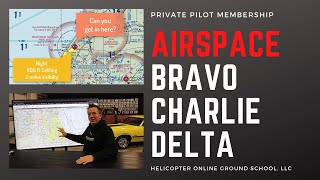
YouTube video transcript of Kenny Keller introducing a revamped airspace section for Helicopter/Private Pilot ground school. Keller explains the motivation (updating course material similar to a weather-section facelift), emphasizes reviewing airspace basics for checkrides, and gives a simple, Chicago-centered overview of Class B, C, D, E, and G airspace plus tools students can use (SkyVector, ForeFlight). He also references a downloadable “Top 10 Checkride Tips” PDF and links to helicopterground.com.
Chapters
Airspace. If you're brand new, you're going to struggle to get through all this and learn it. If you're a rated pilot doing an add on, you probably need to refresh this. We're going to what we're going to do YouTube tonight. YouTube doing this to update the opener video, the intro video to our airspace section inside the private pilot, inside helicopter line ground school. What we're doing is we're going to give the whole airspace section a facelift just like we did with our weather section. If you don't know this, our operations manager, Brian Rutledge went through and rebuilt the entire weather section this year just to update it and try to break it down and make it easier to understand and of course put in anything, anything that has changed over the last few years. So we're going to do the same thing with airspace. Not a lot changes. But what I'm getting ready to do is I'm just going to shoot a quick intro and break down what the airspaces are going into our airspace section because as an instructor you start with the simple and then move to the complex. What we're going to do is just go through and I like using Chicago, for example. We're going to get started here in just a second. And what I want to say is, since I just took a CFI reinstatement checkride, yes, I let mine lapse because I got wrapped up in other things and I should have finished like an online school, but I didn't. So I went and did the CFI checkride, reinstatement, checkride. And let me tell you what we preach over and over and over again. Don't get tripped up on the basics. And even going for a CFI checkride, he starts a reinstatement. He starts with the simple stuff. What do you have to have on you? What do you have to have in the aircraft? Ask questions about medical, all that basic stuff. And then he went right into airspace. It doesn't matter what checkride you're going for, student pilot, private pilot, add ons, commercial cfi. I've seen it over and over through the years. Every checkride, along with getting on the professional environment with 135 checkrides, flying EMS, they still go back during a checkride and they ask you the basic stuff. Okay? So knowing this, remember you got to go back and get the easy stuff. So I'm going to mention top 10 checkride tips. I'll put the free PDF below because I just went through a recent checkride myself. It reiterated all the things that we've been teaching and harping all these years. And that's why 2018 Flight Instructor of the year, Taz Chrisman, pictured here with me on the back. Together, we put this together and it's just the top 10 tips. And then it has a bonus section with some other things where Taz went out and talked to examiners and said, what are people screwing up now? You know, as of today, what kind of problems are you seeing? People showing up for checkrides. So I'll put this free PDF down below that you can download, take a look at it for nothing. And you can also order it and we ship them anywhere for, I think, seven bucks, shipping and handling. But anyway, either way, don't overlook the easy stuff, right? I'm telling you, I've been preaching it for years. And then I got a taste of my own medicine. I should have looked over airspace the day that I went to do my reinstatement, and I didn't, right? And I should have. I got through it, but, boy, it made me think, right? And again, when you're sitting across from someone and they're asking you questions, this examiner I've known for 20 years, we've done multitudes and multitudes of checkrides together. We're friends, but doesn't matter that we're friends and we've been working together all these years, he said, okay, today on this reinstatement check ride, we're going to go through and we're going to hit the things that I see people on a continual basis struggle with. And guess what? It was all the easy stuff. Everything. I've already mentioned airspace. And no, he did with me. Just like an instructor's going to do with you, or an examiner is going to do with you, or a Czech airman, they're going to give you scenarios at a certain place and say, hey, can you get in here with a certain weather? All right, let's talk about some airspace. We're going to start with the basic, okay, as you're learning this airspace, if you're brand new to this, I remember what it look, what it looks like, right? When you first look at this, you go, oh, my God, what are all these lines and circles? And there's so much to look at on these charts. Okay, so what I'm going to do as an intro video to get started with our new airspace section. I just want to give you an intro and give you a simple breakdown that I like to use. It's easy for people to understand on the different airspaces in and around Chicago because most people are familiar with Chicago and most people are familiar with o'. Hare. With o', Hare, one of the largest airports in the country. It's Bravo, big, blue, busy. And on a chart, you're going to see it as a pretty good sized airspace, upside down wedding cake with different layers. Okay, we're going to go into those more in the following videos. So you got o', Hare, that's across Bravo. Then down from that is Midway. And a lot of you have probably heard of Midway. Okay, it's not as big as Bravo, but it's still a pretty large airport, pretty good sized airport with a lot of traffic, still has international flights. It's a little bit smaller. It's a Class Charlie. So remember blue, big, busy for the big ones like o'. Hare. Magenta is for Class Charlie. Midway is an example of more of a, I guess you call it medium sized towered airport. Still a pretty busy airport highlighted in magenta. And then just down from the road from that, we got Gary and Gary, Indiana. And a lot of people have heard of Gary, Indiana because Michael Jackson was from Gary, Indiana. So here it is Bravo Charlie. Then down here is Gary, Indiana. It's a Class Delta. Now it is highlighted by a dotted blue circle going all the way around it. Okay, so that is a Class Delta. Now this still has, you know, has some jet traffic going in and out, has a tower, it's just not quite as big. So as we start working through these videos, we're going to go more in detail with each one, what the requirements are, the things that you have to have on the aircraft and the cloud clearance and visibilities that you need inside these areas. But again, I just wanted to give you the intro because it is complicated. But if you break it down, which again is what we're doing, we had a lot of longer videos jam packed with content and we decided let's rebuild the airspace, go through and let's hit each section, different videos and break it down and make it a little bit easier because it is complicated. Once you get it, you've got it right. You still have to go back and review every so often, but that's a simple breakdown for the towered airports in and around Chicago. And then you're going to hear about Class Gulf. Okay, Glass Gulf. Airports are all these little ones scattered all over the country. Little small airports, they're magenta with a magenta shaded area around them. You're going to hear and see more and more about those. You're going to hear about Class Echo airports, which is right here, one with a dotted magenta line around it. That is a Class Echo airport. Again, this is just a simple breakdown. These are the things that you're going to be learning in the other following videos. What's important about them is knowing what you have to do or what you have to have to get into them. You know what your cloud clearance and visibilities are for each one. There's different requirements day and night in certain areas. So there's a lot to this. But this is just a very simple breakdown to give you an idea as we get started going through this mess of what we see here called airspace. All right, that's a decent little intro. What I'm using right here, for those of you don't know, this is Sky Vector. This is free on the Internet. You can just go in and you know, use that like on your desktop or laptop. A lot of people are using iPads now using something called Foreflight. There's some different things you can use out there, but Brian will cover some of those. Brian's kind of our tech guy when it comes to all the cool tools that you can use when you're checking weather and looking at airspace and all these different things. So there you go. There's our intro for the new airspace section. Probably going to take just a little bit to build it. By the time you see this video, it may be done. So do us a favor, subscribe to this channel, click the subscribe and click the bell to be notified of our videos. We do each week. We cover all kinds of stuff. I am going to put the links down below. I mentioned the beginning of the video, top 10 checkride tips, free PDF and then the paperback copies also available down there. So subscribe to the channel, click the bell and we'll also have a link down below for helicopterground.com which is our training site where we have private commercial CFI instrument. We have FAA written test prep. We have a new app for all devices. We have progress tracking. We have our zoom course button. We have R22, R44 instrument specific information. We have a lot of content. We've been online almost nine years now. It'll be nine years 3-1-2021. We got a lot of great content for you inside helicopter line, ground school and all the monthly memberships. Have a 24 hour test flight and they come with a 30 day ironclad, no hassle, money back guarantee. So go down below, check those links, subscribe, click the bell and we'll see you in the next video. Peace, Sam.










