Autorotations Guimbal Cabri G2 Helicopter
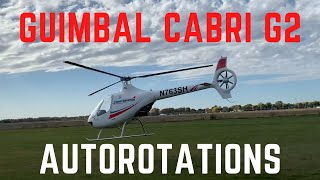
YouTube instructional video by Kenny Keller featuring instructor Chris Hauser demonstrating autorotation maneuvers in a Guimbal Cabri G2. Covers straight‑in autorotations and 180° autorotations with step‑by‑step technique (entry, scan mnemonic RATS, flare, and powered recovery), safety/setup advice, and practical tips on speeds, altitudes, and student common errors. Concludes with contact info for Sweet Aviation/Speed Aviation in Indiana.
Questions this video answers
Kenny Keller (Helicopter Airline Ground School).
October 14, 2020.
Goshen, Indiana (Speed Aviation; Speed Aviation also has location in Fort Wayne, Indiana).
Winds right down the runway about 15 knots, gusting to 19.
Enter the autorotation at 80 knots.
Chapters
Hey, it's Kenny with Helicopter Airline Ground school. We're heading out with Chris Hauser in the Cadbury G2. We're gonna do some auto rotations for you today. We'll do some straight ends and some 180s. And Chris is just gonna talk you through what it's like. He's been teaching the Cadbury's now for quite a while. He's got some good time in him, done a lot of students. So before we get started in the autos, before Chris gets started, I want to show you something really cool we just downloaded today. This is a new maneuver guide. Work them this way as a free PDF. You can go down in the description box below and get a copy of it. Pretty cool. Compliments of our operations manager, Brian Rutledge. And he based this off of.
The.
Downloads we have for you inside the private pilot section inside Helicopter One ground school. Right there you can see the list of the different maneuvers. So just, it's a, it's just kind of a cool PDF. It's something you can take a look at. It'll be a free PDF down below. You can grab it, you can download it, print it off if you like. That will be in the description box below. Go ahead, Chris, when you're ready. As a student pilot, working on my private pilot, show me what I'm. What I'm gonna need to know as you start teaching me these.
All right, well, right now we're kind of, we're heading northbound here to get set up for Runway two three. The winds are right down the Runway today about 15 knots, gusting to 19. So we're gonna have some pretty good headwind going right into the the Runway. First thing I'd like to say though is this. I'm gonna show you the way that we teach it. That sweet aviation teaches it in our G2s. So what we're going to do first is talk about the straight in auto rotation. In Indiana most time when we fly helicopters, we're about 700 or 800ft off the ground. So 1500 indicated is pretty much where I like to be at best range in the G2 is 80. So we will enter the auto at 80 knots and we'll do 2000ft. Today we'll start off with 2000. Just so we can show know time in the glide and show, you know, the scan that we have. This will be to a power recovery when we enter the auto in the G2. Since it's a clockwise rotation system, we will collect them to the floor. The left pedal And a little bit aft cyclic. Now, the POH states that 50 is our magic number and everything. 50 in our departures, 50 in our approach, 50 in the autos. I don't like 50 for the auto rotation because everybody always gets slow so that, so I like to use the number 60. I like 60 knots on my airspeed. When I enter the OR, I will slow to 60 on the airspeed. So we're going to enter the auto at 80 knots down collective, collective to the floor. I teach that I will roll off the throttle. Now, we can get into a discussion about rolling off or not rolling off, however, but for the purposes of my training, I like to roll off throttle. I will also roll throttle back on as the instructor. So my examiner and I got together and we decided that was the best way. So the examiner here will roll off the throttle and then he will also roll the throttle back on when we do the autos. So when we enter the auto, we're going to go down collective, left pedal, half cyclic. I will roll off the throttle to simulate the engine failure. And then I'm looking for 60 once I get into the glide. Once established, then I'm going to get my scan going. We, we use the acronym rats. R A T S rotor RPM airspeed, trim and spot on the ground. R A T S rotor RPM airspeed, trim, spot on the ground. And as I'm, as I'm coming down in my glide, I'm just going to do that scan all the way down, just keeping it in trim, keeping airspeed about 60. Now we can play with the airspeed depending on if we need to extend that glide or if we need to shorten that glide once we get about treetop level. Now I know the book talks about a certain height, but I don't like to use height either because that means the student will then start to stare at the altimeter. So I like to use, I like to teach treetop level. Once we get up to about treetop level, we're going to start a flare. It's going to be a small flare. Then as we get closer to the ground, the flare is going to get more aggressive. Once we get to zero, close to zero airspeed, then we're going to push the cyclic forward to level the nose and then come up on the collective as I add right pedal. As I push forward on the cyclic, I will also roll the throttle back on. And again, like I said, the examiner or your instructor will do that. Goshen traffic helicopter seven six three showtail about the two mile final two, three. Goshen. All right, so we're setting up here at 1800. We're about two miles from the Runway. And again, when we enter it, I will roll off. The nose will go to the right in this aircraft. So an engine failure, the nose will yawn to the right. I'm going to lower that collected to the floor. Add left pedal as I do it, and aft cyclic just slows down. Then I will start my scan, which again is rats R A T s rotor rpm, airspeed, trim and spot. When I get to treetop level, I'm going to start a mini flare. The flare is going to get more aggressive the closer we get to the ground. And then when we burn up all that airspeed, then I will push the cyclic forward to level the nose. Come up on the collective as I add right pedal. And then I will also add roll on throttle to come to that powered recovery. All right, so we're about a mile or so from the Runway. Everything's looking good. This is a land event, so we'll go ahead and do our pre landing. So warning caution lights are off, gauges are in the green. We got plenty of fuel, and we'll go. Landing light on. Go. I'm going to simulate the engine failure by rolling off. 3, 2, 1. There's the yaw to the right, collectors to the floor. That horns our low rotor rpm. It's going to come back, though, as I aft cyclic. Get some left pedal in there. All right, so there's 60 knots in trim. A little bit of forward. Got that scan going. I'm in trim. I've got airspeed. Rotor RPM's looking good. I got the spot on the ground. Everything's looking good. We're still looking good. Rotor airspeed trim okay. Here comes tree top level. A little bit of a flare. A little bit more hold. Let the aircraft settle roll and throttle on and down.
Works out a little better when somebody's not messing with your pedals, right?
Not too bad. I was off just a hair there.
All right, can you show us the 180?
You want to see the 180?
I do want to see the 180.
Ooh, pressure's on now.
All right, so let's talk us, talk us through as a what you're going to be training your. Your new student with. Yep, looks clear on the left. Your new student with whatever. 10, 20, 30 hours, and you're gonna start teaching the 180s.
Goshen. Traffic cop this departing two, three, right traffic, Gosher. All right, so there is no, there's the difference between the straight and the 180 is actually, is the only thing is the turn. The main thing about the turn that I have found that students, one of the biggest faults I guess or things that they mess up, I guess is that they don't get the turn going. It's kind of one fluid motion. You need to get established in the auto first, then get your turn going. However, it's one fluid movement. I like to tell them it's down left aft turn, so down collective, left pedal aft cyclic turn. If you delay that turn, then it's just going to push you away from your spot. The whole purpose of the 180 auto is to get you back into the wind. Okay. So obviously if you need to make a turn, you've got a tailwind or you got a crosswind or whatever, but it's just going to push you away from the spot that you want to go to. You know, here we're using a Runway, so today we're fortunate the wind is coming. The wind is coming right down the Runway. So we're gonna run a downwind here. And what I'm also doing is I'm extending my departure because I want to be set up for my 180 auto. I don't want to have to turn crosswind and then downwind, then all of a sudden have to enter the auto. So extend your departure so when you make that turn crosswind to downwind, you know, you can get into your 80 knots, you can be at your altitude coming around because especially with the tailwind today we got a 15 or 20 knot tail tailwind. We're going to be moving across the ground pretty good. So if I make my turn too early, it's just going to rush my setup. And if for everybody that's watched Kenny's videos, I'm sure he's explained several times that a good setup will result in a good conclusion. So if I rush my setup then my whole maneuver is just going to be. Not going to be good. All right, so here we are on the downwind and we go from cruising about 40 knots indicated to about, well, not indicated about 50 knots ground speed now to about 90 knots ground speed. Goshen, traffic copter three share tails on a right downwind. Two, three. Goshen. Alright. Another error that I see students making is that they get too far from the landing spot. Okay, you want to hug it a little bit. So I'm going to come in just a little bit closer so I know that I can make that turn also, just because we call it a 180 doesn't necessarily mean that you need to do a full 180 or doesn't necessarily mean that you got to do the 180 all in one turn. It could be maybe 290 degree turns or maybe it's just a 90 turn to get into the wind. All right, warning caution lights are off. Gauges are in the green. Got plenty fuel. Landing light is on. All right, here we go. So remember, down left aft turn. 3, 2, 1, roll off. There it is. I'm established turn. Now if you do the turn to the north northeast, if you do a steep turn, then your rotor RPM is going to build. If you. If you just do it nice and shallow, then it won't build so much. And there we go. We still got 300ft. We're just now in a straight in. Everything's looking good except for a little bit of trim there. Here comes treetop level. A little bit of a flare, a little bit more. Bringing it up, getting aggressive. Throttle's coming back on. And down we are.
I look pretty nice.
That wasn't too bad. The turn was a little off. Well, I mean, the turn was good, but you know, trying to. You got to now incorporate looking at your spot by turning your head. So now not only are you looking at your spot, but you also get to turn back in here, look at your gauges, make sure you're in trim. I noticed I was out of trim a little bit. I got a little bit slow, but it's also nice. I'm going to set it down just for a second. What's also nice about the G2. Is that we have that. We have that whole arc there for our autos. But what we can also do is we can play with the speed in this thing. So in an instrument or anything else, I would not get below 45 knots. Maybe even. Maybe 40. All right. But in this aircraft, we can get slow. So on this one, I saw that I was, I. As I was making my turn, I was a little bit out trim and I was about 45 on the airspeed. But me, that's not a big deal. Now, in an instrument, something like that, that might be a bigger deal, but not this one. All right, you want to take the controls from here?
I will soon as hang on to them. I'm going to sign off here before you guys go. Remember, free PDF down below. There it is. And you can download it, print it off if you like, subscribe to the channel because there's going to be a lot more coming from Chris Hauser and Helicopter Land Ground School in the videos. Oh, yeah. Chris, tell everybody where you're flying at. I didn't say that in the opener. We're out.
Speed Aviation, baby. We're here in Goshen, Indiana, two locations. Speed Aviation is in Fort Wayne, Indiana, but we also have an aircraft located in Goshen.
And so if they want to get ahold of you and fly the Capri, they should go to sweetaviation.com correct?
Correct.
There you go. Sweet aviation.com to check out the cab with Chris Hauser. So do us a favor, subscribe the channel. Click that little bell to be notified of the next video. We'll see you on the next one.
Peace.
Peace out.










