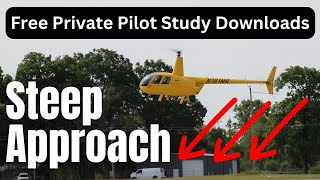
Kenny Keller walks through helicopter steep approaches: intercept at 300 feet AGL, hold 60 knots on final, and keep airspeed above 30 knots until your descent rate drops below 300 feet per minute to avoid vortex ring state. He also offers free PDFs and paid study courses for private pilot through CFI ratings.
Questions this video answers
At least 30 kt (keep 30 on your airspeed until the rate of descent is below 300 ft/min).
15 degrees.
About 300 ft AGL (approximately 1150 indicated in the demonstration).
60 kt.
Chapters
Now I can get slower than 30 as long as I keep that rate ascent below 300. It's at 200. So here we go. Angle still looking good. 200ft per minute. We're going to get right back to.
That video and show you the full video of the steep approach. The big thing on these steep approaches is keeping 30 on your airspeed until your rate ascent is below 300ft per minute. That's going to keep you safe out of selling with power or vortex ring state. We're going to go back to that video, but we've been pimping these all week. Maneuver guide free PDF down below free PDF top 10 checkride tips PDF down below free PDF helicopter checkride down below. You can get a free PDF of chapter one of this down below. And you can also get the whole entire book. Private pilot study guide. People are digging it. It's getting keeps growing popularity. All right, we'll go back to the video.
Okay, this time around, we're gonna show you a steep approach. So right now I'm a beam my numbers nine. So I'm gonna start a small descent. A little bit of down collective, a little bit of right pedal, a little bit of aft cyclic, start slowing down. And with every maneuver, we want a good setup. I want to be around 1150, that's 300 ago, when I intercept my steep approach angle. Going to use the collective to control the angle cycle to control the speed. And we want to keep 30 on our airspeed until our rate of ascent is below 300ft per minute. On these steep approaches, it's easier to get yourself into selling power if you're not being careful. If you don't have much wind, if you get too aggressive, you could get into selling with power. So we're going to keep this or get this descent going, start slowing it down, make a radio call. Warsaw traffic, helicopter one Mike Bravo, right, base. Turning final Runway nine. Warsaw. So again, we repeat it over and over. Key to a good approach is a nice setup. I want to be 300 AGL, which will be about 1150. I want to be 60 on my speed. I want to be in trim, and then I want to intercept that approach angle. The angle for steep is 15 degrees. So we've done a normal, we've done a shallow. Now we're doing a steep line up. There's 1200. I'm going to keep that just. Now, since we're going to be going over some trees, give us a little extra buffer here. And now we're lined up with the Runway so now I'm just waiting to intercept what I believe is a 15 degrees. So right now you see red over red. So we know that's too low. We're going to see red over white. Soon we'll know that's a three degree airplane approach and we're going to want to keep going. There's red over white, so there's 3 degrees. Surely thereafter you're going to be 5 degrees. We'll keep going. We're probably 10 degrees. There's probably normal.
We're going to go a little bit farther.
And for me it's where the strings are at on the windscreen. So when I start going down. Collective right pedal aft cyclic. In the beginning, everybody has a tendency to stare too much inside. So the sooner you can learn to be looking outside and then just looking back at your gauges to verify what you think's going on, the better off your will you will be. You need to learn how to do this by fill. So a good steep approach angle 50 on the airspeed. I'm 500ft per minute, which is fine up here because I still have plenty of airspeed. But I want that rate of descent below 300 before I let the airspeed drop below 30. I have my angle. Still looks good. But now is where I want to start slowing it a little bit. I want to get rid of that rate of descent. So I'm going to keep working that collective in. There we are, 300ft per minute. 200ft per minute. There we go. Now we want to keep that there. Still got 35, so we're in no danger of selling the power. Now I can get slower than 30 as long as I keep that rate. Ascent below 300. It's at 200. So here we go. Angle still looking good. 200ft per minute. Now the airspeed can drop off. Doesn't matter, we don't care. Still 200ft per minute. Nice angle coming in nice and slow. Keeping the helicopter level by doing it nice and slow. There's no big pulls at the end, no big collective pull, no big pedal inputs. Continue in our 15 degree angle right down to the numbers. And that is a standard steep approach right down to the numbers.
Live to fly another day. Helicopterground.com you get one of these when you pass your check ride with helicopter land ground school. If you're new to us, these are our private pilots rolling through every two seconds. These are people that over the past 12 years have passed. Their checkride sent us in a picture. Usually a couple, a couple sentences at Least or more of how we help them get through the rating. Many of them say couldn't have done it without you. A lot of them just use us as a supplement with their ground they're doing at their flight school, instrument pilots. They're rolling through every two seconds. These used to be all over the wall in pictures and we ran out of space so we went digital with it. Over here is our commercial members rolling through every two seconds. And over here is our certified flight instructors running through as well. And we also have our final approach course customers up here. I believe on this screen there's eight of them. Another one come next week. That's finalapproachcourse.com I'll put that down below too. We help you finish up your rating when you're out somewhere else in the country and you can't seem to get a rating finished for whatever reason. There's lots of reasons. People have come this year from Maine, they've come from Florida, New Mexico, they've come from Arizona, Texas and Oregon as of now. And we have another one coming from Oregon. So final approachcourse.com we'll put that down below along with the free PDF, the maneuver guide that's down below, free PDF top 10 checkrides and the paperback. We'll put a link for that. We ship that right now for only like 977, $9.97. Same thing, free PDF for helicopter checkride. That's down below. Or we'll send it to you for $9.77. And there's a free chapter one PDF for this. We haven't mentioned that in the last four videos. You can sample this with a free PDF down below. The private pilot study guide gives you a chance to go in and take a look at what chapter one looks like. This has certificates and documents, airworthiness requirements, weather information, cross country airspace, performance limitations, operation systems, aeromedical factors, general aerodynamics. Let's do a sample. Describe the fully articulated rotor system. Describe angle of attack. Describe pitch angle. Describe relative wind. Describe blade coning. These are the types of things you're going to have to answer on a private pilot checkride. This book gives you all the answers. Each chapter is duplicated. First half the chapter you can test yourself and there's space to write the questions in. And then it's duplicated with the correct answer so you can go in, write your own answer, go to the second half, see how you did. Because we learned through repetition, we learn from reading. We learn from writing and going over.
And over and over.
That's how you do it. So down below, all kinds of links for all kinds of stuff. And 12 years online we have full four fledged, four fledged, four full fledged online courses. Private instrument, commercial, CFI helps you with all the ratings. We have quizzes with the lessons, FAA written test practice. At the end we have a mobile app and more.
All below@helopterground.com Peace.
When you feel the pressure to fly, but know the right decision is to stay on the ground, hit the hogs, no go and live to fly another day. Helicopterground.com.