Before Any Maneuver… Nail Your Normal Takeoffs & Landings
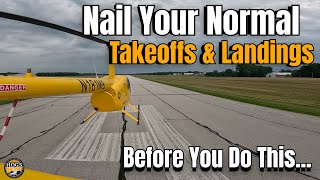
Kenny Keller walks through normal takeoffs and landings as the foundation for helicopter flying. Get your trim, power, and cyclic right before you try anything else. Every lesson starts here, every maneuver builds from it.
Chapters
I guess a question that a lot of people ask all the time is what should we do first on a lesson?
What's your warm up?
What's your go to?
Mine is always a normal takeoff and normal landing every single time. Just to set the pace, see how the helicopter's doing, warm it up. Everything we do starts with a hover, ends with a hover, and then we build everything we learn off that normal approach. We build on steep and shallow. So that's what I do. It's always, it doesn't matter where you come from. Our first flight always go, just show me a normal takeoff and normal landing. How you do it.
Traffic stock 26, 30 Mike going to be doing a crossman, extending our crossman for the traffic for Runway 22. I think it is a very good practice to do that, you know, give you all the tips. If you're an instructor, you'll be able to tell a lot about that student through doing those maneuvers. And as a student, it'll give you a good base to any other advanced maneuvers you might want to do in the lesson.
All right, so I'm descending down to my 1,150, 850, 9501-050115-01150 for my 300 AGL, clearing left and right, turn the left. I want to have a nice setup with 60, zero in, trim, everything where I want it. So we're going to line up with the Runway about 50ft to my 1150. Line up with the Runway, get a hair. So I'll pick that speed back up, get rid of that rate of descent. Because I want the same sight picture every time for consistency. I want to set it up the same way. And that's how you can go to any airport in the world and fly a normal approach. People go, I want to just do my check right here because I, I know the Runway well. If you use good technique, you can go to any Runway in the world and do the same thing.
And do it.
Absolutely do the same thing. So I'm going to use the number nine. Even though it's hard to see, that's where my spot is. So I got my 600 ready to set. 40ft higher, but I don't care. In trim close enough. And I'm coming into what would be.
A normal.
Right about, I don't know about now. So same three things. A little down collective, little right pedal, little left cyclic. Start my descent. Perfect. Should look like I'm always approaching those numbers at the same speed. Elective controls the angle. Cyclic controls the speed. Somebody recently said, the never ending approach.
I go, I like name Lakeland is there for a reason. Right? Lots of humidity around. At this very moment, we're setting up for just a normal approach. So Kenny has been flying all this time, and as we keep saying on these videos, the best thing you can do before performing any sort of maneuver is to do a normal approach. Warm up before you do anything else.
And I like that you chose to do that. I didn't tell you to do that.
Absolutely not.
You chose to do that yourself.
And that's like when somebody's with me and they go, well, here, show me an auto. You do it like it's like, hang on. I don't just. I'm gonna be on the controls for a few minutes. I wanna.
I want to make sure to feel where things are, how everything is behaving.
It's harder work doing it this way. You don't even do hardly anything coming out other than right now. Pulling a little collective, adding a little bit of left pedal and right to my numbers. Little lazy left pedal guy there.
There we go. Perfect.
I like it.
I like it too.
All right, then here's what I do. We've. You and I have been doing this together, obviously already, but this is. I do this even with Private every time. This is how I make them take off.
The slow, painful, methodical.
Yep. Take off. And I do it all year round. Oh, yeah. And I even did this in ems.
I didn't.
I never did aggressive takeoff. And the company was fine with that.
There's no need. There's really no need. Today. The day has cooled off quite a bit. But especially in the summer, especially if.
You fly on a hot day like.
We do in Florida, you know it.
You know it more than we do. You have higher heat and higher humidity. Higher humidity probably. Well, humidity might be higher humidity for sure.
For sure. We operate near the city of Lakeland and the name Lakeland is there for. For a reason. Right. Lots of humidity around. At this very moment, we're setting up for just a normal approach. So Kenny has been flying all this time, and as we keep saying on these videos, the best thing you can do before performing any sort of maneuver is to do a normal approach. Warm up before you do anything else.
And I like that you chose to do that. I didn't tell you to do that.
Absolutely not.
You chose to do that yourself.
And that's like when somebody's with me and they go, well, here, show me an auto. You do it like. It's like, hang on, I Don't just. I'm going to be on the controls for a few minutes.
I want to make sure to feel where things are, how everything is behaving.
Yep.
That we have all our parameters set and ourselves to make sure that we can perform the maneuvers right. Yep.
Take the controls and show me an auto.
Now show me an auto. Correct.
Oh. Give me the controls and let me warm up for a few minutes.
Warsaw traffic helicopter 181Mike Bravis turning right, base Runway niner.
So good point. I'm glad you did that. And the point is, when you go out for the day, do a normal approach.
Starting out, just, just make sure that you have everything set correctly, that your sight picture looks like you want it to look like. And that is going to give you an advantage. Warsaw traffic helicopter 181Mike Bravo is turning final Runway niner. Warsaw. So of course I did a shorter approach in this case. I mean, I didn't set it up super long. We've been working on them for the week, so we'll be able to set it up nicely. Our descent rate is less than 300ft per minute. I'm starting to reduce our speed, of course. And we're going to do that very nice, smooth, methodical approach into the numbers, regulating all of our parameters. Clear on the left. We're clear on the right as well prior to crossing that Runway.
Perfect.
There we go. Our descent rate, less than 300ft. We can slow down under 30 knots. We feel shaky and we start pulling our collective in. Now that we're in ground effect, we get to the numbers without even having to flare. We're back into a Hova.
Nice.
Yeah. I'm gonna set up for a straight in. And usually I do them at a thousand. Of course you do them a little bit closer to the ground, but we'll do that.
Hey, this is your first flight as a certified flight instructor.
This is my first hour as a certified flight instructor.
It is. Because what did happen until you were out and he signed the correct temporary. So this is your first official flight as a cfi.
That is absolutely right.
And we have more free resources like this free video. Private Pilot 101 Helicopter Training Blueprint. It's our Amazon number one bestseller. We'll put a link around this video where you get a free PDF or the paperback copy privateblueprint.com all kinds of free info in there to help you get started on your flight training journey.
Peace out.
Peace out.
When you feel the pressure to fly, but know the right decision is to stay on the ground. Hit the hogs. No. Go. And live to fly another day. Helicopterground. Com.










