Carburetor Heat, Temperature and Carb Icing
This content was created by Kenny Keller. This content was uploaded by Kenny Keller. This is a YouTube video titled "Carburetor Heat, Temperature and Carb Icing" created on August 17, 2021, featuring Kenny Keller discussing the principles of carburetor heat, temperature, and icing in aviation, including the Venturi and Bernoulli effects, and practical advice for managing carburetor heat in various conditions.
Chapters
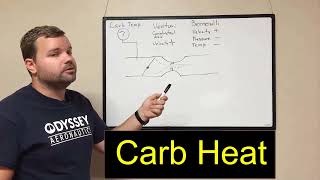
So now we're going to be talking about carburetor heat and carb temperature. Now, to fully understand this, we have to kind of go back to basics, to Venturi and Bernoulli, and then that will lead up to carb icing and why we apply carb heat. So as a review, Venturi effect states that as air goes through a constricted area, its velocity increases. So we have a Venturi here, which just means it gets neck down. And as the air goes through this Venturi, its pressure, or excuse me, its velocity increases. Now everyone always lumps Venturi Bernoulli together. They're actually two different things. Venturi is simply the velocity goes up, but that leads to. Bernoulli figured out that as the velocity increases, the pressure decreases, also the temperature decreases. So in here, inside the Venturi, the air is going very quickly and its pressure is low. Also its temperature drops. That's actually why they put the fuel nozzles in there, is because you have low pressure in there, sucking the fuel out for the engine. Now what happens is as air goes through, let's say the throttle is mostly closed. So first of all you're going to have a pressure drop as it goes through the butterfly valve. So your pressure is going to drop in here and you're going to get a temperature drop associated with that. Then the air is going to go through a Venturi, you're going to get another temperature drop because of the Venturi. Also you have fuel that is being sprayed in and it's atomizing and evaporating. That causes a third temperature drop. So you have three things decreasing the temperature of your air, which means that especially in this venture, in this area right here, you can get ice start to build up. So we have to apply carb heat to preheat the air when it goes in to prevent carb icing. Now what happens is below 18 inches of manifold pressure, which means low power setting, which means this valve is mostly closed. You see, the probe is on this side of the valve. Well, that means this could be reading out of the yellow. You're all good, no problem. But because this side is fine, but then only a little bit of air is getting by, you could actually be developing ice on this backside even when this says everything's okay. So that's why there's a little warning on there saying below 18 inches, apply full carb heat to prevent icing from forming. Above 18 inches, this will be more in an open state, which means you have a lot of air flowing through, which means this is Much more accurate. Plus you're not getting the pressure drop on here. It's just air is flowing through and then getting a pressure drop here. So above 18 inches you just rely on your gauge and keep it out of the yellow at all times. So the other thing to note with carburetor heat and carb temperature is you want to run as little as necessary, as much as you need, but as little as necessary. So let's say you have no carb heat. So you have cold air in here and the air is real dense, you're getting good power. As soon as you apply carb heat, the air density drops. You have actually less air going through. Think of it like a hot air balloon. You have hot air and, and that hot air is thinner, lighter, and that's why hot air rises. So you have less air going into the engine when you pull carb heat, which means you will have an associated power loss. One thing you can do to give an example of this, go out in the helicopter, especially on a hot day, hold a three foot hover and just hold it nice and steady and then apply carb heat. The helicopter will immediately begin sinking and you have to raise collective to hold it up. And you will notice your manifold pressure has to jump up about a full inch of power. Take that carb heat, put it back down, helicopter will start climbing up and you can lower a little bit collective and you'll get an inch of power back. So that's why whenever you're pulling carb heat, use it when it's necessary. But as soon as you can, like if it's not really conditions conducive to carb ice, you know, it's kind of on the edge, but you're still running carb heat on approach when you're coming into land. And you're going to start pulling in power before you do that, put that carb heat back down, you just gain yourself another inch of power. Same thing with steep approaches. As you're coming in on a steep approach and you're pulling in power, my rule is that once I hit 18 inches, I no longer have to worry about applying full carb heat because I'm below 18 inches. And that throws in a power check too. On a max or on a steep approach, as soon as I hit 18, I back that carb heat off and then just keep it out of the yellow. It gets me extra power when I come into the bottom. So now we're going to read right out of the POH as to how they say to use carb heat. Carburetor ice can form in a wide range of atmospheric conditions, but is most likely to form when outside air Temperature is between negative 4 and 30 degrees Celsius. Note that you can get carb ice all the way up to 30 degrees Celsius, which is 86 degrees Fahrenheit. And the difference between the outside air temperature and dew point is less than 15 degrees. So when you listen to your awas, it will give your temperature and your dew point. The closer those get, the more moisture is in the air. And if they're within 15 degrees and you're below 30 degrees Celsius, you have the potential for carb ice happening. That's conditions conducive. When conditions conducive to carburetor ice are suspected, use carburetor heat as follows. During run up, use full carburetor heat. During warm up to preheat induction system and the carburetor heat is filtered. You can run carb heat anytime. So basically all winter long and whenever it's below about 30 degrees, before I even start the engine, I pull full carb heat. It's one, gonna speed up your warm up time, so you're gonna spend less time just sitting there waiting for it to warm up. Two, it's gonna preheat your carburetor and all your induction system. And if you think about it, you're less than 18 inches of manifold pressure while you're warming the engine up and less than 18 inches of manifold pressure. They say run full carb heat, so that's a good time to run carb heat. During takeoff, climb and cruise, use carb heat as required to keep temperature out of yellow arc. So during normal power on flight, you're going to keep your carb temp out of the yellow, adjusting the carb heat as necessary. Now, during descent and auto rotation, descent and auto rotation, you're going to be below 18 inches, which means this gauge does not read accurately. So at those power settings, apply full carb heat regardless of temperature gauge indication because it does not read accurately. Now you use this kind of, you know, you got to think about like, am I going to get carb ice? Am I not? If you're above 30 degrees Celsius, so it's 35, that means it's 95 degrees. And especially, you know, out here in California, we have very little humidity. So if it's like 95 degrees out and the humidity is low, you're not going to have to worry about carb ice. I put that thing Down, I leave it down. All it does is heat the engine up and take away from your performance on an already hot engine. So. So when it's hot out and you're not in this range, and especially if you're far out of it, don't apply carb heat, you don't need it, and it's just going to rob you of power. But if you're in this range, use car peat, as the book said. Now, what happens if you get carburetor icing? Carburetor icing is really tricky because it's not going to slowly set on and give you warning. What happens is, as you start to build ice up in here in your venturi, the engine will start to produce a little bit less power. Now, in an airplane, that would mean the rpms would come down, but we have a governor controlling our RPMs. So as soon as we get ice building up, as soon as that engine drops a little bit, the governor is going to sense it and it's going to open up, adding more throttle. You won't even know it. More ice will begin to build up. The throttle will open up a little bit more and a little bit more and a little bit more. You could be flying along with an engine that is icing up and you'd never even know it until your throttle is going to reach wide open. And it's trying as much as it can to keep those RPMs. As soon as you raise that collective, guess what? Your engine's at wide open throttle. It has no extra power. Now you're going to get low rpm or even if you don't raise collective, you get any additional ice past wide open, guess what? Engine power is now going to start coming down. And you're probably going to have to do an auto rotation because now your rpms are going to be coming down. And who knows if you're going to have time to pull carb heat and blow that ice out before you're running out of power. So the saying is, the governor masks carb ice. So that's why you have to be proactive about it. You have to deal with it before it happens. You can't let it happen and then deal with it because by the time you realize it, it's probably going to be too late. You're going to have to do an auto rot.










