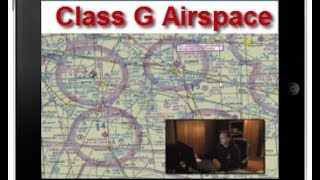
Kenny Keller breaks down Class G airspace, the airspace type that trips up most pilots. The key: boundaries change depending on whether you're inside or outside the magenta circle on your chart, and examiners will test you on this distinction.
Questions this video answers
Surface to 700 ft AGL
Surface to 1,200 ft AGL
Chapters
And I've done a lot of beginner students and I've done a lot of add on guys. And even an add on guy can walk in the door. Been flying for years and I'll say. So where's class G at? Right here at so many feet. Or here so many feet. So I just want to go over this because class G isn't really super tough, but it is if you don't understand it. And not only is it tough for beginners, but also very tough for add on guys. So real simply, I want to try to break it down the best I can. We're going to use Plymouth right here where I have my arrow. Plymouth is where we're operating here in north Central Indiana. Plymouth is a small Class G airport. So the class G airspace at Plymouth starts at the surface and goes up to the overlying 700ft inside the this magenta circle, just outside of this magenta circle, anywhere outside of that circle. Class G starts at the surface and goes up to 1200. So that's the main breakdown that you have to remember. Class G inside the magenta is the surface up to 700. Class G on the outside of the magenta, it's the surface to 1200. And above class G is Class C. So out here, outside the magenta, Class c starts at 1200 and goes on up to the next overlying airspace. Whether it's BA or if there was a bigger airport, it could be something else, could be Bravo. But around here it's not. It goes up to class A in here. Class Echo is going to start at 700ft above the ground and go up to the overlying airspace. So what you have to remember is inside the magenta surface to 700, outside the magenta surface to 1200. These are all small airports right around this area where I'm from. And you notice they've all got their own circle on them. Now when you get off in other areas, you may find where there might be a whole bunch of airports that are grouped all into one area. You really have to look at that shaded magenta area to know what's going on. And the trick is the examiner is going to give you something like you're out here at 700ft, or let's say 800ft AGL, 800ft above the ground. He's going to ask you, what airspace are you in? You are in class G because you are 800ft above the surface. The class G is going up to 1200. It just depends. And he's going to ask you he may give you agl, he may give you msl. So you have to think about it. You just have to be very careful. When he asks questions about getting into a certain airport due to airspace cloud clearance and visibilities, you got to listen. Is he asking msl? Is he asking agl? That's pretty huge. Any examiner pretty much anywhere, I think, on any checkride going to ask you that question. Whether you're going for your private, you're going for your commercial, going back in for your biannual with your flight instructor. He should probably be asking you. And it's only reason I say that is people really have a hard time remembering that. That's what you got to remember. Get this ironclad locked and loaded in your brain. Inside the circle, inside the Magenta service to 700. Outside the magenta surface to 1200.