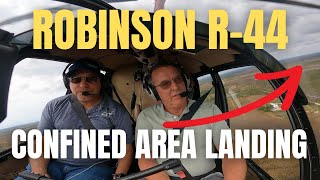
A practical instructional helicopter training video by Kenny Keller demonstrating confined-area landings in a Robinson R-44. Keller narrates his decision process while scouting and executing a confined-area approach: maintain 500 ft AGL while evaluating spot size/shape/slope/obstructions, fly three circles at a minimum of 60 knots as an engine-failure safety plan, use smoke and surface cues to estimate wind and choose downwind/base/final, be prepared to go around if the spot is unsuitable, descend using steep approach techniques while keeping descent rate ≤200 ft/min to avoid vortex ring state (below 30 ft reduce to ≈100 ft/min), perform hover pre-takeoff checks (warnings/cautions out, gauges green, fuel checked) before a maximum-performance takeoff, and prioritize aircraft safety over external pressures. The speaker models go-arounds, wind assessment, path-in/path-out planning, and conservative aborted-landing decisions.
Chapters
All right, whatever you want is your controls.
I have the control here. Is your controls on my six miles to the left inbound. All right, so for confined area landing, what I've always been teaching is 500ft AGL minimum.
Okay.
As you make your three circles and we got a spot picked out over here that's kind of oblong. So of course you're always making your decision. You landed, you could. This is a perfect example. Where do we want to go into the wind and have a shorter stretch or do you want to do crosswind and use have more of an area? Okay, so I'm kind of thinking about that as we go around. So the thing that I've seen over the years is when you're teaching find area landings, people want to get slow. And right now I'm going too fast, so I'm going to slow it down right now. So I do three times around, minimum of 60. And of course we're keeping 60 just in case the engine quits. We're not behind the game, keeping 500 AGL the whole time. We're looking in for, of course, what's the surface like? Size, surface shape, slope, looking for towers, looking for wires. And then I'm always thinking about path in and path out. Where am I going to go if something happens on the way in? And even more importantly, I think is once you get down in the hole, sometimes you forget what's on the other side when you're going to come out. So make it a mental note on the way in. Where am I going to go if something goes wrong when I come out of the hole? What am I. Where am I going to go if something goes wrong? So that's one about one time around. We'll go around two more times. And now I'm thinking about the wind and whether I want to go across to what I feel is more into the wind or whether I want to go kind of with a crosswind. So I'm looking outside, I got 70, so that's good. Got 500 AGL. And the other trick that people a lot of times when you're making these circles, you find yourself either creeping up on your spot or getting way away from it because you got thinking about the wind as you're going around, you know, you're adjusting those circles. So it looks to me.
I think.
The wind's this direction. Would you agree? Yeah, I think going using the long ways, I think is going to work.
Based on the smoke I see over there.
So I'm looking out thinking, okay, going to come up with kind of a downwind base and final for when I make my approach in. So again keeping three circles, keeping a minimum of 60. If you have a hesitancy hesitant or up, people have a tendency to get too slow. So this is time around number two. I know the, we believe the winds that direction due to the smoke. So when I look across I can see kind of a little creek over there that's going to be kind of my downwind and I can see a road back there that I'm going to use for a base and a final. So I've kind of got my plan. I know what my downwind, my base and final is going to be. And of course, as we start our approach in there, we're verifying everything that we saw at the higher altitude. And if we see anything that we don't like fly away, I mean we don't. Nothing says we have to land there. And even from the time I spent in ems, if we didn't like a landing spot, we didn't land there. And if it didn't matter if it was an accident scene and the fire department sets you up a spot and they pick what they think is the best. But then you'll see a danger from above. If you don't like it, you don't land there. You can always find somewhere else. And they were always understanding. When you say we see your spot but we've got a wire or we've got an antenna or something, there's a Walmart parking lot over there, we're going to go over there and land. They were always understanding. So the biggest thing is, you know, if you don't like it, don't do it. Exactly. You find something that doesn't seem right, I just abandon it. And then the go around. You know, in normal training we try to. I try to do a go around every single time I do a lesson with somebody, at least an hour lesson, I want to do it, get them to go around at least one time. If you teach people to go around, they'll do it. If you don't constantly do it, then it won't be in their thought process and they'll end up shooting a bad approach and getting themselves into trouble because they should just went around. And even in EMS they wanted us to go around. It didn't matter what's going on on the ground, it doesn't matter about a patient. Not to be unfeeling, but the important thing is you land the helicopter safely, it doesn't matter what's Going on in the back or what's going on on the ground? It's about getting the helicopter on the ground safely. So you know what? I totally screwed that up. The wind's over there, so my downwind base and final is the wrong direction. So I'm just gonna go around and make my downwind over there and a base and final right into our spot. So, hey, I'm not scared to admit, I just goofed. Luckily, I caught it. Instead of making a downwind approach into a confined area. That would be bad. That would be really bad. All right, so I see a fence line over there for my downwind. I see a spot where I want to turn by a tree and some to make my base. And that'll take us right in to our spot.
Okay, go to land number 22301290.
All right, 500 AGL. Got 70 on the airspeed right now. I'm on my downwind. So as we approach it again, we're going to be looking. Does it look the same on our approach as it did when we were up here? And as we kind of descend and start the basin final, we're just looking for anything that might not look right like it did at 500 ago. I want to start my approach at 60. Going to do a steep approach.
If you would continue on that heading, start showing approach speed, please.
Get a little slow there.
Approach speed one Romeo Mike, make a left 360, please. Three one two nine series land Runway two three.
Did we totally misjudge the wind? I was like, did we totally misjudge the wind? No, I don't think so. Now we're live again. All right, so I'm approaching my spot.
Turn left now. Heading up 270, please.
270 heading on Romeo Mike.
As you roll out on that heading, you'll see traffic, but he's. He's breaking out from the final approach course.
We'll be looking one army of Mike.
You can actually continue to turn to the Numbers of Runway 23, your third land 81 Romeo Mike.
All right, so from here right now, I'm going to keep it 200ft per minute or less and keep us out of vortex ring state because there's our 30. As we get below 30, we're going to keep it below 200, nice and slow. We're looking outside, looking for trees, wires, obstructions, anything that just doesn't look right. Keep under that 200ft per minute, nice and slow. We can still fly away if something transpires. We don't like about 100ft per minute. Coming down nice and slow. Being caught or being thinking about. It's a little damp with some tall weeds. We want to make sure we have enough hover power. We've got enough room. We can fly away if we feel like we're pulling too much power. And there we go.
There.
Very nice. Very nice. Tell clear on the right now. I'm going to go ahead and move back this direction a little bit. Just because we have this benefit. This being kind of an oblong spot.
30 5.
Keeping it under the limitation. This way we can kind of do that mix of altitude and airspeed to get out of our hole. Tell Clear on the right. And then of course a really good hover. Pre takeoff check. Warning. Caution lights are out. Gauges in the green. We still got fuel. Since we're going to be doing a max takeoff. We want to make sure that everything's good and ready to go and it's going to be able to deliver the power that we want. So I'm just going to start gently moving it forward. Raising some collective. We got lots of time. And we have time to even abandon it. If we decided we were going to over pull the power. But doesn't like we're going to have any problem whatsoever. Coming up nice and slow. We could still abandon if we needed to. But everything's looking good. Air speed's alive. 40 knot attitude. Nice climb out. Up over the trees. And away we go. All right. Very nice. I'll give you the controls back. All right. I have controls. That wasn't my best ever. I totally screwed that up. But at least I finally. But I caught myself. Wait. I'm doing it. I'm gonna set myself to do a downwind base and final downwind. Going in the wrong damn direction.
That was good though.
That's my thought process. Probably not a lot different from what you've been taught. I don't suppose.
All right.
So I know where we're at. So.
I usually like to sell them up. Especially when they're busy. Put myself in a position. So all he says go through. Straight to the arrows.
I don't blame you. So don't blame me one bit. So I'm gonna do. I'm going to bypass these.
74 Bravo X3. Go ahead and start.
So you guys use the term antenna farm. I was just telling Glory about that the other day. I'm like, see all those towers? We call those antenna farmers. Yeah. Not to the left. My brother lives out here somewhere.