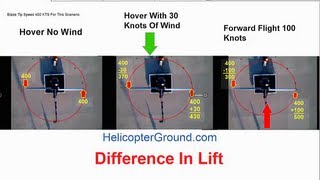
Kenny Keller explains the helicopter aerodynamic concept of dissymmetry of lift by walking students through three scenarios: hovering with no wind (no advancing/retreating blade, example tip speed 400), hovering into a 30‑kt headwind (advancing blade tip speed 430, retreating 370), and forward flight at 100 kt (advancing 500, retreating 300). He uses these numeric examples to show how blade relative airspeed differences produce unequal lift and recommends keeping lessons simple when teaching this topic.
Chapters
The difference in the lift. Now, I like teaching this this way. This is just kind of cool. I think it's a, it's a way, a good way to get people to understand. So I use this first scenario, hover with no wind. If you think about you're out in the helicopter, you're in a hover, no wind, and we're just going to use a random number of 400 for blade tip speed. There really isn't. There is not an advancing blade and there's not a retreating blade. And we all think that it is because we always think advancing blade, retreating blade. But at this point, if there was no wind, you really wouldn't have an advancing blade or a retreating blade. So your Tip speed is 400. You're in a hover, no wind. You go to the next scenario. Think about being in a hover with 30 knots of wind coming at you. So the green arrow represents the wind coming right at the aircraft. You now have an advancing blade. You have the advancing blade on this side. Your Tip speed at 400/30 would make that 430 is your tip speed. Then over here on this side, this is moving away from the wind. This is the retreating blade. So you take the 30 knots of wind minus the tip speed and makes that 370. So there it starts your difference in lift. There starts your dissimilar lift. It's small, but it is a difference of lift. So then when you move to the next one. So then we use our scenario here, Forward flight at 100 knots. Same thing again. You got the aircraft moving forward through the air at 100 knots. So you have the 400 tip speed over here plus the hundred of your forward speed. That makes that side 500. Retreating side now is clear down to 300. Because you got the tip speed of 400, you're moving through the air at 100 knots. That makes that tip speed. You can see now the faster you go 100 knots, depending on what you're flying, of course, we know, you know, your V and a could be 89, it could be 120. Depends on what you're flying. But there's. That's a good way to show somebody difference in lift. And you can, you know, take this as far as you want with advancing blade, retreating blade. And there's all kinds of other things you can talk about. But I like introducing this to students when you're first trying to explain the symmetry of lift. And you know, you can talk about other things as well. But remember, you know, I know in the beginning, you're overwhelmed with how to teach this stuff, and you're going to have the tendency to jump in there, and then you're gonna go get all crazy with stuff. So try to remember when you're preparing these lessons.