Don't forget the essence of flying a solid Helicopter Traffic Pattern
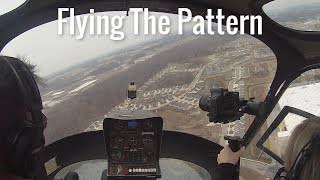
This is an instructional helicopter flight video by Kenny Keller (with Heather filming) demonstrating a standard traffic pattern at a small uncontrolled field. Key teaching points: perform preflight and hover checks, use right-traffic for helicopters (unless local procedures differ), make clear radio calls, use a fixed landing spot (Runway 18 numbers in this flight), climb to 300 AGL before starting the pattern turn, establish and trim to ~60 kt for climb/cruise without adding power using the '30 and 30' technique (30 inches manifold + 30 kt → 60 kt), and control approach angle with collective while using cyclic for speed. The video emphasizes disciplined setup (beam, downwind, base, final) and the habit of going around rather than shifting the landing point if the approach is unstable.
Questions this video answers
Right traffic.
300 AGL.
"30 and 30 make 60" — keep 30 inches manifold pressure and 30 kt airspeed to reach 60 kt (trim into climb without adding power).
Wind 170° at 5 kt; using Runway 18 (landing spot 18).
Chapters
Got your little red light.
All right. Hey, Kenny.
With helicopter land ground school, we're gonna go out and do a standard pattern. And don't click off yet because you think, oh, I know how to do a pattern. Hopefully you were learned. Hopefully you learned a standard pattern when you started flying. Hopefully you learned properly. If not, this could be, you know, some pointers for you. But if you're an experienced pilot, many times you learn and you get your ratings. But then you go out and start flying, whether you're private pilot or commercial pilot, and you just land point A to point B and you lose those skills of the basic pattern. Everything we do throughout our careers is based on picking up, setting down, normal takeoffs, normal landings, standard approach, normal takeoff. Our whole livelihood, everything builds off of that. So we're going to go out and do a standard pattern, normal takeoff, normal landing. Kind of as we get ready to go, thinking about the procedure going out, we'll do the radio calls and just talk through a good standard pattern. At the private pilot level, an examiner may say, well, tell me about the pattern. What do you need to know about flying a pattern? He may say, tell me about the pattern, what altitude you're going to fly, at what point you're going to turn base, what point you're going to turn final, those kinds of things. And then later on, as a commercial pilot, maybe you haven't flown a pattern in a while, but you're going to go interview for a job. And they might do an interview flight and a check. Everyone's gonna go out and have you do a standard pattern and make sure that you still can fly a good normal approach, normal takeoff, and know the elements of a good, of a good pattern. So that's what we're gonna do. Heather's gonna be running cameras for us.
Got the GoPro ready, so we're gonna.
Do quick pre flight. We've already checked fuel and we're gonna go do it.
So we're getting ready to go out and shoot a normal pattern. I just checked weather like 10 miles visibility, 12,000 ceiling even doesn't look like 12,000, but there's plenty. The wind is 170 at 5, so it's just a little bit out of the south. So starting off from the ramp, we make sure we look left and right and make sure there's nobody coming. Two step process, get us up off the ground, get away from the hangar. And the first thing I see is I didn't turn a boost pump on. So what am I going to do? I'm going to set it back down, secure my controls and boost pump on. Alright, so pre lift off, check. We just got away from the hangar. We're clear left and right. Temperatures and pressures in the green. We're good to go. We checked weather, Heather's running camera, I'm flying. Unlock the collective two step process and we'll pick it up. So leading up to the pattern, we're clearing left and right. Pre lift off checks. Hover checks. Okay, so once you get into hover, you want to just take, you know, 10, 15, 20 seconds, look everything over, make sure everything's in the green, make sure all the switches are on, everything you need, make sure you're good to go for the day, see how much power you're pulling, make any adjustments you need. We're clear left and right now I'm going to just go ahead and go across the grass. I could take the taxiways, but you know, I'm not an airplane. No real reason I'd have to do that. Winds out of the south, so I'm going to use Runway 18. So I've already checked the ATIs and see what's going on. This quiet little airport, but I know the volume is working because I just listened to the ATIS and then I just switched it over to the frequency for this airport. So as I'm going out, I'm listening. Is there anybody else in the pattern? I was out flying last night, there was a few airplanes out. This is mid afternoon, so probably be pretty quiet. Other than maybe a jet that might come in. There might be some guys flying after they get out of work. I'm going to come out to the adjacent taxiway. I'm checking the taxiway, checking the Runway. I'm looking around the pattern. So in helicopters most generally we do right traffic. Airplanes most generally do left traffic. Now at any given airport there could be a reason why they don't want you using a certain pattern. Left or right, depending on any given airport. Could be a noise, obstacle, whatever the case is. So I just set down the ground so I can readjust the heat because I'm about burning up. What about you, Heather? Yeah, so I'm gonna turn that heat back a little bit. I'm thinking the same thing. And we can pull some back out when we need to. All right. So when I sat down I kept my hand on the collective. Never take your hand off the collective and the instrument. You can actually take your hand off the cyclic. It's not a big deal. It's got trim motors on it. We're going to do another pickup and get ready to enter the pattern. The two step process. As I'm doing that, I'm looking left, looking right, making sure the area is clear. I'm still listening to the radio in case there's anybody that comes into the pattern, wants to do an approach. Everybody comes rolling out to enter the pattern. Looks clear from what I can see. I don't see anybody. So we are going to use 18 and I'm going to use the numbers 18 for my actual landing spot. And I'm going to make a radio call. Warsaw Traffic Helicopter November 8626 Papa departing 18 for right traffic Warsaw. So I just made a radio call in case there's somebody out there that I don't see. Then hopefully they just heard me before I go into the Runway. So I would say I'm going to use the numbers 1 8, which is right now just behind us. That's going to be my landing point. I like a nice solid point to use for your landing spot so you know exactly where you're going to be landing. No guesswork to it. And if we don't make that spot, we're going to go around. We're not going to move the spot on down the Runway because we screwed up the approach. Many students make that mistake. Not a good habit to get into. If you can't hit your spot, go around, try it again. So I'm going to look left, clear my tail. I'm going to do a full 360 just to be sure. Looking for traffic in the pattern, looking for anything going on. I should have cleaned that windshield before we go out and I didn't. But that's okay. Our detail guys coming this weekend to put a nice spit shine on the instrument, looking all pretty like brand new again. Okay, so for a normal takeoff, first thing pre takeoff check. A lot of guys don't do them and girls but you should be a lot of people are okay. So we're gonna do warning caution, lights out. I just kind of, I start at the top and work my way down. Check all the instruments and the gauges, check all the needles, make sure they're all in the green. Make sure I have all the switches on everything I need. See how much power I'm pulling. Now for a normal takeoff, I'm gonna do this without pulling any single power. I'm gonna use the slow takeoff and I'm just going to inch forward little bit by little bit. We call it even painfully slow. So I'm looking For etl, here it comes. I trim forward just a little bit through ETL and about 30 to 35 is where I'm going to start my climb. Right there's 35 according to the POH. If I get my climb going, I haven't added any power above 50ft. I'm putting it in trim. I want to get my 60 for my climb. Looking good and I want to climb to 300 AGL before I start my turn. So I got my 60, got a good climb going. I got all that with hover power. I didn't add anything. So you always trim up, trim, put in trim above 50ft. Align with the Runway below 50ft. We're above 50 so I'm in trim now. I got 70 which is good. I got another 100ft. We got an intersecting Runway here. So I'm looking left and right, make sure I'm not flying in front of somebody. Another hundred feet to go before I can start my turn. All right, so we're in trim, we got 70. I'm approaching my 1100. Everything looks good. I don't hear anybody on the radio. I'm gonna wait and make a call on my downwind. A lot of people make a crosswind call, which is fine. I don't. I usually wait till downwind, but I do it early in my downwind. So clear left and right before I start my turn or as I'm making my turn, I'm looking around, going to level out for just a moment and then start my right downwind turn. So I'm going to level out, look left, look right, make sure nobody's coming. Looks good. Then I'm going to make me a right hand turn and find me a spot that I'm going to use for my downwind leg. And I've got a road down here on the ground I'm going to use. I just started my downwind so I'm going to level out and I'm going to make my radio call now. Warsaw traffic, helicopter 26 papa right downwind for 1 8. Warsaw. I keep wanting to say Plymouth. All right, So I got 70, about 75. I got my 1500 or my 500 AGL looking good. I'm going to trim, so I'm going to have Heather point to the right here in just a second and show you when we're going to start a little bit of a descent for our approach or I'm sorry, started descent when we're beam our spot. So if you will turn the camera to the right, Heather probably won't be able to see it in the camera, but we're right now we're abeam. The number is 1 8. So this is where I'm going to start just a tiny bit of a descent. Not much. I only need to learn traffic.
Archer 28 M3 Alpha uniform departing the pattern to the west at 2500.
I only need to lose 200ft between now and the time I start my approach. Now looking out ahead, Heather's got the camera going forward. There's a line of trees going east and west. So that's where I'm going to use for my base. I got a very small radio descent going about 100ft per minute. I've only lost about 50ft so far. Going to keep that speed up. I'm going to clear left and right for both my turns and then I'm going to combine my radio calls face to final. You can call them both if you like. This is just what I choose to do. So I'm looking left, I'm looking right, make a right hand turn, line up with this row of trees so I know where my base is. It's nice to kind of get landmarks and fly your pattern the same when you're perfecting the pattern. I've lost 100ft. I need to lose another 100ft now. I got 65 on the speed, which is good. I'm going to start my approach just above 60 today. I'll make my radio call for base. Turning final Warsaw traffic helicopter 26 papa right base turning final Runway one eight. I like making those two calls together. That way it's just one call versus two. I can focus on what I'm doing. I can focus on looking for traffic. Get my number set up here.
It's 94 Romeo Sierra. It's about seven miles northeast. Four farther field teardrop entry Runway 25. Cold water.
All right, looking good. I'm in trim. Well, a little bit of left puddle there. Got it in trim about 100ft high. I'm going to lose that. I want 300 AGL when I start my approach. And then I'm going to align what's visually for me, my eyesight to the compass, to the numbers which may or may not work for you. Depends on what aircraft you're flying. But you should know for your aircraft what your angle is going to look like. For me, about 1 8, about the center of the compass. Again, I can't say how it's going to look to you in the camera, but I'm waiting, waiting. I got my 61.8 is coming right about the center of the compass for me. So I'm going to go down collective. A little bit of right pedal. So the key to a good approach is a good setup. I had a good setup, I'm happy with it. Now I'm just going to use the gauges occasionally. Look at them. I'm doing this more by fill reflective controls the angle, cyclic controls the speed. It should look like I'm always Approaching the numbers 18 at the same speed. So I'm slowing it way down because we don't have much wind today. So I'm going to have to slow it down quite a bit. So I'm keeping that one eight lined up with the compass, keeping it moving forward. I'm bringing collective in. Want to get rid of that rate of descent before I drop below 30. I'm right at 30 now and that rate of descent is about gone there. We're at 300 and that's got a nine second lag. So pedals to get the nose back in line with the Runway and down to the numbers 1 8. So that is your standard pattern. That's a lot of talking. We're going to do it again. But what I would normally do in a class G uncontrolled airport like this is I like doing a pedal turn every single time just to be checking for traffic. I'm going to look out to the left, make sure my tail's clear and I'm going to make a right hand turn. I can see the windsock, I can check the sky around us, Checking the traffic pattern. I'm listening to the radio, just looking at a little bit of everything. There might be somebody out here that's not using a radio. Maybe they're on the rhyme frequency. Maybe they got the volume turned down. Always a good idea to do it to check traffic. And you can even throw in a pickup and a set down if you like. Nobody coming in. So let's do that. This is good when you're doing the pattern when you're training. Help keep up your skills. Clearing turn, nice set down. Here we go. About to touch. There we go. And collective all the way down. Always go collective all the way down and start from scratch to pick up. Alright. So in the instrument I'm going to do 2300 and start raising the collective. Looking outside, raising the collective. Step number one, get the aircraft, line the skids, pause, neutralize all movements. Then when I'm ready I'll gently pick it up. The aircraft's coming up. Here comes the instrument bounce, no big deal. It'll go away as soon as we lift up. All right, aircraft's light. I'm making a pedal adjustment now. I'm going to lift this up in the air. I've already done the clearing turn. Going to do a hover pre takeoff check. Warning. Caution lights are out. Gauges in the green. I'm going to keep the aircraft parallel with the Runway with the pedals until I get about 50ft. This time I'm going to show you something. 30 and 30 make 60. So I've got 30 on my manifold pressure. If I keep that until I get 30 on the airspeed and start my climb, that will give me 60 on my airspeed in an instrument. I can do that without ever adding any power. No power change. I'm not adding no power whatsoever. We're still at 30. Airspeed's climbing. I'm doing this just by gently pushing forward. I'm not adding any power. We're still at 30. Okay, we got 30 on the airspeed so I'm going to let it climb and I'm going to turn this into 60 without ever touching the power. A little bit of trim. There's 60 still at 30 inches and I got about 300ft per minute climb. As we get more effective. Boom. There's your standard climb out. 60, 500. With just a touch above 30 on the manifold pressure. I never added any power whatsoever. That is the best way to take off. Let's do it one more time for Romeo Sierra.
Entering that left downwind Runway 25.
Cold water. So again, standard turnout is at 300 AGL. The five years I flew EMS, the company said 300 AGL. That's where you start your turn. Textbook. Okay, so I've got my 300 AGL. I'm going to clear left and right. Don't see anybody to the right, don't see anybody to the left. Make a right hand turn. And again. I like making my radio calls early on the downwind. I particularly don't make a crosswind call. You could if necessary or you wanted to last year. Four hour and a half. Talk it off. I don't want to. Alright, so there I leveled out. I'm clear on the left, I'm clear on the right. Almost have my altitude, got my airspeed. I stuck my right hand turn because I see my road coming up that I'm going to use for my base leg. So let's see if I can put my money where my mouth is. Let's see if I can hit 70 and 500 AGL with trim and no climber descent.
Turning left base Runway 25.
Cold water. All right, I'm getting my radio call done early now on downwind Warsaw traffic helicopter two six Papa right downwind for Runway one eight. Warsaw. All right, radio calls done so I can get it in trim about 50ft high. So I'm going to go down collective just a hair to get my 1500 at about 66, 67 on the airspeed. I'm going to leave it there. I like starting just a little bit high. So there we go. Everything in trim are all looking good. I'm happy with everything's up. So I was explaining to Heather before we went out, when I say a beam it means we're directly across. So if I look to the right right now I am directly a beam directly across from the numbers 18 which is our landing sp. When I see that I go just. I do the same three things every time. A little bit of down collective, a little bit of ride pedal and a hair of aft cyclic. That's why I didn't care. I was a little fast over my 60 because I knew when I go aft I'll slow it a little bit. I've got my base defined out there. That row of trees is my base leg. So I got all kinds of time to lose the 200ft so I can start my normal approach at 300 AGL. Textbook with the airspeed I want in trim because the key to a good approach is a good setup. Been preaching it for years. Luckily I had that drilled in my head when I was first started out. I had some amazing people that taught me and I've just. All I've done is kept everything that I learned. Alright, let's clear left and right real quick, make sure there's no traffic. Don't hear anybody. Radio messed up my right hand turn. I'm a hair slow so I'm going to pull up just a little bit of power to keep my 300 AGL. Get my 60 back level out. Check the Runway, Check right and left for any kind of traffic. I don't hear any traffic.
Cirrus 173 Whiskey Mike. We're about six miles to the northwest inbound over five and field manager left downwind, Runway 25 Coldwater.
All right, go make my radio call. Warsaw traffic helicopter two six Papa right base turning final Runway one eight. Warsaw. Okay, so I got my 300 AGL right now. That's good.
Eight and a half miles to the northeast of the field of Mount Salamay 13 Andrews.
Alright, I'm in trim. Got my 300 AGL. Got my 60 or just a hair. 62, 63. That's good. Perfect. Now I just want to hold this. I want to hold everything until my sight picture gets the sight picture I want. And again for me maybe the GoPro is about right hopefully. But from my visual my eyesight is going down through the center of the compass and I want it lined up with the numbers 1 8. So when I start that approach, I'm going to use that collective to control an angle all the way down there. So I'm almost there. I actually climbed 100ft but that's okay. Same effect will work. I'm going to start right now. Collective controls the angle, cyclic controls the speed. So the whole time I'm coming in, I'm using my collective to control that angle.
Now about four miles to the north northwest, I'm going to be applying the field 2,500. Entering left downwind.
25 need a little bit of right pedal. Keep it in trim until I get to 50ft. My angles with 18 is freaking looking good. I got rid of more speed this time a little sooner so I can, I can make this smoother at the end. Angle's nice. Collection controls. I like it, I like it a lot. I'm going to go ahead and put the right pedal in. I'm up higher than 50 but I'm going to put the right pedal in. Line up with the Runway. My angle really nice. Coming in nice and slow. Angle still right on where I was the whole time. It should look like you're always approaching those numbers at the same speed. You should be slowly just bleeding the speed up from start to finish so that it always looks like you're approaching that same speed. And there we go, right to the numbers. Yeah, not bad for a rookie. All right, well I think if you would Heather, look out the right hand side, make sure our tail's clear. And I'm going to make a left hand turn here and we're going to head back to the hangar and go and see how we did, see how it came out. First flying video we've done this year. First one we've done in quite a while actually. So I'm going to call clear the Runway here in just a second. Warsaw traffic, helicopter 26 Papa is clear the Runway. Warsaw nice slow hover taxi back over to the hangar. So nothing fancy there. Everything that we do builds off that normal approach, normal takeoff traffic.
Demo 131 in time is at 3200 descending traffic 2 miles north of the field and max line limit 1, 300.
Cover taxi speed of a brisk walk. Got some uneven areas here. Just keeping that in mind and we've showed you in the past video this past year we painted a red line on the concrete at the hangar. So when I go over here to park, I know how to keep myself clear of the hangar. We have a rule. We do not start up or shut down with hangar doors open ever. Just general they have to be closed. With that being said, as long as those doors are always closed, we have a red line right there. So I know as long as I keep my skids on this side of that red line, I will not have, I will not hit the hangar. I can take my skids clear up that red line. I'll still have about 4 or 5ft clearance from the hangar. So I don't go to the clear to the red line. I just, I know if I stay to the west of that red line with my skids, I will not hit the hanger. So we're just going to kind of line her up here so we can hook the wheels up and put her back inside and set her down nice and easy. And we're going to go in and edit this dude up. And if it just happens to be a good video, I didn't do anything too stupid. We will probably leave it up. So do us a favor and subscribe to the channel and click that little bell when you do. We're gonna beef up the flying videos this year. You know, we're getting ready to celebrate eight years since the launch of Helicopter one ground school because it's ground school in eight years. I've never put a lot of time and effort into flying videos, right? Because it's been about the ground school and so many people are making helicopter flying videos that I just never felt really felt the need and money wise, you know, overtime hates. It's expensive, right? So now that helicopter on ground school is a little more established to where it is, we can go on and do some fresh videos and it doesn't totally drain the checkbook to nothing like it would be in the old days, right? So we're going to do some more flying videos, put some, get some new stuff for just for fun on YouTube and informational stuff. But also we're going to reshoot the maneuvers inside helicopter land ground school. Some of those videos are, I was telling Heather earlier, some of those videos, there are videos that are in there that are older than the ground school, right? It's 8 years old, March 1st. Some of that stuff is what I shot prior to starting ground school. So some of the videos inside helicopter line ground school are legitimately 9, 10, 11 years old. So the members are going to be happy when we go in there and start updating them. And the thing that we'll do different with the newer videos is, you know, we'll do an intro in the hangar, talk about we're going to go do. And we'll go do it in the fly in the helicopter, then come back and debrief those where the videos in there now we just kind of throw them out there. Hey, here's a quick stop. And you just see us in the helicopter doing it. You know, with advancements in time and technology and better equipment and more experience, I think you're gonna like the new maneuver videos that will be going into helicopter on ground school gonna be awesome. Gonna be badass. So subscribe and when you do, you got to click the bell to be notified of our day of our not daily video. But we've been cranking out three or four a week and probably will now that spring's coming. Got the instrument back, we're excited to get flying. Lots more cool stuff going to be happening. Getting ready to start celebrating eight years online. March 1st, 2020. Gonna have a big sale from the March 1st up until my birthday on March 15th. So if you've been dragging your feet about joining, you're thinking about it and you want to do it, but you're not sure, we'll come up with some good discounts for you that will be available starting March 1st with my birthday March 15th. And you count on that every year. All right, we're gonna shut this thing down, go edit this up, and we'll see you in the next. Sam.










