Enstrom Helicopter Engine Failure Student Pilot Interview
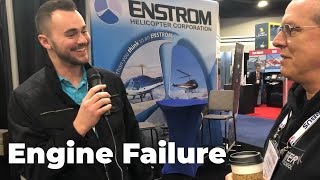
Student pilot Cole survived an engine failure in a 1981 Enstrom helicopter at 400 feet. The engine shut down instantly with a shake, and he autorotated into a hayfield west of a police station in about 20 seconds. Smoke from oil filled the cockpit during the descent.
So if it would have been a helicopter where if that collective is not down in two seconds, it might not have worked out. The nstrom's really safe in auto rotation. So I would say, you know, maybe by the third second, oh, the engine quit, you know.
All right. Hey, we did an interview with the young man who survived an engine failure in an instrument helicopter. We're going to roll that interview right now. We talked to this gentleman at one of the previous heli expos. Thought it'd be kind of fun to review this video because we all talk about auto rotations and losing an engine, but many of us have never experienced that, not from altitude. I've had one in a hover auto, but that's it. So we interviewed this young man and we're going to roll that video. But real quick, we have a maneuver guide. We've had this out for a couple years put together by our operations manager, Brian Rutledge. It's something cool that you can download, just use as a PDF. Copy it off if you want. Just something you can take a look at. It's kind of handy. We'll put a link down below to sign up and get a free version of that down below this video. So let's check out this interview with this young man that survived the engine failure. We'll be back to tell you about how to get signed up with ground school. Lookout for ground school with a discount. We wanted to get to Cole first. So, Cole, I'll hand you the mic over and just tell us briefly what it feels like. We don't, you know, the engine quit. Okay. What happens from there?
Sure.
And you told us yesterday about something that I never really thought about when it happened. Right.
So fairly windy day. You know, it's important to know the conditions of the day, I guess. I was working on steep approaches, and my instructor, Jan, was working on a student in a different or working with a student in a different helicopter. And she said that day, well, don't do any auto rotations by yourself. So, good thing I didn't listen to her. But we were about 1200ft. We both decided, let's go fly over the city, because we have two endstroms here. That's cool. You know, let's, you know, loose formation, snap a picture or something like that. And I said, hey, are you guys ever going to catch up? And she said, well, are you. Are you ever going to come down to 1200? Because that's supposed to be, you know, it's just about 400 AGL. And when they Talk about the engine's going to quit when you move the throttle. That's true. So if you're over water, don't touch it. And. Yeah, so, you know, just. It's a C model, no governor, no correlator. Just roll the throttle out, down a little bit. And it was instant. It. Sometimes you hear. It takes four or five seconds, sometimes you hear different things. It was quick, it was instant, and first thing you got is shake. It's just a quick shake. That was the first second of it. And you know, the human factor part of it takes a couple seconds to figure out what happened. And I thought, because the helicopter, you know, just quick first second I thought the helicopter went left. I didn't want it to do that. Maybe something hit the tail rotor. Well, torque. So that's what happened. The engine quit and we started to the left and I was downwind when it happened, so. Got it. Yeah, you got it. You got to go the other way, right? Yeah, yeah. So, you know, that kind of helps. There's a little bit of, maybe a little bit of luck involved. But. Yeah, so we, we're starting in a left turn. I'm a student pilot working on my commercial. It's on a Friday, and my checkride is supposed to be the next Wednesday. And I guess where I'm going with that is it takes a little bit to figure out what happened, you know? Yeah, yeah. So if it would have been a helicopter where. If that collective is not down in two seconds, it might not have worked out. The nstrom's really safe in auto rotation. So I would say, you know, maybe by the third second, oh, the engine quit, you know, so it's like 1, 2, 3. Oh, okay. And there was a nice big hayfield. It was kind of confined by a couple buildings. It was right next to the police station, which I think is funny. And I radioed to my instructor, who's watching the whole thing. There's a big trail of smoke from all the oil. And she said, well, can you make it back to the airport? No, no, we can't. Can't make it back to the airport. And so I said, I'm. I said, I'm auto rotating to this field west of the police station. And it was just, I don't remember being panicked. Of course, there's not enough time. It was about, you know, maybe it's 20 seconds or less and just flare it out like normal and put it down. So I, you know, then I just kind of sat there for a second until mine. Yeah. And then Jan, my instructor, she said, well, get out of there, you know, I'm like, oh, okay, yeah, I better get out. And then I went back to get my Dunkin Donuts once everything was under control. There is a lot of smoke in the cockpit. It comes up or came up through the right side collective, where that spot is. And this is a 1981, so maybe that wouldn't happen in a different one. But smoke came in, so once the collective is down real quick, with my left hand, I could barely see out, so I just flipped the door up right real quick and everything just kind of sucked out.
Yeah. Yeah. I thought that was interesting again to hear from somebody who's actually survived an engine failure. And particularly the Enstrom helicopter, which many of you have heard, many of us say it has one of the best auto rotations of any helicopter ever built. They are absolutely amazing. And until you've got to experience it firsthand, it's kind of hard to imagine how just docile they are in that, with that high inertia rotor system. It is an amazing auto rotation. You have to really screw it up to make it go bad. Honestly, if you get the collective down, get your speed, pick your spot, get into the wind and you do it right, you're going to walk away. So, helicopter line ground school. We've been online over 10 years now. We have private along with an advanced option, all available@helopterground.com the link is down below for our website if you want to go check it out, see what we have to offer. And if you want some personal help getting signed up. Heather is your member concierge. Her number is 574-767-1797. That's the Hogs business line. That's a mobile phone she keeps with her seven days a week. You can text or call her at that number and she can help you get signed up. And she can throw you a discount code just because you stayed to the end of this video. Again, you can reach out to her at that phone number or also email her helicopterground.com so leave us your comments about auto rotations and we'll see you next video. Peace out.










