EP 17 Robinson R-22 R-44 Pilot First Flight Cabri G2
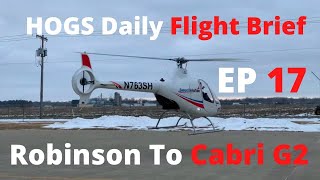
Kenny Keller and Charlie Keys instruct Chris Hauser on flying a Cabri G2, covering how it differs from Robinson helicopters, especially its clockwise rotor and coupled pedals. They walk through startup, hover, cruise, and landing, then debrief the flight.
Questions this video answers
Oil temperature greater than 100°F or oil pressure less than 95 (whichever comes first).
Governor takes over at 400 (stated in transcript as 'at 400').
Approximately 800 ft (transcript: '800Ft').
Around 74–78% (cruise power); less than 70% will likely result in descent.
Chapters
Greater than 100 or oil pressure less, Just a little bit until you hit 400 and then kind of stay with it.
Wow. This is normal, Chris.
It is normal. When people move into this, you're doing just fine.
Hey, it's Kenny with Helicopter Line Ground School. A Hogs member, Charlie Keys is here with Chris Hauser. Getting ready to go for an intro in the Cadbury. Charlie's a pilot. First time going in the cavalry. So first time in the clockwise system. We're gonna just record a little bit of their intro. Chris talking to Charlie about the cavalry. And we're gonna film the flight for you. And Charlie is a world record holder. Has held a record since 2007 on the biggest loop as a trick roper. He broke a record that had been held for 99 years. He broke the record in 2006, broke it again in 2007, has held since. And yesterday he stopped by the Hog studio, signed his picture for the Hogs Wall of Fame.
It was really cool.
Fun times. We're gonna pick up on their conversation. Getting ready to go out in the cabin.
The gimbal G2. So you are used to an R22, R44. Think of, you know, if you have an engine failure in an R22, that nose is going to go to the left. If you have an engine failure in this thing, the nose is going to go to the right.
Nose to the right. Okay.
In a low power setting, you're adding left pedal in this one inst. Right pedal in your other aircraft.
Okay.
And one of the key things I told. And I even told Kenny this, and I think he. He remembered it like this. Act like that collective in this aircraft. Act like that collective is connected to your left leg. Okay? So if your left leg is going down, then that collective is going down. So if you're pushing down on that collective, act like that left leg's going with it, and that's pushing the left pedal in also.
I see.
So if you're pushing down on the collective, that means your left leg is going down, which means you're pushing in.
I see. Okay.
So if you're coming up on that collective, that left leg is coming with you. If you're pulling up, the left leg is coming with you, which means you're pulling that pedal, which.
Which pushing the right pedal and right pedal. Oh, okay. That's a. Interesting.
So anytime. Yeah, anytime. Collective is going down, that left leg is going down, which means you're pushing that left pedal.
Okay.
That's an easy way to remember that part of it of course, once you start flying, just do opposite of just give opposite control inputs once. Ok. I mean like once we, when we.
Pick it up, you're going to have.
A lot of right pedal wind.
Okay.
Okay. And once we get it light on the skids, remember the two step process, picking up the aircraft once it starts to get light, just add opposite input of whatever the aircraft's doing. So if the aircraft is starting to spin to the left, just give it a little bit more right pedal. Or if you got too much right pedal and it goes to the right, then just give it a little left pedal.
Okay.
Applying carb heat. Okay, well this engine is a carbureted engine. However, we have an auto carb heat mechanism.
Oh, okay.
So even though it's called, we don't have to worry about applying carb heat.
Okay.
It'll take care of it. It's good to know.
One less stressful thing to worry about.
We do have a governor just like the Robinsons. So once we get up to ready to go, we'll flip the governor switch on, roll throttle up, governor takes over at 400 and then now we don't have to worry about the rpo. So that'll have the traditional tail rotor like you would on Robinsons or the instruments. We have the Finishedron tail system. It's got good tail RO authority, quieter, safer. You're not going to, you know, walk into this per se.
I like that part of it.
But you'll see that because of the design, that's why you have to give it a lot of right pedal. When we're, when we're in there, huge.
Amount of tail rotor authority.
Yeah. So when we get in there, you'll see when we're getting ready to pick up, we're going to be offset. Our pedals are going to be offset like this. You're going to have a lot of right pedal and then as you start to come up, you're going to adjust that a little bit, but you're still applying a lot of the right pedal. Once we move into etl, your pedals are going to start to come back neutral.
Okay. It's right here.
So this is just a little luggage area.
Oh, wow. Oh yeah, it's nice.
And then they built, incorporated a step. So you step here and then this, they've reinforced this. You step here and then you climb up on top and look at your runner. Okay. So another difference. The R22. I climb up.
Oh yeah, yeah.
So when you grab me, close this for you. So when you climb up, grab here, don't grab here because they've reinforced that.
I see. Okay.
And then you can actually throw your feet right up there. Yep. There you go. So there's a limitation on this in the POH that you can't fly the G2s in falling snow.
Okay.
However we have added the. We modified, we. We bought the heated pitot tubes and that will eliminate. Supersedes that limitation.
Oh, I see. Okay.
So we are allowed. We had to have. In northern Indiana. You gotta, you gotta, you gotta be able to fly in the snow.
So.
It's a beautiful machine, isn't it? I would not mind having one. We'll see how it flies and see if my brain can adjust to the clockwise rotation.
I think you'll find, see what happens. Don't. Don't think about it. There's. There's actually key to it. Don't think about it because then you'll. You'll overthink it. So Pic in here sits on the right. So I'll sit on the right Today we'll put you in the left side. Obviously same controls, same everything. The only difference is, is on, on my collective is the starter button and the governor switch. So that's the only difference. So wheels are so a little more.
Gross weighted on this than a 22.
Yeah.
I can't remember. Up clear on the left over there.
Clear left.
All right. Clear right. Yep, yep. So now I'm just going to engage. I've got everything. Oil pressure looks good. Alternator lights off. It's showing a charge.
Goshen traffic says the 1905 Victor turning final Runway 27. Goshen wind three one zero at one two. Peak gusts two.
We're looking for an oil temp of greater than 100 or oil pressure less than 95. So which one ever comes first during your warm up? Once that happens, then we can bring it on up. Alright. So to pick this sucker up, you're going to add some right pedal. Go ahead and give me some right pedal. A little bit more. A little bit more. There's your starting position for your right pedal. Okay. Your cyclic kind of be to the right and aft just a little bit. There's your start position.
All right.
All right. You ready?
Uh huh.
All right. What I like for you to do is just pick it up a little bit of right.
There you go.
Stay with it. A little bit of right pedal. Right pedal. There you go. All right. Tail, you're clear. Put it sail to the right there. Bring it on around. Pick up that yellow line. For me, we'll hover taxi out on the yellow line.
Okay, that's a little different. Interesting. First time I've flown. Feels like.
All right, just get used to that rotor system.
Wow.
I'm gonna come on with you just to get it.
Okay.
Get it stabilized here. A little bit of right pedal. There you go. Now just follow that yellow line out.
This is normal, Chris.
It is normal when people move into this. You're doing just fine. So we've got winds coming from our left side now, so just push forward a little bit so we're not worried about winds on our left side. Like you would be in a counterclockwise system. Right side for our loss of tailor effectiveness. Wow. Yep. Just keep pushing forward. There you go. Don't let her get away from you. There you go. You can see how much right pedal you're pushing. Yeah, I see. That's all normal. There you go. Now we're set on down.
Let me see if I can hover here for.
Okay.
Wow. This is.
Yep. What we can do is we can cross the grass here and we'll go over to the taxiway and we'll.
Go traffic helicopter 7630. Tilt tax hangers, taxiway alpha.
Wow.
This is something.
Doing just fine.
Seriously. Yeah.
Wow. Yeah.
Change of plans. Kenny had a guy come to visit him, so we're giving him a quick flight and then I'll be heading to Fort Wayne after this.
Okay, sounds good.
One of his students was passing through from Wisconsin and stopped in to say hi, and he's like, hey, let's get you in the G2. So that's what we're doing.
Okay, that sounds great.
All right, give me a 90 degree left pedal turn. Tails. Clear my side. There you go. All right, now bring it on back around to the right. There you go. Coming on with you just for a second. Okay. Get you back stabilized here. What we'll do is we'll.
Incredible.
We'll take off so we have a little bit of flight and then we'll come back in and we'll do a little hovering. So warning caution lights are off, gauges are in the green gauges and everything looks good. Plenty of fuel. All right, what we're doing is just going to start pushing nose forward just a little bit. Looking for etl. Stay on top of your pedals. Point that nose pointing right down the taxiway. There you go. There you go. Once we get through etl, she's going to start coming up. And now just come back on your cyclic just a hair. There we Go. Wow.
Oh, boy.
What we're going to do is we're going to climb out around 50, and then we're going to climb up to at least 300. Then we'll make our turn to the south. We'll just do a little bit of cruise flight there so you can feel it out. We'll climb up to 1500. All right. If you want, clear the area to the left, and we'll make a turn to the south here, and we'll continue to climb.
Okay. Wow, Chris. Oh, boy.
Feel a little different.
Oh, my gosh. Feel like it was the first time I've flown down.
So we do have a trim hat. The Robinsons, you know, have that trim lever, that little knob where you pull up. So on this one, we have a trim hat. So if you feel like you're having to push the cyclic in one direction or the other, then you're going to push that trim hat in that direction. So, like, if you feel like you're having to pull it to the right, then you're going to push to the right. But if you need to push to the left, then I would push a little bit of left, but a little bit of left trim. Exactly. Just push it to the left just a little bit.
Oh, I see.
Okay. And it alleviates those forces a little bit for you.
So just kind of keep bumping it.
Yeah, just bump it till you wear where it feels like you're not having to push it so much. Push it to the left. Yep. Kind of bump it to the left a little bit. There you go. All right. So it's your aircraft. You're flying it. We like to cruise around. 80 is our best range.
Okay.
So airspeed, obviously. Here's our altimeter down here. Of course, all this does that, too, but I like to use the steam gauges there.
What's the.
What's that.
What's the elevation here?
800Ft.
So are these more maneuverable than a Robinson?
I think they're probably about the same. So cruise power is probably going to be around 74, maybe 78 somewhere in there.
For an auto?
No, for cruise.
For cruise flight. So that just kind of gives you an idea. You know, anything less than 70%, you're probably going to be descending. You won't have enough power to maintain level flight.
A lot of information here. That's pretty.
Yeah.
Just think of this like your manifold pressure on your. On your Robinson. That's what that is.
More power.
We can't pull up to 100%.
Does a ski hill hit it Used.
To be it's a closed ski place now. I don't know what they do now with it, but, yeah, they definitely don't do any skiing now.
But yeah.
And this thing, the yellow, we can pull into the yellow. As long as we're under 30 knots, we can be in that yellow for five minutes. So what we'll do, the airport is basically our 12 o'. Clock. Okay. So what we'll do is we'll set up for like a left base into 2 7. Yeah. See, you're getting the hang of it. It's fine. It's fine.
Yeah, they're taking me.
Yeah.
Getting used to the. The cyclic trim is.
Yeah. So we don't have hydraulics.
We just got that trim.
And the instrument, like the 280 that's in the hangar, it's got the same thing. It's got a trim button there. And all it's doing is helping to take away those forces so you don't have to feel like you're pushing it in to a certain direction.
Okay. Yeah. So we're about 800ft off the ground.
Yep.
Goshen Traffic Helicopter 763 Sierra Tails on a left base 2 7th Goshen.
So just do a nice normal approach. I don't care about hitting the spot or anything. Just do a nice normal approach to the Runway. So warning caution lights are off, gauges are on the green. We got plenty of fuel. I just flip. Landing light on. Final looks good. I don't see anybody. Haven't heard anybody out there. So just like a normal approaches, like in your Robinson, just at the very end, we're going to be pulling. As you're lowering that collective, you're adding left pedal. But then as we come into that hover where the pedals are going to transfer, you're going to be adding a lot of right pedal.
Traffic cops at three chair toes left, they start to final two seven Scotia.
And then as you start to come in now, you're going to get that and start adding that.
Oh, yeah, the right pedal.
Here you go. Stay with it. Stay with it. Coming on with you. There you go. This thing's got good tail Rotoru for the right pedal.
It'll.
It'll bring it out if you start spinning, or it should. All right, just bring. Bring me to the hover here.
Okay.
And I'd like for you to set it down. Yep. Stay on that right pedal.
There you go.
Nice and easy. Get her stabilized.
Let's see if I get her stabilized here. Wow.
Yep. Right pedal. Right pedal. Wow. There you go. Boy. As soon as that nose starts to go that left, just add that. Get that right pedal in there. Just slowly work that collective down. Looking for the ground. There you go. Here it comes. Good. There you go. There's a nice one. Nice.
All right, thanks. Thanks for your positive attitude. I appreciate it.
You're doing just fine.
I needed that.
Alright, what I'd like for you to do now is get that right pedal. So a little bit of right pedal right there. A little bit of right cyclic, little aft cyclic. And now pick it up. As she starts to get light on the skid, just add opposite control input. There you go. Bit of right pedal. There you go. A little bit more right pedal. A little bit forward cyclic.
Nice.
There you go. Keep on top of that right pedal. As you add power in this, the nose is going to go left. Wow. Alright. See if you can work our way over toward a little aft cyclic. There you go. Brings back to the taxiway there.
Oh, boy.
Wow. Yep. Stay on that right pedal because now you got that tailwind. Yep.
Hold.
All right, right pedal. Push her in there. There you go.
The carnival ride.
Yeah. This is just fine. This is normal area. Yeah. It's just getting used to it. You know, those pedals are. It's a different. It's a different animal. It's a different aircraft.
Bring her down a little bit.
Yep. Pick up that yellow.
Eyes are outside.
Yep. Doing fine.
Little movements.
Have you ever watched Kenny's video the first time he was in this?
I think I have.
Yep. Yeah. So if that nose starts to go left and then you increase collective, it's gonna make that spin worse. Yep. Stay with the right pedal. Wow. Cause now we got that tailwind just.
For the heck of it. Chris, could you take the controls?
Okay, I got the aircraft.
You have the controls. So do you enjoy this over the Robinsons?
You know, I much prefer to teaching this than an R22. I do really like the R44 though. I think it's a great aircraft. I But I feel that this is probably a little bit better of a trainer than the R22.
Okay.
But I would love to teach in an R44. I really like the 44. Platform tails clear on the left there. Almost slide to the. Yeah, it's a pretty good win today. There's 13 gusting to whatever.
Gusting to 100.
Yeah. We'll roll completely off and we'll disengage the blades and then we're looking for a split on the needles and then we can turn the engine off.
That's wind, too, so that don't help.
Sure. Of course, it was different aircraft, windy, so we did all right, though.
Well, it's fresh in your mind. You just climbed out. We just pulled the helicopter in. Just give a brief description what you think of the cavalry.
I was just. It was a little challenging to get used to it, the. The pedals and the clockwise rotation of the rotor. But it's a beautiful helicopter. I think I could fall in love with it.
It is pretty. It's pretty cool.
I know Chris mentioned right away.
Did you ever see the video? The video of Kenny flying it for the first time?
Let's just say, yeah, it's the common thing.
Right pedal.
Right pedal more.
Right pedal more.
Right pedal more. Right pedal more, more, more.
Awesome.
Thank you, Chris.
Appreciate it.
Thank you.
This is a new maneuver guide. Work them this way as a free PDF. You can go down in the description box below and get a copy of it.
Pretty cool.
Compliments of our operations manager, Brian Rutledge. And he based this off of.
The.
Downloads we have for you inside the private pilot section inside Helicopter One ground school. Right there you can see the list of the different maneuvers. So it's just kind of a cool PDF. It's something you could take a look at. It'll be a free PDF down below. You can grab it, you can download it, print it off if you like. That will be in the description box below.
Go ahead.










