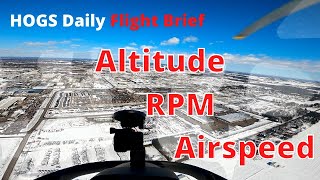
A short conversational YouTube episode (Kenny Keller with guest Chris Hauser) about helicopter safety focusing on the three forms of stored energy—altitude, rotor RPM, and airspeed—and why keeping them improves odds of surviving an in-flight failure. The speakers emphasize "RPM is life," warn that losing rotor RPM causes rapid uncontrolled descent (citing an R22 video), and stress maintaining forward airspeed during autorotation practice. They advise pilots to plan maneuvers to preserve at least some of the three energy forms and to make takeoffs/landings "as safe as possible."
Chapters
Foreign.
Daily Flight Brief. Welcome back. Kenny Keller, Crater Helicopter railing ground School Chopper Guy 53 on Instagram also known as Chris Hauser, CFI2 working for Sweet Aviation.com stored energy, altitude, air speed and RPM. You should have these things on your mind when you're out there flying and making your decisions on during a takeoff, on your landing, flying cross country, if you're thinking about the three forms of stored energy and have the mindset that if I have all three of those, my chances of dealing with emergency are pretty good. Or a failure of some kind. If you take away any one of those three, not saying you can't survive, I'm not saying you won't have a good outcome, but your chances are less likely to come out and walk away. It is something that should be going through your head because again, the scenarios are endless. Takeoff, landing, cross country. No matter what it is you're doing, if it's just something that's in your thought process, maybe you're flying alum, you're a little bit too low. Go. You know what? If I had ninja player right now, like here we are now, we just, we were open, open fields just 60 seconds ago. Now we're over a city. Okay, so are we going to change our altitude from where we were to where we are now? So it's always just, you know, in my thought process, try to keep that three forms of stored energy. And it's a checkride question examiner may very well ask you about what are the three forms of stored energy and why do we care? Why are they important? Anything you can add to that, Chris.
You know, in a helicopter, RPM is life. That's what. Absolutely. If you lose your rotor rpm you will literally fall out of the sky.
You're screwed.
Yeah. And you're not going to get it back. I mean, there's a old video of an R22 that fell out of the sky because he got the RPM too low. Yeah, the rotor RPM too low. I mean, literally, he falls out of the sky like a rock. Because I mean, once you lose that rpm you can't get it back.
That's the one you saw at the Robinson factory safety course.
Yeah. RPM is life in a helicopter. And if you lose that RPM there, there's nothing you can do. As I see it all the time as an instructor doing practicing autos, people get too slow. You're too slow. You're too slow. I mean, well, you just lost your airspeed, you know, so. Sure, we can, you know, we can play with that a little bit, but There are, you know, we gotta have some forward airspeed when we do that auto. You'll learn about it as you go through your training. You'll read about it, your instructor will discuss it. You just got to have those things to help you get to the ground in case of an emergency.
Absolutely. Rpm, altitude, airspeed, and there are going to be those times where certain situations you just, you can't have the best of all three. But some takeoffs and some landings, depending on the situation, you're gonna, you can be lacking in those areas. So what you do is you just tr. Try to avoid those times where, you know, you're a little behind the game or I don't know if that's the proper terminology. There are times during takeoff and ladding, landing a certain phase of flights where you're doing the best you can, but you, you're gonna, you can be lacking in one of those areas that's just by nature of, of the maneuver that you're doing at that time. You just try to mitigate that risk.
Got to make it the best. You the safest. That's what I tell my guys. You got make it the safest. I always kind of, I, I say, I joke around, but when you're doing for takeoffs and landings and you're doing confined areas, you know, if something should happen and the FAA comes asking you, you can explain to them that this, I did it the safest I could. Yes. That's all you want. I mean, by nature, helicopters are made to do things that aren't the safest, but you can make them as safe as possible.
Yep. So awesome. Come back tomorrow for the key to a good auto rotation. Go below free PDF and we're gonna do some auto rotation videos that are on the list here. We're gonna go through. I've done a lot of auto rotations in the past, but I like what we've been doing together lately. Gives me a chance with Chris flying and to do some different things with cameras and I've upgraded my equipment. Just things are getting better. So we're gonna, we're gonna do some rotation videos coming up in the next few videos. It's gonna be, gonna be good. So come back. For key to a good auto, subscribe the channel. Click that bell. That's the notification bell. So you'll be notified of the auto rotation videos coming up. Go down below for helicopter. All in ground school memberships. We have over 30 new videos we've uploaded in the last 10 months. Over 30, it might be even closer to 40 at this point, and we're uploading new content every week. Like, subscribe. See you next video.