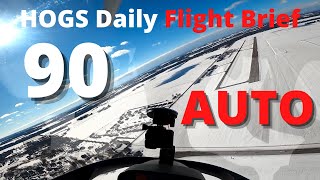
Kenny Keller and Chris demonstrate a 90-degree autorotation from base to Runway 27, walking through the setup and technique calls. They emphasize practicing 90-degree turns so pilots can handle real crosswind and landing-spot scenarios instead of relying only on straight-ins or full 180s.
Questions this video answers
Runway 27
About 80 knots indicated (KIAS)
About 1,600 ft indicated
"34 0" (spoken as the wind)
Chapters
Goshen Traffic copter three trot on a right base turning final two seven Scotia.
All right, three, two, one, roll off. There's nose to the right and there's our simple turn. RPM might build. Coach traffic copter three zero teleporting 27 right traffic coast.
All right, welcome back to Hogs Daily Flight Brief. Today we're going to do a 90 degree auto rotation or two. And a lot of times when I talk about these people go, well, but you do straight ins and 180s for the checkride and it's like, yeah, that's true. But going back to that instructor that helped me out. If you watched yesterday's video, when I was a brand new cfi, I wasn't super confident when I first got my first job to go out and teach. So I hired a full time RA high time R22 CFI to go out with me and freshen up my knowledge. And so he taught me the importance of doing 90 degree auto rotations and how you can take those 90 degree auto rotations and turn them into an actual 180. So Chris, just kind of talk us through thought process again, upsetting up and performing a 90 degree auto rotation.
Yeah, so we'll just do a 90 here. So I'm kind of extending, kind of going away from the Runway here just to give us a little bit more time on base. Yeah. The reason why again, what I call a training scar, the way that we do our training makes you have a training scar. So yes, you're right. We train for straight in and 180. And if that's all you do, sometimes in the need of the emergency, the student's only going to think, well, I only can do a straight in or 180 because that's all I've trained for.
Right, sure.
Well, the 180 is nothing. But that's the most the turn is going to be to get you into the wind. Obviously if you're flying along, you have a tailwind and the engine quits, you need to do a 180 to get back into the wind. Well, you know, how often do you actually have that direct tailwind? A lot of times you got a crosswind or you may just have a 30 degree off to the right or something where you just got to make 30 degrees, you know, so that's why it gets it. You get, we do the 180 so you get right back into it. But really, you know, the odds of you doing have to do a complete 180 are low, I think. So what we're going to show today is just do. We're just going to do a 90 degree. So I've extended my right base here. Again, the winds are 34 0. But in order to do the training, we want the Runway which is 2 7. I'm on an extended right base right now for 2 7. And what we're going to do is we're going to enter an auto. We're just going to do a 90 degree turn into 2.7. Get a little closer here.
Goshen traffic copter three share tails on the right.
Base 27 Again, we're cruising about almost 80 knots. We're about 1600ft indicated, which is where I would be normally cruising anyway. We want this as real world as possible. All right, warning caution lights are off. Gates are in. The green landing light is on. Got plenty of fuel. Look down for final. I don't see anybody. Haven't heard anybody. Nobody on the. Yes.
Go.
Traffic copter three trails on the right.
Base. Turning final. Two seven, go.
All right, three, two, one, roll off. There's nose to the right and there's our simple turn. Rpm might build depending on how steep your turn is. If it builds, then we're just going to come up a little bit on the collective and slow it down. And then once it slows down, then we're lowering it back to the. And now it just turns into a straight in. So just a small little turn. Now I'm just riding it down. Here comes street, top level. A little bit of a flare. Flare is gonna get more aggressive. Let the aircraft start to settle, push the nose forward, come up on that collective, be ready for that right pedal. And there we go.
Awesome. And I want to back up what you said. It could be straight in, could be 90, could be 180, could be 170, could be 30, could be 46, depending on the situation. Once we get into the real world, autorotations, whatever it takes to get into the wind the best as possible or to take a combination of what's going towards the wind plus an open spot versus a wooded area. The scenarios are endless. So back to that objection of training to a standard people going, well, that's not real world. Well, you go out and try to find some things to do to make it more real world. And that's a little bit of what we're doing now. And we're going to do an upcoming video practice engine failure altitude, which is a maneuver in the PTS that's going to become the ACS that's upcoming in another video now that we've showed you the 90 come back tomorrow and we're going to talk about the 180 autorotation. And again, this is food for thought. And I want to show you something that this instructor taught me when I was a new CFI and I was struggling trying to build up my confidence to teach autos. Something he showed me that I think is really, really cool. We'll come back tomorrow for 180 degree auto rotations. Do us a favor, subscribe the channel, click the bell and we'll see the next video. Peace out.
I almost forgot what we were doing on that last one.
Did you?
I was like, oh, I need to make that turn. I need to enter the auto before I turn final.
Nice. Hey, a lot going on. You're flying the helicopter, you're listening to me, you're looking outside, you're trying to plan web. You know where you're gonna enter and then pretty soon, yeah, you go, what the.
Right? Yeah, I got it. Like, oh yeah. I need to enter the auto before I make this turn to final. Oops. Whatever.