EP 31 Helicopter Engine Failure Autorotation Practice
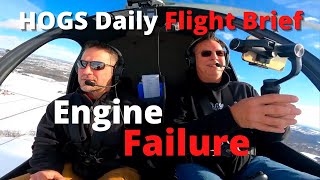
Chris and a co-presenter walk through a surprise simulated engine failure during helicopter training. They cover how to recognize failure (needle split, silence), the control inputs needed (lower collective, pedal adjustments), picking a landing field, and what examiners look for on checkrides.
Chapters
I know, but with two turns, I didn't know if we were doing what we were doing.
Oh, you want to go back and do a full 186?
I don't know. Whatever you want to do.
We could. You want to go back and do one? This might be a good time to lead into the power failure at altitude.
Why in the heck would I want to do that? Oh, power failure. Look at that. I know. The wind's coming out of the northwest. Make a slight little turn. That's all there is to it. Going into this field. Now, when we go into a field, we're looking for wires, looking for trees. I'm adjusting my turn just a little bit to give me a little bit more room. There's my treetop level. A little bit of a flare. Flare a little bit high. I'll let the aircraft settle a little bit. Roll and throttle back in and coming back in.
Well, welcome to Hug's daily flight Reef. After we've entered the maneuver when I didn't know it was going to happen. Okay, we're back. We had to clear out a little static there in the radio. Well, here it comes again.
So, yeah, we had that. You know, I surprised Kenny on that. You probably got the shock on his face because it true. It was a legit shock there.
It was. Was not prepared for that.
Now I have to stress, though, that I do know this area very well. We're close to the airport. I know all the fields around here. So I knew the field that we were gonna go into gonna be just fine. But that's something that as toward the end of our training with a student, I'll do something like that. Sure. And that's. And back to what you were started. Maybe that's what the pts requires. They require a power failure at altitude, and that's what the examiner is going to do. Our examiner. Usually I'll tell the little secret. Usually on the 180, he'll tell you, let's go do a 180. But he's not going to tell you when it's going to happen.
Right? We know that.
All right, now you can talk and introduce. Oh, today we're doing power failure.
Yeah. Today we're going to do power failure at altitude. And maybe Chris will do another one for us.
Yeah, let's see what we can do here.
You know, the thought I had in mind was Jerry Ventrella. I talk about him all the time. Legend in the industry. I did my private and commercial with him. Awesome guy. Learned a ton from him too. I remember him saying, you know, just be prepared. And anytime you see the examiner's hand kind of moving down towards the collective, and you're flying over an open field like we are right now, he said, just know that there's an impending engine failure coming up. Right. So it's a little tip for you. Maybe your examiner will give you a little. Maybe you'll have a H. Maybe your examiner won't give you a hint. But with this examiner, you least did. You knew. And I could tell right after doing a couple checkrides with him, I learned that. I could see that he. I could see him adjusting the seat a little bit, and I'd see the hands start going down. I'm like, okay, I know what's about to happen. So your examiner may give you a little. If you're paying attention to him, you might catch what's coming up.
Yep, exactly.
Okay. Gosh. Traffic helicopter 763 Certello at the top of the field at 1900 Southeastbound.
Okay, so here we are just, you know.
Yeah. Do you want to.
Talking and do you want to talk.
Us through another one? You did one. You did one on a. For a surprise for me. I mean, how do you just kind of. As a cfi, if you were getting ready to start showing me about. We're going to do this training called failure at altitude or engine failure at altitude, you're going to show it to me for the first time. What is your mindset of what you're telling me and how you're planning on doing it?
This would be like toward the end of your training, you know, we're get. We're in checkride prep. We're in those three hours that you. That we're just going over the maneuvers, just over and over and over, make sure that you're honed in on, you know, And I may say, hey, okay, let's head out to where we do our confined areas, and let's do a. Let's do a confined area, and maybe on the way out there, we may just. I may just roll the throttle off, you know, and that way, I want them to recognize the main thing there is. I want them to recognize that during an engine failure in the G2, that nose is going to come to the right. And when that happens, my eyes immediately go to the instrument panel, and I see the needles have split. As soon as you. That nose to the right and you see that needle split. Engine failure, you got to be thinking, engine failure. And then what does that mean? That means collective pull down. So the blades will flatten out. So you have that rotor rpm Remember, RPM is life in a helicopter. We've discussed that before. Yep. Luckily because of the fully articulated system of this, this does have a slight delay in it. Unlike the R22, you know, this kind of has a built in system saying, you know, it gives your brain time to recognize, oh crap, we just lost our engine. I better enter the auto by lowering collective so it kind of gives you that delay. The R22 does not. So there's about a two second delay in this. So. Yeah. So right now we're just. And usually what I do too is when we're practicing, you know, if we're practicing the autos, I'll just say okay, here we are, we're, we're in cruise flight, we're on the way to do whatever and I'll just roll off. So I just kind of make a joke out. We're two guys just cruising cross country, just joking about life and having fun and all of a sudden, oh, there it goes. All right, I know I'm going to the left. Get my scan going. I got a field picked out. Luckily in Indiana we got nothing but fields. Get my scan going. I'm making my turn into. Little bit out of trim there. We'll get the trim come street top level, little bit of a flare. Flare is going to get more aggressive the more I come down. Bow and throttle back on because we want that. And there we go. Okay, check for wires. Check for anything out here.
Clear on the left.
Got an irrigation system out here. And that looks alright. That's far enough ahead of us. If you're going to operate, you're going to. It's just like in law enforcement, we train for real life. Right. So however you train, that's what's going to happen when you're under that pressure. Whether the engine failure or whatever that emergency is. Right. So if I constantly put you in an auto and then I bring the power back in at 300ft so we don't go all the way down then that's in real life, when you get at 300ft you're gonna just naturally think, okay, let's fly out of it. So I will, I mean I train, I'll take my guys all the way in confined area, same way. I'll find a nice confined area and we'll go all the way in there. We won't land. We've had that discussion before. We won't land, but I'll take them all the way.
Traffic Seneca two niner One two zero taxi into Runway two seven.
How was that?
Awesome. I like it.
Were you surprised kind of on that one too, or were you just.
Just a little bit. Because it's weird when you're. When you're messing with cameras and you're focused on trying to get the camera. Even though I know you're going to do it, it still gets my gut.
Just a little bit.
I mean, and you made it kind of realistic there with the nose kind of, you know, you made it a little bit abrupt. And that's good. That gives you the feeling of what it could feel like. We know that they say when it really quits, it's still a lot different.
Right. It's not.
It's going to feel even different than your practice on rotations.
I mean, you're not going to have. It's going to be really quiet. You're not going to hear. That's right. That's kind of things too. I'll ask, well, what's the indications of an engine failure? And surprisingly nobody mentions. Well, it's going to be quiet. There's. You're not going to hear the engine running. Yeah.
It's going to be weird.
Right.
So we should mention for somebody that's just brand new that we're in a clockwise system today.
Correct.
And if you're in a counterclockwise system, the pedal inputs are going to be different and you're going to notice a difference.
But just that nose will go to the left and the counterclockwise.
Yes.
But the. Once you input it's all the same other than pedal down collective. Then you're going to add right pedal and a counterclockwise. So awesome.
Good video. Give us some. Give us some love on this video. Give us the thumbs up. Yeah.
Tell me what I'm doing wrong because I can already. I already see what I'm looking doing my scan that I'm out of trim a little bit. My speed is kind of not where exactly where I want to be, but you know, is what it is. Right. That's.
I'm sure we'll have some second. What do you call them? Armchair quarterback.
Yeah, that's all right. I like talking. I like discussing.
It's okay. Put those, Put those comments below. Tell us how to do it right. Subscribe to the channel. Click the bell and I forget what's coming up next. Do you remember what's coming up next?
I remember. What do you got going on?










