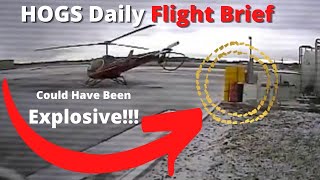
This is a helicopter training YouTube video (EP 32) featuring Kenny Keller and Chris discussing the importance of adding pedal input when rolling off the throttle—particularly when sitting on snow/ice—to prevent unwanted aircraft rotation. They share a near-miss anecdote where rapid throttle reduction caused rotation near fuel pumps, note that adding the appropriate pedal (left/right depends on model) counters the torque reduction, and outline upcoming instructional videos (flare at treetop level, autos with S-turns, zero-airspeed auto). They also mention a recurring CO sensor alert during preflight/hover and routine radio traffic at Goshen.
Chapters
I have my seat belts on. My door appears to be closed.
All right, clear on the left.
So since we're sitting on some icy area here, Chris.
Yes.
I think you should talk about picking up and setting down and what. What you're thinking about as you're.
Well, I'll tell you what I was really thinking about there. When you don't see this, here I am at rev up here, so I'm ready to go. But, you know, I don't see this a lot with students, especially when I fly with other students from other schools or someone that's. I've never flown with. Yep. I'm surprised at how many times people don't give some pedal input when they split the needles. The check sprag clutch. Here we are sitting on ice.
Yes.
I split the needles by rolling throttle off quickly. If you don't add right or if you don't add the correct pedal, you're gonna go spinning. Yeah, it's happened to me. I almost. I was with a student. I'll give you a quick example. I was with a student one time. He rolled off throttle very quickly to do the power or do the sprag clutch check. And I wasn't ready for it. Yep. You know, and he just did it. And we were sitting next to the fuel pumps, and it scared me because the whole aircraft rotated and we were so close to pumps that I thought we were. We almost hit it and I actually popped my door open to look back to see how close we were. And I mean, we were farther than what I thought. But it did scare me. And it's all because he rolled that throttle off to split the needles. You got to add pedal when you do that, just for this. This exact case. Here we are, we are sitting on top of snow and ice. Yep. When I rolled off today, I added left pedal and we didn't rotate. But if I would have rolled quick, that rolled that throttle off fast and didn't add any pedal, we could have turned the whole aircraft. So I see that a lot with people that I don't. That I don't train. They never add that pedal. And it's just something easy to do. So you don'. Rotate the aircraft.
I am going to back that up exactly what you said 100%. You'll fly with someone that came from somewhere else. And this isn't us, just passion. Other instructors. There's people that just haven't been shown this. Luckily, I was taught early on, you do it all year round.
Right.
You always add pedal when rolling throttle off, depending on which model? Left or right pedal? Could be. But the point is to. When you roll throttle off, always add the proper pedal so the aircraft doesn't spin.
So you get it, it counteracts that torque that takes that torque way. When you take that torque away, the aircraft's gonna spin. So if you just add that pedal, it's a nice easy way just to keep it straight. And you're right, I do it all year round because it's a habit for me. And I'm sure I picked that up from you because you're my instructor. But it's amazing to me. I mean, this is a prime example. I don't know. Hopefully our viewers can see it, but we are sitting on ice right now. So, I mean, this is a prime example of us is gonna, we're gonna slide a little bit maybe when we start to get light on skids. But when I rolled that throttle off, we definitely wanted to add some pedal today because that, that aircraft will twist. And I, and I'll tell you what, I, that I'll never forget that time. And I do have it on video. I show it every once in a while.
Nice. You have to give me a clip of that.
Yeah. And it was just, you know, I mean, it's just one of those things where I wasn't ready for it because I usually talk him through it. And it just happened and it twisted the aircraft. And I thought for sure we were going to hit the, the protection markers that are by the fuel pump that we're next to.
So maybe if you train in the southern states, deal with ice, maybe that's coming up, could be part of it.
Yeah. And you're right. I mean, maybe they don't deal with that stuff at different, different locations, but yeah, here in Indiana, when you set down, when you're sitting down on a tarmac that's covered in snow, you know, you don't know what's underneath that snow. It could be ice.
Yep. And I won't even bore you with Miles with all my stories. You're absolutely right for us, in these states where you have ice, sometimes you gotta, you gotta be prepared for that. Clear on the left, a hogs flight brief video that we didn't even know we were going to do.
Yeah. And we just did one. Huh? Just in the moment, it's like, hey, nice.
This is a good. Let's shoot this right now.
The gate. Top Alpha Final 27 Touching the Hog ocean.
That was a good one.
Yeah, that was good.
Watching you guys going out and watching all the turbulence. Blowing around the helicopter. I'm like, oh, we got to figure out how we can shoot some good videos like on landing and snow.
Yeah.
And we need to do that while we still got some snow. But we need to pre plan that out.
But some whiteout conditions or something.
There's a couple of methods and we need to do that in another video for sure.
Well, looks like these guys are still using 2 7. So after this guy taxis by, we'll jump out there and we'll depart Windsor. Last time I checked, winds they were 180, so they're coming out south. Of course, I didn't know he wanted to take his time taxiing either. You know what, here's what we're gonna do because we can because we're a helicopter. All right, clear him left, quick little right pedal turn. Check on the power. Everything's looking good. All right, coming back around. He's taking his sweet time there.
Goshen traffic helicopter 7630 tower. We're going to be departing from the east hangers westbound with a south turnout.
And I got the airplane right there. A second aircraft taking off. Goshen is a busy airplane flight training school, so we're always being aware of them. All right, caution lights are off, gauges are in the green. Got plenty of fuel.
All right, Hogs daily flight brief. I'm going to give you a little insight to what the next few videos are going to be because Chris is going to go right down, go around right now and do a normal approach, kind of warm up before we do some autos. But we are going to cover the next few videos. The terminology flare at treetop level, we're going to do that today. As soon as he warms up, we're going to do another video on the counter versus counterclockwise and how I've changed my attitude now that I've been one around, been flying one for a while with Chris Gaushian.
Traffic eight top Alba turning left, crosswind two seven, Gaushian.
My attitude has changed and we're going to talk about that in another video. We are also going to cover autos with S turns because we, we've done straight in, we've done 90s, we've done 180s with 290 degree turns. We're going to show you some autos with S turns and we're also going to show you a zero airspeed auto and we're going to do a video on stretching your glide during the audio.
Radio call real quick. Goshen Traffic Copter 3 Cheritz on a left downwind. 27 Goshen.
And I would like to point out that we do have a CO sensor that popped. So what I've done is I've turned off our heater, opened up a vent. Just so the viewers know, we are having an issue with that sensor. This is the third time it's come on today.
Okay.
But I've done the necessary things that we want to do. Turn off the heater, open up a vent. But as you all know, helicopters don't seal the best. So I'm not too concerned about carbon monoxide poisoning here. Yep.
I can feel the fresh air coming in.
Yep. But.
You pointed that out. Because I didn't even catch it.
Yep. So I don't know. We've had it's. Come on. That's the third time today, so. But I think since you're going back. See, now. Now it's gone. So. And you might get One of those CO's quick little in insight, you might get one of those if it's a windy day and you're doing a lot of hovering and all that exhaust is getting blown back into the cabin. That's usually when it happens. Usually when you transition into forward flight, you'll clear the cabin out and that'll go away. Clear on the left.
Awesome. Clear on the left.
Goshen. Traffic Copter 3 Churro tells left base. Turning final two. Seven Gaussian.
Okay, so I'm going to intro this treetop level statement while Chris flies his first normal approach to get warmed up.