EP 33 "Tree Top Level" For Autorotation Flare
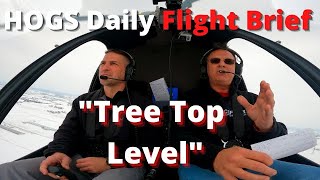
Helicopter instructors Kenny Keller and others debate using treetop height as a visual cue for starting the autorotation flare. They compare it to the POH altitude and discuss why keeping students' eyes outside matters more than following a fixed rule.
Chapters
Okay, so I'm going to intro this treetop level statement while Chris applies his first normal approach to get warmed up for the day. So we just had a member or. I'm not sure if he's a ground school member or not, but been around our YouTube videos for a long time, always commenting, and we appreciate all of his comments. His statement was something effective. You guys are using the terminology treetop level during turning west. Base 27. Goshen. During the auto rotation. Sturgis traffic. Cessna 823 Charlie Sierra's turning base for Runway 36. Sturgis. What I want to say is it's the terminology I used early on. I think I got it from my instructors where we fly in Indiana. It works for the height of our trees. I know his comment said it doesn't. Traffic eight Pop Alpha's final two. Seven helicopters in sight. Goshen. It doesn't work for us with trees that are 130ft tall. That's a great comment and I appreciate the feedback. Point is, it works for us.
Right?
And I'm gonna. I'm gonna let you kind of get through your takeoff here. Well, 75649. Four miles west.
That was kind of a crappy approach because airplane. Here's a little tidbit for airplane pilots. Helicopters move slower. We get slower. As we do our approach, we come into a hover. I have an airplane coming right up. He's not giving me any. Any room here, so I'm just gonna get going here. So I don't make him have to do a go around or anything. Right. Heaven forbid if he would have extended his downwind or something like that for me to have time to make the approach. Sorry.
Coming from an airplane pilot.
I am an airplane pilot, so I am allowed to say stuff like that.
Goshen, traffic copter three, Sarah tells only go 27.
Right.
Traffic, Goshen.
Yeah, sorry about that. But you know, you know, if you're flying at an airplane heavy airplane school airport, they don't pay attention to us. They don't. I mean, heaven forbid. Like I said, all he had to do is extend his downwind a little bit to give me a little time to make my approach. But he obviously did not want to do that. He was turning final before I was even on my. On my short final. So I'll just get out of the way for him. Okay, sorry. So let's go back to our.
And that's okay because you know what that's like. We have a video in the free radio Course about this topic how going into a lot of times to towered airport where if they work with helicopters all the time and they're very familiar with them, you don't usually have any trouble. But sometimes you'll go to an airport where they just don't have a lot of helicopters.
Right.
It's, it's very infrequent that they come in. So sometimes they'll give you a, they'll give you some direction that they think works. Right. When it us in a helicopter, it doesn't work. It's just by nature of. They're just not used to aircraft, helicopters coming and going.
You know, most time I can, you know, helicopters going direct to the spot that you want to land at. So usually I would have been going direct to the ramp or I could have sidestepped and used the taxiway, but there was already an airplane taxiing down the airplane and I could have sidestepped to the side just north of Runway. But it's all snow out there, so we would have got into a white out condition for sure. Right. You know, sometimes I want the Runway. It's a, you know, I have the right to the Runway just like the airplane guy does.
Sure.
So, you know, it's just, I don't know, pilot courtesy, I guess. All right, so back to our.
That's okay. You know, it's a little bit of our reality of what happens, what goes on and you know, always want to be prim and proper in every single video and never really let people know what really goes on. Sometimes you get aggravated. Right.
We've had a couple today. We had the co. We had that guy. It's good learning video.
It is. You got to always be ready to adapt, do what's right, do what's safest.
And sometimes, and that's part of, you know, actually that's a good, I mean, I just mentioned this to Seth who we saw earlier. You know, it's good situational awareness. Yes. You're learning what's going on in here. You're learning how to fly the helicopter. You might be learning instruments, but you also got to know what's going on around you. Yep.
You know, so like the other day in the video when I forgot my train of thought. You forget, you forgot what maneuver you were doing. Right. All in the same shot. Because. And I defend you in the video and say, well, you're flying the helicopter, you're looking outside, you're paying attention to what you're doing, you're listening to what I'm saying and Trying to figure out your next move. There's a lot going on.
There is a lot going on.
Okay, so now we'll get back to the.
Okay, so now we'll get back. So you stated about a member who talked about they, they didn't like the term treetop level for the flare because of their trees aren't that high or they're too short or they didn't have trees or something to that.
Yeah, trees were a lot higher. And he's probably, I think he was, if I remember right, he's in California. So you know, the height I could understand that he, where he's at, the trees might be much taller than what we have here in Indiana. So the thing that comes to my mind is one poh says flare at 50ft. One poh says flare at 100ft. One poh may say flare at 75ft. Number one, you got to go with the aircraft you're flying. What's POH say?
Correct.
But then also how can you know, can you differentiate 60 between 50?
Well, that is my thing. If you want my two cents here.
Go ahead, jump right in.
Obviously we all know, everybody knows that you were my primary instructor. So you know, you instructors learn from other instructors. So you know, you taught me tree top level. So that's how I continue to teach my students. And I'll tell you why I like treetop level is because, well, the poh for the G2 says flare at 60ft.
Okay, good example.
Okay, if you're a brand new student learning to be, learning how to do an auto rotation, I want them outside, I want your eyes outside. If you tell them flare at 60ft, what are they going to do? They're going to be right down, their head's going to go right down to the altimeter gauge and they're going to stare at it until it says 60ft. And then by that time we already just plummeted right into the ground. Right? So I use treetop level because it's a visual reference outside, outside the helicopter. And usually there's trees around the airport most of the time. So you can look, I mean like Goshen's a good example. I can look right down two seven and I can see a tree line all the way at the very end. So I'm just looking outside. When I see that, when I get level with the treetop, I start my flare. Now one thing that I teach, which I think someone mentioned this earlier, which you taught me, is I start off with a mini flare. Okay? So treetop level, I'M not telling you to yank back on that cyclic and really get that nose up.
Exactly.
I'm telling you at treetop level, start a mini flare to start decreasing that speed. And then I teach that that flare gets more aggressive. So really when you really the way I teach it, once you really get into that aggressive flare, you're at your 60ft or your 50ft or whatever that is. And guess what? If your flare a little too high, I teach hold off, let the aircraft as you start to push forward, let the aircraft start to settle a little bit, then come up on your collective. So my thing is the treetop level to help so this guy, your hogs member understands. I like to treetop level because it keeps the students eyes outside. Okay, we're already doing a scan. We're doing our rats, R A T S, our rotor speed, airspeed, trim spot. Okay. It keeps them outside. That's part of your scan. When you get down there at the very end when everything's starting to happen real fast, I don't want them inside, I don't want their eyes inside. I want them looking outside, getting ready for that flare or pulling that collective or whatever we got going on. It's hard to visualize, you know, we're 820 here at Goshen. Add 60ft to that. Now you're at 880. Hey, real quick, point to 880 on that altimeter, please.
Exactly.
You know, I could round it up and say 900. You can spot the nine real easy. But again, your eyes are back to the altimeter and I don't like that. I want my, I want my students eyes outside.
That's why you don't want them checking rotor and airspeed and RPM and trim and then add an altitude on top of that. Are you kidding me? But no, I'm teasing. It's a good point because yeah, you're going to add trying to figure out who can who is that good that you can look down and go 57ft by flaring?
Right, right.
I mean, and I'm going to be transparent and say you can tell, you can tell me. I'm bragging. But R22, R44 Bell 47 Instrument BK117 easy. 135 Jet Ranger. I don't care across the board. Everything I've ever flown, I use treetop level. Yeah. No matter what the ph says. Because like you said. What? I like what you said. You starting the flare tree top level. And we know we should start with a small pull, just a small pull on that cyclic. So depending on the day and the way and every other thing that affects your auto rotation, you've got time to change that flare. Like Chris said, start small, make it bigger. Make it bigger. And depending on your situation, you can make that pull gradual or you could make it more aggressive. So using treetop level, you can still adjust as needed going in to the amount of flare that you need to make the outer rotation successful. And if you got other terminology that works better, that's great.
Yeah. And again it goes back to what your instructor teaches you. What the, you know, what, what the PoH says, whatever. Yes, I understand that the book says 60ft, but again, point out 60ft when you're a brand new student trying to do an auto. Show me how you're going to know what 60ft is. Easy. Pre top level, start your flare. Flare gets more aggressive as we settle.
Before I moved to the airport I'm at now, I was at the previous airport for 10 years. I trained out of there for 10 years. One paved Runway down between two rows of trees.
Yeah.
So it was perfect for our intensive purposes. I was already used in that terminology prior to flying out of that airport. And the whole 10 years I was there, it just, you know. Yeah. I'm not going to change what I say now.
Yeah, me either. I like it. Like I said, I, I like treetop level. I think that's, I think that's all we got. I think we killed it.
I did put down in the comments below if you got some other verbiage that you use that works for your situation because we'd like to hear it. I mean there's probably some cool things.
People.
And versus treetop level. But it's a good video. So hey, subscribe and come back tomorrow for we're gonna go ahead and hit counter versus clock counterclockwise again. It'll be pretty short, but that's tomorrow. And then we're gonna get back to the audio videos.
Okay.
Like subscribe. See you in the next video. See how our little, our little topic where it goes.
Right. But it's good. I think we beat that. Good. Because I want people to understand why I do it. You know, I mean, if we have.
A good rebuttal for that.
Well, the thing of it is, as you learn as you know, as an instructor, if, if your students don't understand why they're doing it, a lot of times they're not going to learn if you just tell them, you know, like now.










