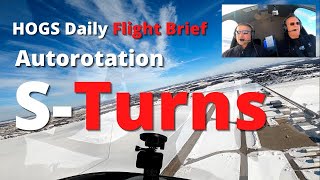
YouTube video (Kenny Keller, Feb 15, 2021) showing Chris and Kenny discussing and demonstrating S-turns during autorotation in a helicopter (Cadbury G2). The hosts explain how S‑turns help a pilot reach a small landing spot during an engine failure, contrast training standards (straight-in, 180s) with real‑world techniques, and demonstrate an S‑turn approach from ~1,500–1,600 ft at 80 knots, noting training guidance to be out of turns above about 200 ft but that in a real emergency a pilot might remain in the turn down to ~50 ft.
Chapters
We made our mark on five.
So this is our landing spot where we've just touched down on the sill.
Been one of those days, buddy. Goshen traffic, helicopter 7630 departing five, right. Traffic ocean. All right, what are we doing? What are we setting up for? What do we want to do?
All right, Hogs daily pipe brief. We're going to do S turns today. We've been doing some different videos on our rotations. Doing them all kind of for the beginner. Show you the things you're kind of going to learn. And next on the list, we had S turns because you're going to go out and you're going to learn straight ins and 180s and 90s and all these other different things. Something that's not in the pts, and some instructors will teach you, some maybe not, is S turns. And an S turn would be simply, let's say you're flying along real world and you can see outside. Let's say that little square in front of us right now, we had to get in there because we had an engine failure right now. And everywhere else was trees but that square. Chris could enter an auto right here and do S turns to get in that spot. Now, we're not going to do that because there's horses out there in the field and we'd scare the. You know, it wouldn't be a good idea. Okay, so to give you an idea, that was a good example of just you got an engine failure and there's a spot just off your nose, but you're afraid of overshooting it. You could do some S turns to get into that spot. So I'm going to turn it over to Chris and let him set it up for you on how he would teach an S turn in the Cadbury G2.
Okay. Yeah, so you're right. I think this is more of a advanced maneuver, not necessarily something that I would show as a private student. The private rating you're looking for mainly straight in or the 180. But when we start doing commercial work, start doing some commercial training, I will show a couple different options to the student on how they can get into a spot. You know, either extending the glide or delaying your forward airspeed or the S turns or maybe even a 360 turn just to lose altitude right above the spot, you know? So, yeah, we're going to do an S turn here. Right now we're on the downwind for five, which let me call that Goshen traffic cop to three chair tails on the right downwind Five Goshen. So what we're going to do is we're just at altitude here. We'll be at an altitude. Right now we're cruising about 1600. We're at 80 knots. And again, we were having this discussion earlier. I like to, when I teach my autos, I like to have the person at. I like to have the student be in. Cruise. Well, just cruise, you know, whatever altitude they want to be at, whether it's 500 AGL or 1000 AGL and then whatever their airspeed's going to be at, which in this aircraft best range is 80. So my thought process is, you know, let's set it up exactly how you would be going from point A to point B. You're going to be at 80 knots at 1500ft. Okay? So that's what we're going to be at to practice that simulated or to practice that, that, that auto. So that's how I like to teach it. And that also teaches once, you know, that's kind of real world to me. It trains the brain. Again, I've taught, I've said that before. You know, it gets the students to realize, hey, you got to come half psychic to slow down. You've got to, you know, why practice an auto at when you have 2,000ft to come down if you're not really going to be flying at 2,000ft ago? You know, so that's my thought.
We've done good lately at trying to, you know, point out standard for training and then give you some food for thought for the real world stuff. Because again, I mean, the best I guess you can do is train for real world. Until the real world, bad things happen, right? So we come up with things that we can think of to give you food for thought, put other thoughts in your mind. We understand training to a standard and.
We believe in it and we do it and we teach it.
But we also want to try to give you some scenarios to make you think that give you options to think outside the box. Because if that engine really quits, you got to do whatever you got to do to try to make that spot, whatever spot that may be, whether it's ahead of you or you're turning to go back to it or whatever.
Traffic Copter three share tolls about one mile Final five. All right, so here we are set up. We're at 1500. We're cruising 80. Everything's looking good. What I'm going to do is I'm just going to delay my entry. You can't really see five because it's a turf Runway and it's covered with snow. But I've got my spot picked out, which we landed on it earlier. So we've got some marks down there now kind of where the fence line starts there. And I'm just going to delay that entry and then we're going to do a couple s turns to try to hit that spot. Here we go. In 2, 1. Come to the right. Got my scan going already. Good. Coming back Left trim. Get my airspeed going. Coming back to the right. Flare throttle's coming back in. Nice.
Very nice.
I don't.
Hopefully you can see that in the camera. Those, those land the skids. The marks were in the snow.
And he. I am about one departing Runway. I am less than a fuselage length away from where we sat down. Nice. Actually, it's right. See him right outside my window here. So I'm very nice. Less than a fuselage away from where we landed earlier, less than where I wanted to touch down.
So to give an example of that square we saw over there, within that square of trees, you just would have made the spot. You'd have made it. So if that was a parking lot, an opening, a vacant yard, whatever that spot was, you made it. The engine failed, the spot was close. You did those turns and you put.
It in there and it's, you know, and I was thinking that as I'm doing it, like for training, you know, we like to be out of that, we like to be out of that, that turn and kind of make it the very end. You want to kind of like a straight in. But in real life, you may, you may actually have to start your flare while you're in that. A little bit of a turn to line up with whatever, to avoid trees, to avoid a fence line, to whatever. You know, in training, though, we like to, we tell them that we like to be out of the turn at least. No, no less than 200ft. So that way we can be a straight in. But you know, in real life, you might be in that turn all the way down to 50ft above the ground and then finally straighten it out and flare. So and that's kind of what happened there. We were, you know, I kind of made that last minute turn and then we flared right there at the bottom.
Yeah, that was nice. Perfect. I don't have a lot more to say other than if you haven't done those with your instructor yet. Ask, ask your instructor to do some s turns. Again, it's giving you some food for thought. Another tool for your toolbox something you could do if you ever really had that engine failure.
Yeah.
There's our spot again. So you can see it out the window. That's the spot we were talking about again. Let's say we had to go in there because everything else was just forest. We could have made that spot.
Let me make a call. Here we go. Traffic Copter 3 Startell just departed 5. I've got the airplane inside of that.
So go down below for a maneuver guide while I tell you about what's coming tomorrow. Oh, the next we're going to do is zero airspeed auto rotation. This is something not in the pts, not something we teach on a normal basis, but a person could be hovering out of ground effect at whatever height, let's say 500ft, doing photo work or whatever. You had to hover if the engine quits. You got to know how to be able to transition into airspeed, pick your spot and land. So that's coming up in the next video. So go down below to grab that free PDF of the helicopter maneuver guide brought to you by helicopter all in ground school like and subscribe the channel and we'll see you tomorrow for zero airspeed auto rotation. Peace. Yeah, that was a nice S turn.