EP 35 ZERO Airspeed Autorotation Entry
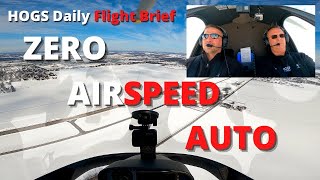
Kenny Keller and Chris demonstrate how to enter an autorotation from a hover, a maneuver useful when you need to descend quickly from a photography hover at 500 to 800 feet. The technique involves controlled descent, monitoring rotor RPM, adding forward airspeed around 500 feet, then flaring to recover. They recommend practicing it with an instructor even though it's not required for checkrides.
Chapters
Kind of even passive. We're not passive people. But to say we're gonna show you something, it might work, it might not, huh? Give it a try. It's food for thought. Okay, Hogs daily flight brief. Today we're gonna do zero airspeed auto. I'm letting Chris get warmed up. I'll let you talk him through what his thought process when he gets ready to do it. But the zero airspeed auto, not something we teach on a normal basis. It's not in the practical test standards that will soon be the airman certification standards. It's not a maneuver to be taught by those current standards. But if a person is hovering out of ground effect at say 500ft and you're doing photo work and the engine quits, you're going to have to transition to forward flight or airspeed or sideways or backwards or something, get some air speed and then perform your auto. So this is, we're showing you food for thought again, more of a real world thing. He's kind of slowing down here. So I'm going to turn it over to Chris.
Yeah, you know, we were talking about this earlier too. I had never really been shown this until, you know, I was with another instructor. There you go, you learn, you know, you learn from other instructors. You know, he's like, let's do a zero airspeed. I'm like, what are you talking about? Out of ground effect hover into auto, then into, you know, power recovery. I'm like, what are you, are you serious? What are you talking about? And I tell you what, we did it and it was really nothing to it, you know, and then that got me thinking about the whole helicopter principle and what it's used for. And I mean, how often does, you know, photography flights end up in an out of ground effect hover at 500 or 800ft or whatever it is, and you're just sitting there waiting for the photographer to get his picture. You know, you might be there a couple seconds or you might be there a minute, you know, whatever. And in that time frame, you might have that engine failure. And what are you going to do? How are you going to, how are you going to handle it? So here we are, we're right above the Goshen airport. We're about 800ft off the ground right now. Let me make a radio call.
Goshen Traffic Helicopter 33 Hotel is just above the airport at 1700 and Hover Goshen.
So, yeah, the thing with the zero airspeed in the G2 and I'm not going to talk about other aircraft. I'm just going to talk about this particular G for this particular aircraft. If you're in an out of ground effect hover with no airspeed and you have to enter an auto, the main thing is we want to get speed, we want to get forward airspeed, but it doesn't have to be right away. And actually you actually want to fall just a little bit to let the aircraft kind of settle into it, I guess to kind of stabilize in that descent. And then once that happens, then you can figure out when you need to apply forward airspeed. So we're, I mean, I don't know if the camera can pick it up, but the spot that I'm shooting for is directly right off the nose. Like I can't even see the spot because of the, of how the aircraft is pictured there. So what's going to happen is I'm just going to roll off throttle, I'm going to enter an auto, but I'm going to fall a little bit, I'm going to come straight down and then toward the end I'm going to pick up some air speed and then it just becomes a straight in auto. People might say, well, if you're following at 1500ft straight down, aren't you going to get into vortex ring state? Well, no, you're not. And why is that? It's because we have no power applied. What's one of the things you got to have 20 to 100% available power. Right. We're going to be down to zero. So we're going to be falling. The rotors are going to stabilize. They're going to say, you obviously want to watch your rotor RPM because you want to maintain that. But you'll see that our rotors will stabilize. We'll stabilize probably at 1500, 1700 foot descent rate. And I'm just gonna come straight down until I decide that I want to apply forward airspeed in order to make our spot nice. So are we ready to do this?
Yep.
We'll slide over just a little bit. So we're right into the wind. It's nice today. Winds are about nine knots right down the middle of Runway five. So here we go in three, two, one. There's the drop. Now we're watching rotor RPM. We're at 1500ft descent rate right now. There's 1800. I got my spot in view. RPM looks good. We're coming straight down. We're holding. We're holding. There's 500ft AGL. I think I'll start pushing Forward. Build a little airspeed. Building airspeed right there. There we come. Here comes my treetop level. Start my flare. Flare's gonna get a little bit more aggressive. Throttle's coming back in. As you can see, we're about, what, 30ft from our original skid marks.
That we're 20, 30ft. Yep.
And really, this is a non event. It really is. Yeah. You get. You catch that breath kind of right there as you start that fall. Kind of that roller coaster motion when you drop over that first hill.
Yep.
But after that, the aircraft stabilizes. I mean, you saw that. I think we hit 1800 foot descent rate. RPM, you know, always in. When you first start off, the rpm's gonna drop, but that comes back. And we stabilized. I think we were in the green there. And then it got a little bit faster as we pushed that forward airspeed. And then we. As I came back on the cyclic and loaded the rotors. But it's really a non event.
It is. And I like what you said. You know, I've been riding around these things since 1997. That still got me a little bit. When you first entered it, it's got that weird feeling of just dropping and going straight down. And then pretty quickly that feeling passes and.
Oh, yeah.
Hey, Just waiting for the. You were just waiting for your 500ft to start building up your airspeed. So ultimately, it really was a non event. But because it's not something we talk about a lot, not something we do in the normal course of training. Maybe we should. You know, and I'm sure. I'm sure there's reasons why they don't.
Right.
Put it in the pts, I'm sure. And I don't even. It doesn't even matter to me because right now it's not. Maybe sometime in the future, but.
And I would encourage to practice with an instructor, but go up. You know, I'll be honest with you. We. I did this one time in this aircraft. We went up to 6,000ft, myself and our instructor, and we entered at zero airspeed, and we came down. I mean, we came straight down and we held that. We actually did some pedal turns. We did some 360 pedal turns while we were coming down. And then there toward the end, you know, we, you know, a thousand feet to go or something. We pushed it forward, built some airspeed. We came into a power cover, and it was. It was kind of cool because it was. It's just another trick, another tool in the toolbox that if you need to hit that spot, that's Right there.
Yep.
You know, just something to think about. I mean, well, and we don't teach that. Usually we say straight in or 180, you know, and here we are. Well, what happens if I have this failure right now and I need to go right there off of nose? What are you going to do? Well, right, an S turn might work, but more than likely if you hold that speed, you're going to overshoot it. So.
Yep. I just remember I had a guy show it to me in an R22 when I was going for private and then I did not see it again until the Examiner I talk about all the time. When I was a brand new cfi. The company says, go out and fly with the examiner for an hour. He takes me over the numbers 27 on the Runway and he goes hover 2 7. He goes, think I can enter an auto right here and go right directly below us? And I go, I guess you're going to show me. And he entered the auto and he went backwards and he went sideways and he went the other direction and he backed up again and then got airspeed and came right out on the numbers 2.7. So it's not in the normal course of training. And like Chris said, I wouldn't advise private pilots to go out and do that. I would advise you if you want to do the zero airspeed, I would say do it with a CFI who's comfortable teaching it. Like you just showed it wasn't a. It's not really a non event, but there's some hype over it. Oh, zero airspeed. Oh, you know, if you haven't seen it and you haven't done it, it feels a little weird when you enter it. But that's a good video and a good topic and I'm glad we that we did that today.
But do get that airspeed in there sometimes you want to have that airspeed.
Right. So we didn't go all the way to the ground. He went dropped about 500ft AGL, then increased airspeed, but had plenty of time to do it. You had all kinds of time to build your air speed, to do a nice flare and to come back down.
I don't know if they could see. I think we were about 17 or 18. We entered and we dropped about 500ft straight down. Then I pushed it forward and got some airspeed and pretty much hit our spot.
Maybe I turned this one camera back a little bit hoping that maybe we could catch a little bit of that. Awesome. So go down below for our helicopter Maneuver Guide. Free PDF is down below. Subscribe to the channel. Click the bell so you can come back tomorrow and see what we're going to talk about next. And this is something really cool and that should be maybe taught a little more in training is stretching the glide during a rotation. And you know, you'll read the numbers in the POH for whatever aircraft. You know, airplanes, helicopters usually have a best glide. There's ratios and different things. But believe it or not, the examiner that we are using now, I actually did his CFI many years ago. And when we were doing his cfi, he's the one that showed me how far you could really stretch a glide in an instrument. I was kind of blown away the first time he showed me by taking it to the low side of the rpm. How far? And he was stretching a glide for his full down for his CFI checkride. And I was blown away the first time we really, like, took it to the low side and stretched that glide. I was quite amazed. So depending on the aircraft you're flying, the numbers could be different and the methods might be different. But Chris is gonna show you how to. How to stretch the glide in the Cabaret. So I'll let you take off. Take it from there. Chris.
Are we starting the next video already?
Yeah, I think I started the next video.
I think you kind of just rolled into it.
Did I?
Usually you say, hey, we're back again.
With Kitty, but hey, it's hog's daily flight brief. And I'm just now doing the intro halfway through the video.
Right. There you go.
Perfect.
Okay. So, yeah, stretching the glide. And I'll have to be honest with you.










